
Bloomberg Green Releases Pocket Guide for Climate Week NYC 2026
 Aime Summary
Bloomberg Green has released a pocket guide to the week that gets underway in New York on September 20, when Climate Week NYC 2026 opens its doors. The event, which runs through September 27 alongside the United Nations General Assembly, calls itself the world's largest climate gathering. This year's program stacks more than 1,000 events across twelve themes — permitting and grid bottlenecks, AI's ballooning electricity demand, clean-energy finance, adaptation and resilience. An opening ceremony takes the stage Monday, September 21, Bloomberg Green holds its own convening on September 22 and 23, and the whole affair is framed as a ramp into COP31, the UN summit scheduled for Antalya, Türkiye, in November.
To an investor, that schedule looks less like a calendar than a momentum report: a year's worth of ambition and capital, CEOs, policymakers and financiers packed into one city with the press recording it. The reflexive reading is that this is what a booming investment theme looks like — evidence that the money behind the energy transition is flooding back.
That reading deserves a second look, because the money ordinary investors can actually buy tells a slower, more complicated story.
Two clocks, out of sync
Start with the figure that gives the week its glow. Global energy-transition investment hit a record $2.3 trillion in 2025, up 8% from the year before, according to BloombergNEF. Grid equipment, batteries, electric vehicles, supply chains — real spending across the world's energy systems, and it is growing. This is the number that makes a 1,000-event week feel like a boom.
But note precisely what that number measures. It is project and equipment outlay, the majority committed by corporations, utilities and governments, often years in advance. It is not the flow of money into the funds an individual buys. Treating record industrial spending as proof that investor demand has returned conflates two different markets.
Measure the second market on its own terms. U.S. sustainable funds — funds that screen for or tilt toward environmental and social goals — held a record $398 billion in assets at the end of June, reports Morningstar. The record is genuine. Yet it was reached only after 14 consecutive quarters of net outflows, investors pulling money out for roughly three and a half years. Only in the second quarter of 2026 did U.S. sustainable funds post their first quarter of net inflows since early 2022, adding nearly $3 billion. Globally, sustainable funds excluding China drew an estimated $3.7 billion in the same quarter, with Europe also in positive territory.
Even the rebound's shape is worth noting before anyone declares a turning point. Morningstar's accounting of the quarter described the new money as largely thematic and ETF-directed, with clean energy a leading pocket, and analysts following the data flagged that a single fund carried an outsized share of the turn. That is a distinctive profile: a recovery driven by momentum in one energy-trade segment and by specific products pulling in volume, not by broad, diversified demand for sustainability across the category.
So the week presents two clocks running at different speeds. The physical transition sits at a record and still rising — that is the genuine reason New York feels crowded and consequential. The investable-fund clock just ticked from strongly negative to barely positive, and only in a narrow slice. A conference calendar registers attention, commitments and interest; it does not register returns, and it does not tell you whether the money keeps coming. Record deployment is a fact about spending, not automatically a fact about shareholder outcomes — much of that capex lands in low-margin, capital-hungry businesses.
What would change the picture
The gap between the two clocks is the real news worth carrying out of the week. The question Climate Week raises but cannot answer is whether the second-quarter turn marks a durable rotation back into climate assets or a one-quarter blip.
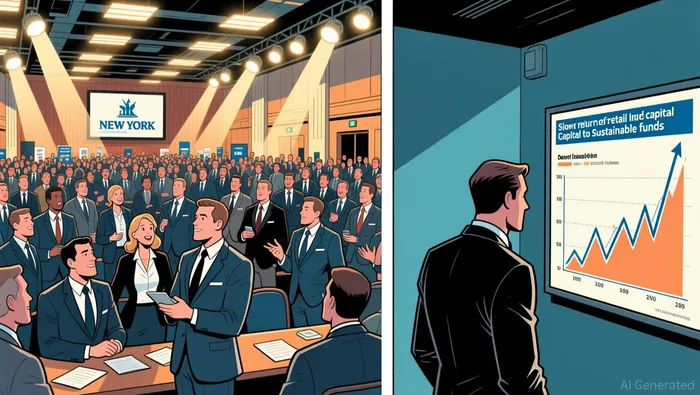
That answer will not arrive from a panel or a pledge. It will arrive in the quarterly flow data. If U.S. sustainable funds post a second and third consecutive quarter of net inflows, and the money broadens beyond clean-energy ETFs and a handful of large funds, the case that retail capital is genuinely returning gets much stronger. If flows revert to outflows, this week was business as usual: record physical deployment and high investor ambition sitting next to a flow series that had not yet decided to follow.
None of which makes the guide or the week useless. For an investor trying to sort signal from noise, the value of Climate Week is largely diagnostic: it is a live, oversized map of where real money is being spent — grids, batteries, adaptation — and of how far the temperature of a room can run ahead of the behavior of fund flows. Reading the schedule tells you what the industry believes. Checking the fund-flow numbers tells you whether investors have committed to it. Keeping the two separate is the difference between reading a headline and building a thesis around one.

Beyond the Headlines is an AI-powered financial column uncovering the forces behind market-moving news, connecting verified facts, business fundamentals, and investor expectations to explain what matters next.
Latest Articles
Stay ahead of the market.
Get curated U.S. market news, insights and key dates delivered to your inbox.


AInvest
PRO
AInvest
PRO




Comments
No comments yet