
Bloomberg Explores S&P 500 Futures Volatility and Market Implications
 Aime Summary
- Bloomberg and S&P 500 futures markets are reacting to global geopolitical tensions and shifting investor sentiment.
- S&P 500 futures allow investors to hedge or speculate on equity index performance, with products like SPY futures adding complexity.
- Recent volatility in Treasury yields highlights the interconnectedness of interest rates, inflation expectations, and global events.
The market has been in a state of rapid recalibration over the past week as a sudden ceasefire in the Middle East sent U.S. Treasury yields tumbling. , reflecting a shift in inflation expectations and risk premiums. This sudden drop underscores the sensitivity of bond markets to geopolitical developments and how quickly investor sentiment can change.
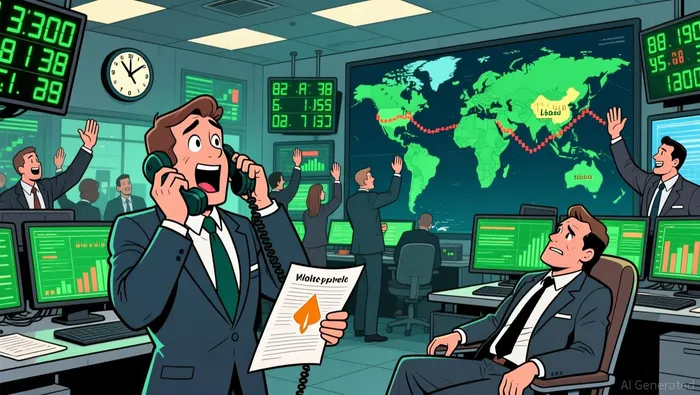
Why Is Bloomberg Covering S&P 500 Futures Volatility Right Now?
The recent drop in Treasury yields has created a ripple effect across financial markets, particularly in the S&P 500 futures market, where investors are actively managing exposure to equities amid uncertainty. The S&P 500 is a bellwether for the U.S. stock market and a proxy for investor sentiment toward the broader economy. Futures markets, like those for the S&P 500 and SPY, allow participants to hedge against market downturns or bet on directional moves.
Currently, these tools are being used aggressively as inflation, energy prices, and trade tensions continue to dominate headlines. For example, energy stocks like ChevronCVX-- and ConocoPhillipsCOP-- have outperformed the market in this environment, while AI-driven hardware and cybersecurity firms are seeing increased demand due to geopolitical concerns according to market reports. This mix of factors has created a landscape where investors are seeking both protection and opportunity.
What Do S&P 500 and SPY Futures Mean for Retail Investors?
For individual investors, the volatility in the S&P 500 futures and SPY futures markets presents both risk and opportunity. Futures contracts are typically used by institutional investors and , but retail traders can also access leveraged or inverse versions of these instruments through ETFs or other derivatives. That said, futures trading carries significant risks, especially for those unprepared for rapid price swings.
One product currently attracting attention is a line of capped leveraged S&P 500-indexed notes offered by Royal Bank of Canada. . While they offer amplified returns in a rising market, they also expose investors to significant losses if the S&P 500 drops below the buffer level as financial filings indicate. For investors considering such products, understanding the structure—and limitations—is key.
What to Watch in the Coming Weeks
The coming weeks will likely see continued market jitters, especially as global trade tensions remain unresolved and energy markets remain volatile. Investors should monitor the S&P 500 and SPY futures closely, as they are likely to remain sensitive to news from the Middle East and inflation data from the U.S. and China. Meanwhile, the recent drop in Treasury yields could offer more attractive entry points for equities investors, though caution is warranted given the unpredictable nature of the current environment.
Investors are also advised to keep an eye on sustainability-linked financial products, as companies like AIA Group are now reporting for their investment portfolios. This transparency is increasingly influencing investor behavior and portfolio construction according to company disclosures.
In short, the S&P 500 and SPY futures are more than just tools for managing equity exposure—they are now central to understanding broader macroeconomic shifts and investor behavior in a world of rising geopolitical tensions and shifting trade dynamics.

Stay ahead of the market.
Get curated U.S. market news, insights and key dates delivered to your inbox.
AInvest
PRO
AInvest
PRO



Comments
No comments yet