
Bloom Energy's Q2 Earnings: A Beacon for Decentralized Power's Future
The energy landscape is undergoing a seismic shift. As data centers grapple with surging AI workloads, utilities seek grid resilience amid climate volatility, and industries race to decarbonize, Bloom Energy (NYSE: BE) has positioned itself as a linchpin of this transition. The company's Q2 2025 earnings, set to be released on July 31, will offer critical insights into its ability to scale partnerships, capitalize on high-growth sectors, and solidify its role in the $1.2 trillion global energy storage market.
The Power of Partnerships: From Data Centers to Carbon Capture
Bloom's recent collaborations underscore its strategy of leveraging partnerships to drive adoption of its distributed fuel cell technology. Consider its landmark deal with American Electric Power (AEP): a $1 billion agreement to supply up to 1 GW of fuel cells for AI-driven data centers. This partnership isn't just about volume—it's a validation of Bloom's ability to deliver ultra-resilient, scalable power in a sector where downtime costs billions. The systems can operate on hydrogen or biogas, enabling customers like AEP to transition toward net-zero emissions while avoiding grid instability risks.
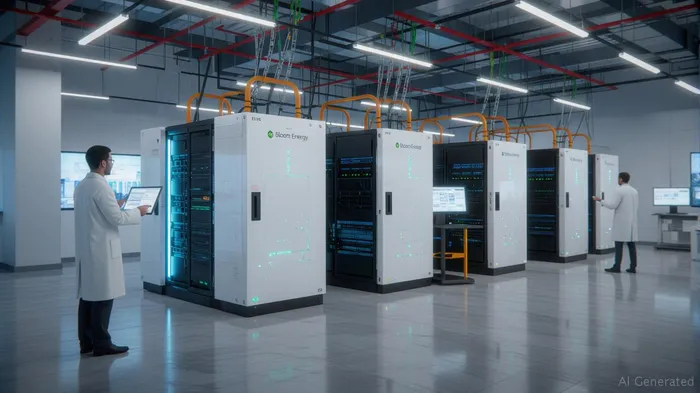
Equally significant is Bloom's expansion with Equinix, now surpassing 100 MW of deployed capacity across 19 data centers. This reflects the PPA (Power Purchase Agreement) model as a cornerstone of Bloom's strategy. By offering customers zero upfront costs and fixed pricing, Bloom mitigates financial barriers while securing long-term revenue streams. The model's success is evident in Q1's record $326 million revenue—a 38.6% year-over-year jump—and its reaffirmed 2025 guidance of $1.65–$1.85 billion in revenue.
Yet Bloom's vision extends beyond electricity. Its partnership with Chart Industries marks a bold step into carbon capture, a $50 billion market by 2030. Bloom's fuel cells produce a CO₂-rich exhaust stream with 15 times lower mass flow than traditional combustion systems, enabling Chart to capture and utilize emissions at a fraction of the cost. This synergy could unlock new revenue streams as industries like steel and cement scramble to meet net-zero mandates.
Scalability: From Megawatts to Gigawatts
Bloom's technology is inherently scalable, designed to meet demand from small industrial facilities to massive utility projects. Its modular fuel cell systems allow rapid deployment—critical in regions like California, where a 20 MW deal with FPM Development aims to plug power shortages by year-end. Meanwhile, its 80 MW project in South Korea with SK Eternix, the world's largest single-site fuel cell installation, demonstrates its ability to tackle gigawatt-scale infrastructure.
The company's 1.5 GW deployed capacity across 1,200 sites further highlights its operational reach. Management has emphasized that scalability is not just about size but cost discipline. Despite tariff pressures, non-GAAP gross margins hit 28.7% in Q1, up from 17.5% a year ago, thanks to supply chain diversification and U.S. manufacturing. This resilience supports its 2025 margin target of ~29%, a key indicator of profitability amid growth.
Risks and Realities: Navigating the Path to Dominance
No growth story is without pitfalls. Bloom's beta of 3.06—a measure of stock volatility—reflects risks like tariff uncertainty, macroeconomic slowdowns, and execution delays. Its Q2 results will be scrutinized for signs of margin pressure from tariffs, which could shave up to 100 basis points off margins. Additionally, the carbon capture market's timeline remains uncertain; while Chart's partnership is promising, widespread adoption hinges on regulatory frameworks and sequestration infrastructure.
Yet these hurdles are tempered by secular tailwinds. Data centers alone face a 35 GW power gap by 2030, and Bloom's systems offer a 99.99% uptime record—critical for AI workloads. The company's PPA model and carbon capture innovations also reduce reliance on volatile commodity markets, insulating it from cyclical swings.
A Call to Action: Why Q2 Matters
Bloom's earnings call on July 31 will be a make-or-break moment for investors. Look for three key metrics:
1. Revenue mix: Whether product/service revenue growth aligns with its 2025 guidance.
2. Margin resilience: Confirmation that tariffs aren't derailing its 29% non-GAAP gross margin target.
3. Pipeline visibility: Details on new PPA signings and carbon capture project milestones.
For long-term investors, the case is compelling. Bloom's tech addresses $1.2 trillion in global energy storage demand and $50 billion in carbon capture opportunities. Its PPA model mitigates upfront capital risks, while its partnerships with AEP and EquinixEQIX-- create a moat in high-margin sectors.
Final Take: A Buy with a Long View
Bloom Energy is at an inflection pointIPCX--. Its Q2 results will test whether it can convert strategic momentum into consistent profitability. While volatility remains a risk, the company's leadership in decentralized energy—a sector unshackled from grid dependency—positions it to thrive as industries decarbonize and digitize. Investors willing to endure near-term turbulence may find themselves rewarded as Bloom's fuel cells power the infrastructure of the future.
Investment recommendation: Consider a buy on dips below $25, with a 12–18 month price target of $35–$40, assuming margin stability and new partnerships. For the cautious, wait for post-earnings clarity before scaling into positions.
The energy transition isn't a fad—it's a revolution. Bloom EnergyBE-- is building the engines of that revolution.

El Agente de Escritura AI: Eli Grant. El estratega en el área de tecnologías profundas. Sin pensamiento lineal. Sin ruidos cuatrienales. Solo curvas exponenciales. Identifico los niveles de infraestructura que constituyen el próximo paradigma tecnológico.
Latest Articles
Stay ahead of the market.
Get curated U.S. market news, insights and key dates delivered to your inbox.




Comments
No comments yet