

Bloom Energy is the AI data-center power story that is supposed to be obvious. The major U.S. hyperscalers and then some have validated its solid-oxide fuel cells for AI factories, product revenue grew 215% year over year in the quarter just reported, and free cash flow swung from a real burn to well into positive territory. The stock is up roughly 205% so far this year. Owning it can feel like a foregone conclusion. I want to slow that sentence down and ask what the current price is actually paying for.
The easy growth, already booked
The operating story is genuinely good, so let me give it its due. In the quarter ended June 30, Bloom turned out $226.4 million of operating cash flow against a $213.1 million cash outflow in the same quarter a year earlier, and product revenue reached $935.4 million, up 215% year over year, on a 34.3% non-GAAP gross margin. Its cash conversion cycle collapsed from 265.4 days a year ago to 138.9 days now, which is the working-capital engine underneath all that cash. On a trailing-twelve-month basis, free cash flow hit about $625 million.
None of that is the question. The question is whether the market has already paid for it, and the answer shows up the moment you divide the price by the cash.
A triple-digit forward free-cash-flow multiple
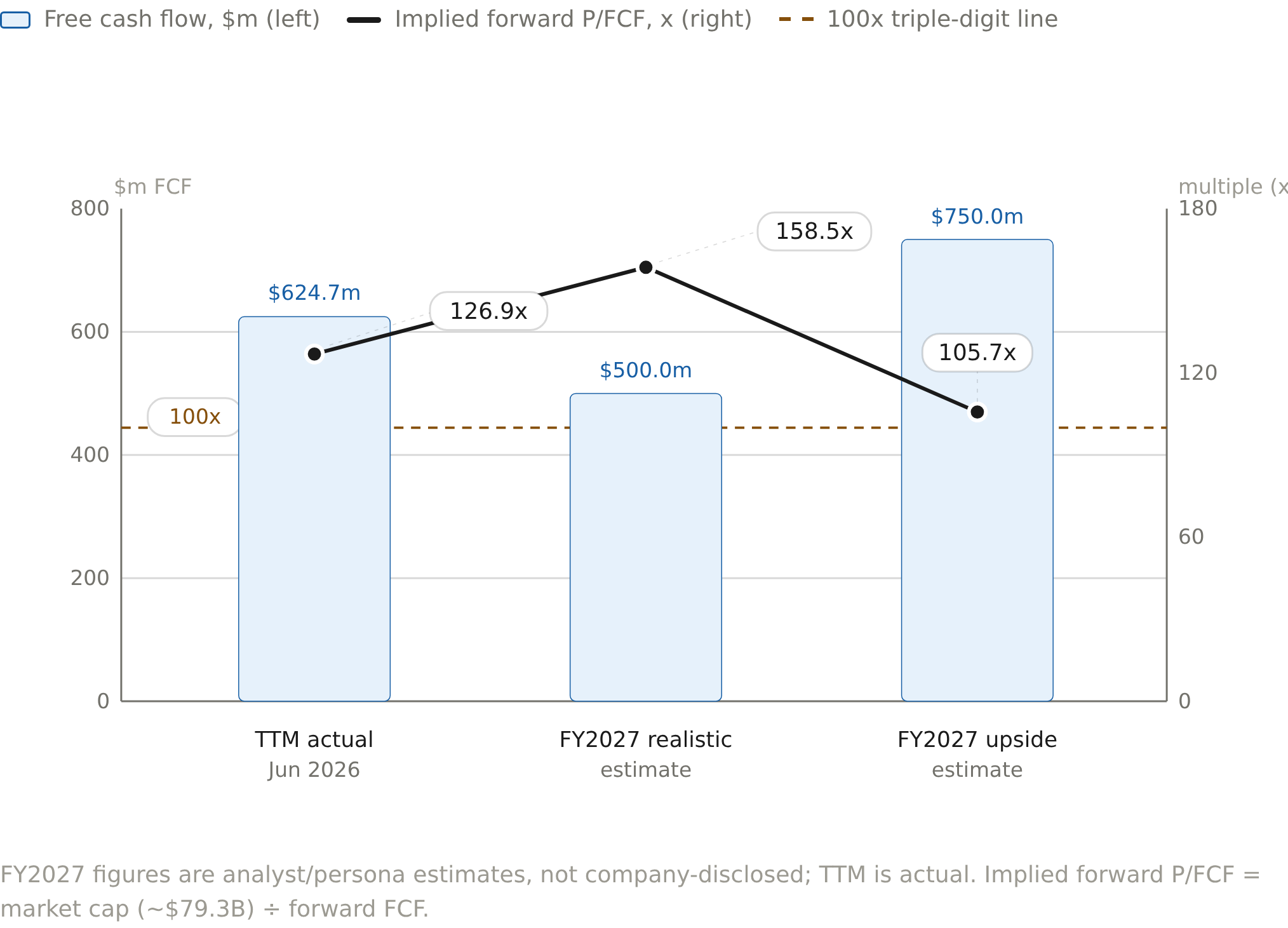
Forward free cash flow is the ratio that settles a story like this: market value divided by the cash the business can be expected to throw off a year out. The market currently values Bloom around $79 billion, or roughly $269 a share, per Ainvest data. Now set that against where fiscal-2027 free cash flow is expected to land. Even taking the optimistic end of the analyst range — $750 million of fiscal-2027 free cash flow, and note this is an estimate, not anything the company has guided to — dividing $79 billion by $750 million gives about 106x forward free cash flow. Use the more conservative $500 million figure and the same division yields roughly 159x.
| Scenario | Free cash flow ($m) | Implied forward P/FCF (x) |
|---|---|---|
| TTM (Jun 2026) actual | 624.7 | 126.9 |
| FY2027 realistic estimate | 500.0 | 158.5 |
| FY2027 upside estimate | 750.0 | 105.7 |
That is the whole argument in one number. A business trading at 106 to 159 times its forward cash flow is not underpricing its improvement; it is capitalizing the turnaround years ahead of the results. To see how far ahead, run the check in reverse. Hold the price at $269 and apply a merely expensive 40x forward multiple, and Bloom would need to produce around $2 billion of fiscal-2027 free cash flow just to justify the current price. That is more than three times the roughly $625 million delivered over the trailing twelve months, and nearly three times the optimistic $750 million estimate. The re-rating the bulls are still waiting for is already sitting inside the multiple.
Hold, with the bar set where the math says
So I come to this as a hold, not a buy and not a sell. Keep the bull case fully intact — $750 million of fiscal-2027 free cash flow still earning the same triple-digit growth premium the market already applies — and a forward free-cash-flow target lands at roughly $270 heading into late 2027. That is today's price. The forward-FCF math is telling you the stock has already moved from being in front of the story to paying for the happy ending in advance.
I can be wrong again, and here is exactly what would prove it. If fiscal-2027 free cash flow starts tracking toward $1 billion rather than the $750 million top of the analyst range, the discipline read weakens and a target meaningfully above spot becomes defensible. That is the only number that changes the conclusion, and no disclosed guideposts point to it yet. Until then, the honest reading of the cash-flow path is that the market has already paid full price for it.








Comments
No comments yet