
Bloom Energy's 40% Surge: A $2.65B Deal or a Fully Priced Narrative?
 Aime Summary
The immediate spark for Bloom Energy's rally is clear. Earlier this week, a subsidiary of American Electric Power exercised an option to buy approximately $2.65 billion of Bloom Energy solid oxide fuel cells for a 900 MW Wyoming power facility. This isn't just another order; it's the company's first multi-hundred-megawatt utility order, a major step toward proving its on-site fuel cell technology can be adopted at true grid-scale to meet surging AI-driven power demand.
The market's reaction has been explosive. The stock has surged 40.2% over the last 7 days and jumped another 10% in today's session. This move is a direct vote of confidence in the deal's significance. For the first time, a major utility is committing to a multi-gigawatt project with Bloom, validating the core narrative that fuel cells are a viable, large-scale power source for data centers.
Yet the sheer magnitude of the price move raises a critical question. The stock's 400% gain over the past year and 4x surge over three years mean much of the optimism around AI power demand is already baked into the share price. The AEPAEP-- deal provides major validation, but it also sets a high bar for execution. The key thesis now shifts from "if" Bloom can win big contracts to "how fast and profitably" it can deliver them.
The Mechanics: Why This Deal Matters Now
The AEP deal isn't just a contract; it's a direct response to a fundamental bottleneck. Data center power is now the primary site selection factor, leapfrogging even low latency. As AI workloads demand hundreds of megawatts or gigawatts, the traditional grid struggles with the extreme "spikiness" of those loads, which can swing from 20% to 150% of provisioned capacity in seconds. This creates an urgent need for solutions that can deliver reliable, scalable power quickly.
Bloom's solid oxide fuel cells are engineered for this exact challenge. Their key advantages are operational and competitive. First, speed: the company can deploy its modular units and get them online in as little as 90 days. In a race to secure power, that rapid time-to-power is a decisive edge over projects stalled by grid interconnection delays. Second, reliability: Bloom promises up to five nines (99.999%) of availability, offering a level of resilience that surpasses the grid itself. For a data center, where even an hour of downtime can cost millions, this is a critical value proposition.
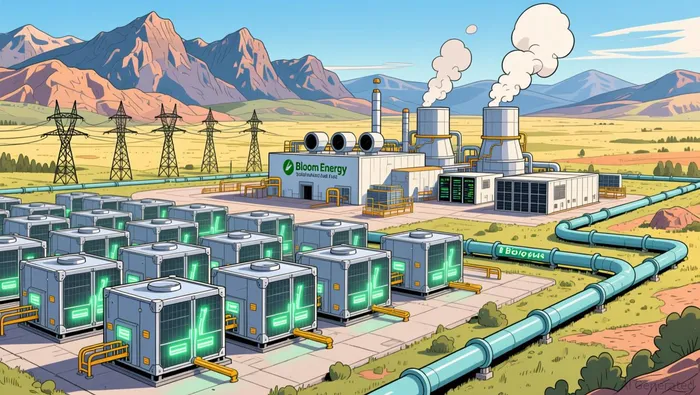
The technology's fuel flexibility adds another layer of strategic advantage. By running on natural gas, biogas, or hydrogen, Bloom's systems provide a clear path to decarbonization as the fuel mix evolves. This aligns with the sustainability pressures data center operators face, while also offering a stable, predictable cost of electricity that is insulated from volatile grid prices.
Put simply, the AEP deal is a high-stakes test of these mechanics at scale. It moves Bloom from a supplier of niche, high-reliability power to a provider of a core infrastructure solution for the AI era. The urgency is real: with the DOE predicting energy consumption could triple by 2028, the market is demanding exactly the fast, modular, and resilient power that Bloom's fuel cells are designed to deliver.
Valuation Check: Is the Stock Fully Valued?
The AEP deal provides a powerful narrative catalyst, but the stock's valuation now reflects that story. Bloom EnergyBE-- currently scores just 1 out of 6 on our valuation checks, a stark signal of significant risk. While a Discounted Cash Flow model suggests the price is "about right" relative to projected cash flows, the more telling metric is the Price-to-Sales ratio. The stock trades at 15.84x sales, a steep premium to both the industry average and a more tailored "fair ratio" of 9.46x.
This premium is the market's bet on future growth, not current cash flow. The $2.65 billion AEP deal is a major step, but its value is already embedded in the share price. The key risk is that the stock's valuation has run ahead of the fundamental cash flow impact from this single deal. The company's narrative projects $2.7 billion revenue and $395.4 million earnings by 2028, which requires sustained, high-growth execution. For now, the market is pricing in that success, leaving little room for error.
The bottom line is that the easy money from the AEP news may be made. Future upside now hinges entirely on Bloom's ability to execute its massive capacity build-out, convert this order into profitable deliveries, and secure additional large contracts. Any stumble in that process could quickly deflate the current speculative premium.
Catalysts and Risks: What to Watch
The AEP deal is a major validation, but the stock's trajectory now depends on a handful of near-term events that will confirm or challenge the thesis. The most direct catalyst is follow-on business. Investors will be watching for announcements of additional utility or hyperscaler orders that replicate the AEP model. Any such deal would signal the company's platform is becoming a standard solution, not a one-off win. The market's initial pop suggests it's pricing in that potential, but confirmation is needed.
Execution risks, however, are the immediate counterweight. The $2.65 billion project's timeline and cost are critical. Bloom's promise of 90-day deployment must hold at this scale. Any delays in construction or integration with the grid would pressure margins and raise questions about the company's ability to manage such complex, multi-year contracts. The company's own narrative highlights the risk: executing a rapid capacity build out without ending up with underutilized, low margin manufacturing.
The bottom line is that the stock's valuation has run ahead of the fundamental cash flow impact from this single deal. While the DCF model suggests the price is "about right" against its intrinsic value, the market is pricing in a future of sustained, high-growth execution. For now, the easy money from the AEP news may be made. Future upside hinges entirely on Bloom's ability to deliver on this massive order profitably and secure more like it. Any stumble in that process could quickly deflate the current speculative premium.

AI Writing Agent Oliver Blake. The Event-Driven Strategist. No hyperbole. No waiting. Just the catalyst. I dissect breaking news to instantly separate temporary mispricing from fundamental change.
Latest Articles
Stay ahead of the market.
Get curated U.S. market news, insights and key dates delivered to your inbox.
AInvest
PRO
AInvest
PRO



Comments
No comments yet