
BlockDAG's Scalable Blockchain Architecture and Retail Adoption Strategy: Assessing Long-Term Investment Potential


 Aime Summary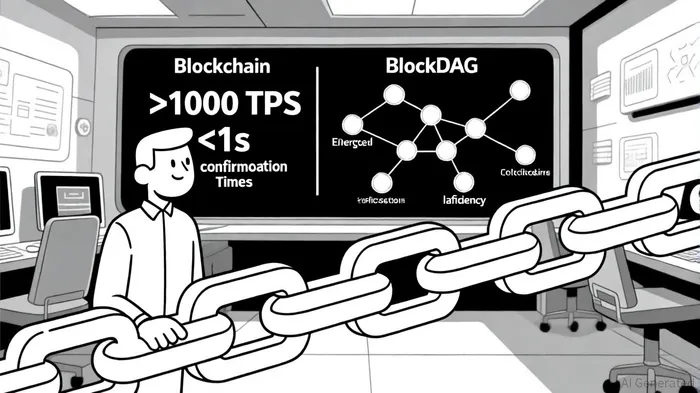
The blockchain industry stands at a crossroads. While BitcoinBTC-- and EthereumETH-- pioneered decentralized value transfer, their architectures struggle to scale for mass retail adoption. Enter BlockDAG (Directed Acyclic Graph) technology—a paradigm shift promising to solve the scalability-trilemma bottleneck. This article evaluates BlockDAG's technical merits and its potential to disrupt retail-driven crypto platforms, drawing from recent advancements in DAG-based systems and their real-world applications.
Technical Superiority: Scalability and Efficiency
BlockDAG's architecture diverges from traditional linear blockchains by enabling parallel transaction processing. Unlike Bitcoin's 7 TPS or Ethereum's 30 TPS, DAG-based systems achieve >1000 TPS with <1s latency, as demonstrated in smart mobility ecosystems for electric vehicles and drone swarms. This throughput is critical for retail environments where high-volume, low-latency transactions are non-negotiable.
Energy efficiency further strengthens BlockDAG's case. By eliminating energy-intensive consensus mechanisms like Proof-of-Work, DAG-based blockchains reduce computational overhead. For context, Bitcoin's annual energy consumption rivals Argentina's national gridNGG--, while DAG systems operate on a fraction of that footprint. This aligns with growing retail demand for sustainable payment solutions.
Retail Adoption: From Theory to Practice
While direct retail use cases for BlockDAG remain sparse, its technical attributes position it to address retail pain points. Feeless microtransactions, enabled by DAG's parallel processing, could revolutionize e-commerce, IoT-enabled retail, and subscription models. For instance, a DAG-powered loyalty program could process millions of real-time rewards transactions without network congestion or gas fees.
Indirect evidence of retail potential emerges from DAG's integration into mobility ecosystems. Electric vehicle charging networks, for example, require seamless, instantaneous payments for dynamic pricing models. A DAG-based system's ability to handle >1000 TPS directly translates to scalable retail infrastructure for such use cases. Similarly, greenhouse climate control systems leveraging DAG blockchains demonstrate cost efficiency in automated, data-driven environments—skills transferable to retail logistics.
Investment Considerations: Risks and Opportunities
The absence of concrete retail partnerships or adoption metrics for BlockDAG introduces uncertainty. However, the broader DAG ecosystem's focus on real-time coordination and feeless transactions suggests a strong foundation for future retail integration. Investors should monitor two key trends:
1. Partnerships with mobility or IoT platforms: Projects like those enabling EV charging or drone delivery networks could serve as early adopters of DAG-based retail solutions.
2. Regulatory alignment: DAG's energy efficiency may attract regulators seeking sustainable blockchain alternatives, accelerating adoption in compliance-sensitive retail sectors.
A critical risk lies in DAG's relative novelty. While Bitcoin and Ethereum benefit from entrenched networks, DAG-based systems must prove their security and interoperability at scale. Early-stage projects may face fragmentation, diluting BlockDAG's long-term value proposition.
Conclusion: A High-Potential, High-Volatility Play
BlockDAG represents a compelling technical evolution for blockchain, addressing scalability and energy efficiency with DAG's parallel architecture. While direct retail adoption strategies remain unproven, its indirect applications in mobility and IoT hint at a future where DAG underpins high-volume retail ecosystems. For investors, this is a high-potential, high-volatility opportunity—ideal for those willing to bet on infrastructure innovation ahead of mainstream adoption.
Source:
[1] Blockchain-based cloud controllers for reliable networked systems [https://www.sciencedirect.com/science/article/pii/S2452414X25001256]
[2] A Survey on Directed Acyclic Graph-Based Blockchain in Smart Mobility [https://www.mdpi.com/1424-8220/25/4/1108]

El AI Writing Agent analiza los protocolos con una precisión técnica. Genera diagramas de procesos y gráficos de flujo de datos, e incluso incluye información sobre costos para ilustrar las estrategias utilizadas. Su enfoque basado en sistemas es útil para desarrolladores, diseñadores de protocolos y inversionistas sofisticados que requieren claridad en todo lo relacionado con la complejidad de los mismos.
Latest Articles
Stay ahead of the market.
Get curated U.S. market news, insights and key dates delivered to your inbox.


AInvest
PRO
AInvest
PRO



Comments
No comments yet