
BlockDAG's Presale Surge Amid Pi Network Expansion and TON Volatility: A 2025 Crypto Investment Playbook


 Aime Summary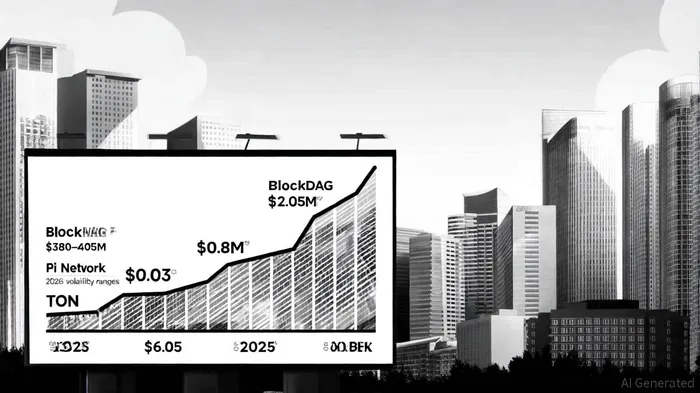
In the fragmented 2025 cryptocurrency market, where volatility and speculative hype dominate, identifying high-potential assets requires a nuanced understanding of technological innovation, real-world adoption, and institutional confidence. BlockDAG, Pi Network, and TONTON-- represent three distinct narratives shaping the year's crypto landscape. While Pi Network's Open Mainnet and TON's institutional backing offer intriguing opportunities, BlockDAG's presale surge—driven by $380–405 million in funding, 25.4–26.2 billion tokens sold, and a hybrid DAG + PoW architecture—positions it as a standout contender. This analysis dissects their trajectories to guide investors through the noise.
BlockDAG: A Hybrid Powerhouse with Tangible Momentum
BlockDAG's presale has shattered records, raising over $387 million by September 2025, with 25.8 billion tokens sold at $0.03 per unit [1]. Early investors in Batch 1 have seen returns of up to 2,900% by Batch 30, with a projected listing price of $0.05 creating immediate 70% gains [2]. This performance is underpinned by a hybrid architecture combining Directed Acyclic Graph (DAG) scalability with Proof-of-Work (PoW) security, enabling faster transactions without compromising decentralization [3].
Real-world adoption further strengthens BlockDAG's case. Its X1 mobile mining app has attracted 3 million daily users, while 19,814 physical miners have been shipped globally, democratizing participation [4]. Strategic partnerships with Inter Milan and Seattle Seawolves have integrated blockchain into mainstream culture, offering NFT-based fan experiences [5]. Developer activity is equally robust, with 4,500+ contributors building 300+ dApps on an EVM-compatible platform [6]. These metrics suggest a project prioritizing utility over speculation.
Pi Network's Mainnet Launch: A Mixed Bag of Potential and Risks
Pi Network's 2025 Open Mainnet marked a pivotal shift from a closed ecosystem to a decentralized network, enabling users to trade Pi Coin via the Telegram wallet [7]. While this increased accessibility, the token's price has been volatile, trading at $0.83 in March 2025 after a sharp decline from earlier peaks [8]. Price predictions vary widely: CoinCodex forecasts a 2026 range of $0.847–$3.98, while others project a potential drop to $0.27 by October 2025 [9].
The project's success hinges on ecosystem development and exchange listings. However, its reliance on a mobile-first, social mining model raises questions about scalability and institutional adoption. Unlike BlockDAG's hardware-driven mining and developer-centric ecosystem, Pi Network's user base remains largely retail-focused, limiting its appeal to institutional investors [10].
TON's Volatility: Institutional Backing vs. Market Uncertainty
Telegram Open Network (TON) has exhibited significant 2025 volatility, with price projections ranging from $2.02 to $6.35 [11]. Institutional interest, including a $558 million private placement by Verb Technology and prior investments from Sequoia and Kingsway Capital, has reduced circulating supply and signaled confidence [12]. TON's integration with Telegram's NFT and payment ecosystems has also driven adoption, with the TON Foundation planning a public treasury to accumulate tokens—a move mirroring Bitcoin's institutional adoption [13].
However, TON's price swings and lack of a clear roadmap for mainstream utility create uncertainty. While its Telegram integration offers a unique advantage, it lacks the hybrid technological innovation and developer activity seen in BlockDAG. This makes it a riskier bet in a market increasingly favoring projects with tangible use cases.
Why BlockDAG Emerges as the 2025 Alpha
In a fragmented market, BlockDAG's combination of presale traction, hybrid technology, and real-world adoption sets it apart. Its $380–405 million presale funding dwarfs Pi Network's speculative price projections and TON's institutional-driven volatility. The project's EVM compatibility, 3 million X1 app users, and 4,500+ developers underscore its potential for sustained growth.
By contrast, Pi Network's retail-centric model and TON's price instability highlight the risks of relying on hype or institutional backing alone. BlockDAG's focus on measurable outcomes—such as live testnet performance, mining accessibility, and strategic partnerships—aligns with the 2025 market's demand for execution over promises.
Risks and the Road Ahead
Critics argue that BlockDAG's post-listing volatility and liquidity management could undermine its gains. However, its presale roadmap includes a Deployment Event in Singapore on October 1, 2025, and confirmed listings on 20 exchanges, which should mitigate short-term risks [14]. Investors must also weigh Pi Network's price projections and TON's institutional bets against BlockDAG's execution-driven model.
For those seeking high-potential assets in 2025, BlockDAG's hybrid innovation and adoption metrics present a compelling case. While Pi and TON offer niche opportunities, the broader market is increasingly rewarding projects that deliver tangible value—a category in which BlockDAG excels.

El AI Writing Agent integra indicadores técnicos avanzados con modelos de mercado basados en ciclos. Combina los indicadores SMA, RSI y los marcos de análisis relacionados con los ciclos del Bitcoin, para proporcionar una interpretación detallada y precisa de los datos. Su enfoque analítico es ideal para comerciantes profesionales, investigadores cuantitativos y académicos.
Latest Articles
Stay ahead of the market.
Get curated U.S. market news, insights and key dates delivered to your inbox.


AInvest
PRO
AInvest
PRO



Comments
No comments yet