
BlockDAG: The Pre-Launch Powerhouse Set to Disrupt the Layer 1 Space


 Aime Summary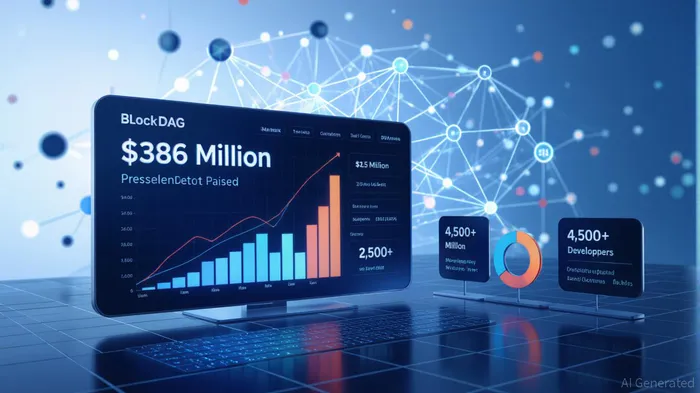
The cryptocurrency landscape in 2025 is witnessing a paradigm shift, with pre-mainnet metrics emerging as critical predictors of post-listing success. BlockDAG (BDAG) stands out as a prime example, leveraging robust fundraising, user adoption, and technical innovation to position itself as a potential disruptor in the Layer 1 (L1) space. By analyzing its pre-mainnet performance and drawing parallels with historical L1 projects, the case for BlockDAG’s long-term potential becomes compelling.
Fundraising Momentum: A Benchmark for Success
BlockDAG’s presale has raised $386 million, with 25.8 billion tokens sold across 30 batches, outpacing projects like AvalancheAVAX-- and Aptos [1]. Whale investments further amplify this momentum, with over $10 million pooled by institutional-grade investors, including two transactions exceeding $4.4 million [1]. Early investors from Batch 1 have already seen returns of 2,900%, based on the current price of $0.03 in Batch 30 [1]. This level of capital inflow mirrors the trajectories of successful L1 projects like Hyperliquid, which raised $225 million before its mainnet launch and achieved a $6 billion TVL within months [3].
The correlation between presale performance and post-listing success is evident in projects like Berachain, which secured $100 million in funding and achieved a $3 billion TVL within weeks of its mainnet launch [3]. BlockDAG’s fundraising model, combined with its deflationary tokenomics (50 billion token cap, 70% allocated to community incentives), creates a flywheel effect that could drive sustained demand [2].
Adoption Metrics: User and Developer Growth as Key Indicators
BlockDAG’s X1 mobile mining app has attracted 3 million users globally, while 19,000 ASIC miners have been sold, and 200,000 token holders are already on-chain [1]. This user base is further bolstered by EVM compatibility, which has drawn 4,500+ developers to build over 300 decentralized applications (dApps) [1]. Such developer activity is a hallmark of successful L1 projects like EthereumETH-- and SolanaSOL--, where ecosystem growth directly correlates with network value [4].
Historical data underscores this trend: Hyperliquid’s $320 billion in perpetuals trading volume and $86.6 million in protocol revenue in July 2025 were preceded by a 31% airdrop allocation to 90,000 addresses [3]. Similarly, Berachain’s 175,000 daily active users and 219 million transactions in its first year were driven by strategic airdrops and a Proof-of-Liquidity (PoL) consensus model [3]. BlockDAG’s dual focus on user acquisition and developer incentives positions it to replicate this success.
Technical Architecture: Solving the Blockchain Trilemma
BlockDAG’s hybrid DAG-PoW architecture enables 10 blocks per second, outpacing many live L1 networks [1]. This scalability, combined with PoW security and EVM compatibility, addresses the blockchain trilemma—a challenge that has hindered projects like Monad, which remains in testnet despite raising $225 million [3]. BlockDAG’s third-party audits by Halborn and CertiK further validate its technical robustness, a critical factor for institutional adoption [1].
Historical Precedents and Future Projections
The success of L1 projects like Hyperliquid and Berachain demonstrates that pre-mainnet metrics—TVL, airdrop size, and developer activity—are strong predictors of post-listing performance. Hyperliquid’s Assistance Fund, which allocates 97% of trading fees to token buybacks, has acquired $1.3 billion in $HYPE tokens [3]. BlockDAG’s deflationary model and community-driven incentives could generate similar buy pressure, especially as it targets U.S. exchange listings [2].
With 2.5 million users on its X1 app and 10,000+ transactions per second, BlockDAG’s metrics already rival those of established L1s. Its projected 36x return on investment, driven by early-batch discounts and institutional infrastructure, suggests a strong case for long-term growth [2].
Conclusion
BlockDAG’s pre-mainnet performance—marked by record fundraising, user adoption, and developer engagement—positions it as a formidable contender in the L1 space. Historical precedents like Hyperliquid and Berachain validate the correlation between pre-mainnet metrics and post-listing success, reinforcing the argument that BlockDAG is primed for disruption. As the crypto market evolves, projects with robust technical foundations and community-driven ecosystems will dominate, and BlockDAG appears to have all the ingredients for a breakout 2025.
Source:
[1] Solana News Today: Whales, Miners, and Mainnets [https://www.ainvest.com/news/solana-news-today-whales-miners-mainnets-blockdag-surpasses-giants-dual-track-adoption-2508]
[2] BlockDAG vs Ethereum and Injective: The Highest Potential Crypto for 2025 [https://crypto-economy.com/ethereum-price-4286-injective-on-chain-expansion-blockdags-200k-holders-2025s-highest-potential-crypto/]
[3] Hyperliquid (HYPE): S1 2025 Activity Report [https://oakresearch.io/en/reports/protocols/hyperliquid-hype-s1-2025-activity-report]
[4] Top Layer 1 Crypto Projects in 2025 [https://coingape.com/top-layer-1-crypto-projects/]

Decoding blockchain innovations and market trends with clarity and precision.
Latest Articles
Stay ahead of the market.
Get curated U.S. market news, insights and key dates delivered to your inbox.






Comments
No comments yet