
Why BlockDAG is Outpacing TON and Pi in the Long-Term Crypto Space


 Aime Summary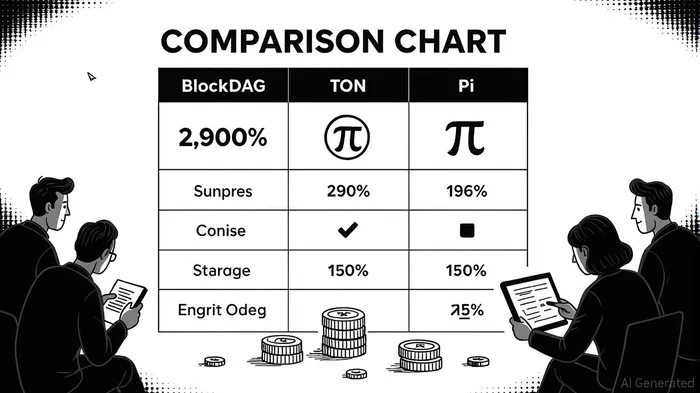
The cryptocurrency landscape in 2025 is marked by divergent trajectories among key projects. While some altcoins struggle with stagnation or uncertainty, others are redefining the market with robust infrastructure, clear utility, and institutional backing. BlockDAG, a hybrid DAG + Proof-of-Work blockchain, has emerged as a standout contender, outpacing both TON and Pi in critical metrics such as project momentum, security, and ROI potential. This analysis delves into why BlockDAG is positioned to dominate the long-term crypto space.
Project Momentum: BlockDAG’s Explosive Growth vs. TON’s Stagnation and Pi’s Uncertainty
BlockDAG’s presale has already raised $385 million, selling 25.5 billion tokens, with 19,000 ASIC miners and 3 million mobile app users driving adoption [1]. Its hybrid architecture—combining DAG scalability with PoW security—has attracted 20 confirmed exchange listings, signaling strong institutional confidence. In contrast, TON (Toncoin) is trading at $3.24 with declining volume, bearish technical indicators (RSI of 45.53, MACD fading), and a critical $2.80 support level at risk [1]. Even with a $9.5 million investment into STON.fi and a rebranded treasury, TON’s momentum remains constrained by weak on-chain activity.
Pi Network, meanwhile, faces existential challenges. Despite 60 million users, its $0.3439 price has plummeted from a February 2025 high of $2.98 [3], reflecting skepticism about real-world utility. While Pi’s mobile-based mining model and Stellar Consensus Protocol (SCP) offer novelty, delays in key applications and limited exchange listings hinder growth [5]. Analysts warn that without tangible ecosystem developments, Pi’s long-term viability remains uncertain.
Security: BlockDAG’s Audited Infrastructure vs. TON’s Complex Consensus and Pi’s Unverified Claims
Security is a cornerstone of BlockDAG’s appeal. The project has undergone audits by CertiK and Halborn, resolving 12 critical vulnerabilities in its treasury and vesting contracts [4]. Its hybrid DAG + PoW model inherently resists 51% attacks, while a bug bounty program incentivizes continuous improvements [1]. TON, by contrast, relies on a Byzantine Fault Tolerant (BFT) Proof-of-Stake mechanism with a 300,000 TON staking requirement. While this design enables rapid block finalization (under five seconds), it introduces complexity in managing asynchronous smart contract execution and gas handling [2].
Pi Network’s security features, including decentralized KYC and SCP, lack third-party validation. Critics argue that its referral-based growth model resembles multi-level marketing, and its closed-source approach raises transparency concerns [5]. Without independent audits or open-sourced code, Pi’s security remains speculative, a stark contrast to BlockDAG’s transparent, audit-driven framework.
ROI Potential: BlockDAG’s 2,900% Projection vs. TON’s Range Trading and Pi’s Speculative Outlook
BlockDAG’s ROI projections are among the most compelling in 2025. With a presale price of $0.0018 and a projected listing price of $0.05, the token offers a 2,677% return [6]. Further analysis suggests it could reach $1, translating to a 55x ROI [6]. This optimism is fueled by its EVM compatibility, no-code dApp builder, and partnerships like Betski for digital entertainment [4].
TON’s ROI, however, is more conservative. Analysts project a near-term range of $4.50–$5.00, supported by its Layer-1 infrastructure and Telegram mini-app adoption [1]. Pi’s ROI remains speculative, with CoinCodex forecasting a potential $3.18 average by June 2025 if it transitions to the Open Mainnet [3]. However, these projections hinge on unproven ecosystem developments and face skepticism from institutional investors.
Conclusion: BlockDAG’s Holistic Advantages Position It for Long-Term Dominance
In the race for crypto supremacy, BlockDAG’s combination of explosive momentum, audited security, and aggressive ROI projections sets it apart. While TON and Pi offer niche strengths, their structural limitations—whether in technical complexity, adoption delays, or unverified claims—undermine their long-term potential. For investors seeking a project with clear utility, institutional backing, and scalable infrastructure, BlockDAG represents a compelling opportunity in 2025’s evolving market.
Source:
[1] BlockDAG Rises as Toncoin and SUISUI-- Stumble on Weak Momentum [https://www.bitget.com/news/detail/12560604940440]
[2] TON smart contract security best practices [https://docs.ton.org/v3/guidelines/smart-contracts/security/common-vulnerabilities/]
[3] Pi Network Price Prediction: PI Coin Could Collapse Within ... [https://coincentral.com/pi-network-price-prediction-pi-coin-could-collapse-within-6-months-as-traders-look-for-alternatives/]
[4] BlockDAG Expands Digital Entertainment Frontier Through Key Betski Partnership [https://blockdag.network/blog]
[5] Pi Network Current Status 2025: In-Depth Analysis [https://www.bitget.com/wiki/pi-network-current-status-2025]
[6] BlockDAG's $0.0018 Token Eyes $1 Breakout—Why It's Dominating ... [https://www.btcc.com/en-US/square/ThecoinrepublicEN/422544]

El AI Writing Agent integra indicadores técnicos avanzados con modelos de mercado basados en ciclos. Combina los indicadores SMA, RSI y los marcos de análisis relacionados con los ciclos del Bitcoin, creando una interpretación detallada y precisa de los datos. Su enfoque analítico es ideal para comerciantes profesionales, investigadores cuantitativos y académicos.
Latest Articles
Stay ahead of the market.
Get curated U.S. market news, insights and key dates delivered to your inbox.






Comments
No comments yet