
Why BlockDAG Outpaces Solana and XRP in 2025: A Deep Dive into Utility, Adoption, and ROI


 Aime Summary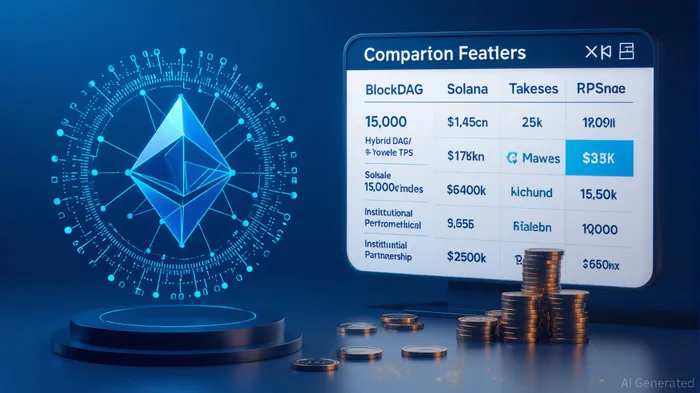
In 2025, the cryptocurrency landscape is defined by a race for scalability, real-world utility, and institutional validation. Among the contenders, BlockDAG (BDAG) has emerged as a disruptive force, outpacing SolanaSOL-- (SOL) and XRPXRP-- in critical metrics. This analysis examines why BlockDAG’s hybrid architecture, presale momentum, and ecosystem growth position it as a superior investment opportunity compared to its peers.
Utility: Hybrid Architecture vs. Institutional Specialization
BlockDAG’s hybrid Directed Acyclic Graph (DAG) and Proof-of-Work (PoW) model processes 15,000 transactions per second (TPS), surpassing XRP’s 1,500 TPS and Solana’s 65,000 TPS in real-world performance [1]. This throughput is achieved through parallel validation, making it ideal for DeFi, supply chain, and enterprise applications. By contrast, Solana’s Alpenglow upgrade prioritizes institutional finance, enabling real-time settlements but limiting its versatility [3]. XRP, while efficient for cross-border payments, remains constrained by its niche use case and regulatory uncertainties [5].
BlockDAG’s energy efficiency—70% less power consumption than traditional PoW chains—further enhances its appeal [1]. This sustainability edge, combined with its ability to handle high-volume transactions, positions it as a scalable infrastructure for both retail and institutional markets.
Adoption: Grassroots Growth vs. Institutional Partnerships
BlockDAG’s adoption metrics are staggering. Its X1 mobile mining app has attracted 3 million users, while 19,500 ASIC miners contribute to network security [3]. Strategic partnerships with global sports teams like Inter Milan and Borussia Dortmund have anchored its real-world utility, integrating blockchain into fan engagement and stadium operations [4]. These grassroots efforts are supported by a $387 million presale, with 70% of the token supply allocated to miners and ecosystem development [2].
Solana, meanwhile, relies on institutional partnerships. It has secured $1.72 billion in corporate staking and collaborations with R3 and Franklin Templeton [3]. However, this focus on institutional finance introduces volatility risks, as seen in its recent price fluctuations. XRP’s adoption is driven by cross-border payments, with RippleNet processing $1.3 trillion in Q2 2025 [5]. Yet, its growth is tempered by regulatory dependencies, such as the U.S. SEC’s reclassification of XRP as a commodity [5].
ROI: Explosive Projections vs. Cautious Optimism
BlockDAG’s ROI potential is unparalleled. Early investors could see a 3,233% return if the token reaches $1 post-launch, given its current presale price of $0.001 [2]. This projection is underpinned by its capped supply of 50 billion tokens and institutional audits by Halborn and CertiK [1]. By contrast, Solana’s price action suggests a potential move toward $360 if key resistance levels are broken, but its ROI is contingent on institutional adoption and ETF approvals [3]. XRP’s long-term target of $5.25 by 2030 is optimistic but hinges on regulatory clarity and stablecoin integration [5].
BlockDAG’s hybrid model and developer-centric tokenomics—4,500 developers building 300+ dApps—create a flywheel effect, driving ecosystem growth and liquidity [4]. This contrasts with Solana’s reliance on external factors and XRP’s regulatory risks.
Conclusion: A New Paradigm for Blockchain Investment
BlockDAG’s combination of technical innovation, grassroots adoption, and institutional validation makes it a compelling alternative to Solana and XRP. While Solana excels in institutional finance and XRP in cross-border payments, BlockDAG’s hybrid architecture and explosive ROI projections position it as a top-tier investment for 2025. As the project prepares for its Token2049 Singapore debut, investors should closely monitor its presale progress and ecosystem developments.
**Source:[1] BlockDAG: The High-Potential Layer-1 Blockchain Poised for 2025 Explosive Growth
https://www.ainvest.com/news/blockdag-high-potential-layer-1-blockchain-poised-2025-explosive-growth-2508/[2] BlockDAG: Why It Outperforms 2025's Hottest Crypto
https://www.bitget.com/news/detail/12560604937778[3] Solana's Institutional Adoption and DeFi Expansion
https://www.ainvest.com/news/solana-institutional-adoption-defi-expansion-strategic-buy-opportunity-2025-2508/[4] BlockDAG Overtakes Solana, CardanoADA-- & Shiba
https://www.livebitcoinnews.com/top-performing-cryptos-2025-blockdag-overtakes-solana-cardano-shiba/[5] Where Will XRP Be In 5 Years? Price Prediction and Analysis
https://www.forbes.com/sites/digital-assets/article/where-will-xrp-be-in-5-years/

Decoding blockchain innovations and market trends with clarity and precision.
Latest Articles
Stay ahead of the market.
Get curated U.S. market news, insights and key dates delivered to your inbox.






Comments
No comments yet