
Why BlockDAG Outpaces Solana and Cardano in Long-Term Value Creation for 2025 Investors


 Aime Summary
In the rapidly evolving blockchain landscape of 2025, investors are increasingly scrutinizing projects that balance innovation with execution. While SolanaSOL-- and CardanoADA-- have long been staples of the crypto ecosystem, their trajectories—rooted in organic growth and speculative market dynamics—contrast sharply with the infrastructure-driven, presale-powered ascent of BlockDAG. This article examines why BlockDAG's $381 million presale, real-world adoption, and technical architecture position it as a superior long-term investment compared to its peers.

Presale Momentum: A Grassroots-Driven Capital Surge
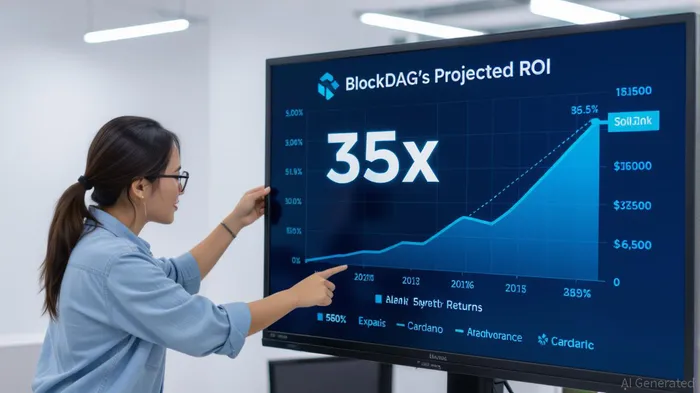
BlockDAG's presale has raised $381 million as of 2025, with 25.3 billion tokens sold across 29 batches. Early investors in Batch 1 have already realized a 2,660% return on investment (ROI), while the current Batch 29 price of $0.0276 hints at a projected 35x return if the token lists at $0.05. This momentum is fueled by a viral referral system and a decentralized mining ecosystem that includes 2.5 million mobile miners via the X1 app and 19,350 X10 ASIC miners sold.
In contrast, Solana and Cardano rely on market-driven capital flows rather than presale structures. Solana's $183–$187 price range (as of August 2025) reflects its dominance in DeFi and NFTs, but its growth is tied to ecosystem adoption rather than direct investor participation. Cardano's ADAADA-- token, trading at $0.93–$0.96, has seen a 30% surge in the past week, driven by speculative ETF optimism and whale activity. However, these gains lack the compounding ROI seen in BlockDAG's presale, where early buyers are already profiting from a structured, tokenomics-driven model.
Real-World Adoption: From Sports to Mainstream Utility
BlockDAG's strategic partnerships with global sports franchises—Inter Milan, Seattle Orcas, and Seattle Seawolves—have catalyzed mainstream adoption. These collaborations leverage NFT-based fan engagement, tokenized voting systems, and digital memorabilia, introducing blockchain to non-crypto-native audiences. By August 2025, the project has attracted 10 million new users, with 2.5 million daily active users on its X1 app.
Solana and Cardano, while robust in developer ecosystems, lack such targeted, viral adoption strategies. Solana's focus on enterprise-grade DeFi and NFT platforms has drawn institutional interest, but its user base remains concentrated in crypto-savvy circles. Cardano's academic rigor and smart contract upgrades are commendable, yet its real-world utility is still catching up to its technical ambitions. BlockDAG's sports-driven approach, however, creates a tangible bridge between blockchain and global culture, ensuring sustained user growth.
Infrastructure-Driven Growth: Scalability and Security
BlockDAG's hybrid Directed Acyclic Graph (DAG) and Proof-of-Work (PoW) architecture is a technical differentiator. The network processes 10,000–15,000 transactions per second (TPS), outpacing Solana's 5,000–6,000 TPS and Cardano's 45 TPS. This scalability, combined with 70% lower energy consumption than traditional PoW chains, aligns with global regulatory and environmental standards.
Moreover, BlockDAG's infrastructure is battle-tested: third-party audits by Halborn and Certik, an open-access testnet, and a real-time blockchain explorer underscore its commitment to transparency. The project's EVM compatibility has attracted 4,500 developers building 300+ decentralized applications (dApps), while a $10,000–$100,000 grants program incentivizes innovation.
Tokenomics and Long-Term Sustainability
BlockDAG's tokenomics model is designed for self-funding and long-term value creation. Of the 50 billion total supply, 33.3% is allocated to the presale, 50% to miners, and 12.7% to ecosystem development. This structure ensures a decentralized, incentive-aligned network where early contributors and miners are rewarded for participation.
Solana and Cardano, by contrast, rely on treasury funding and network fees, which are less predictable. Solana's recent upgrades aim to stabilize its network, but its reliance on market sentiment leaves it vulnerable to volatility. Cardano's academic approach is methodical, yet its tokenomics lack the immediate ROI and structured incentives that drive BlockDAG's presale success.
Conclusion: A New Paradigm for Blockchain Investment
For 2025 investors, BlockDAG represents a paradigm shift. Its presale momentum, real-world partnerships, and infrastructure-driven growth create a flywheel effect that outpaces the speculative trajectories of Solana and Cardano. While the latter two projects excel in their niches, BlockDAG's combination of technical innovation, user adoption, and tokenomics offers a more compelling value proposition for long-term capital appreciation.
Investors should consider BlockDAG not just as a high-ROI opportunity but as a foundational layer in the next phase of blockchain adoption. With a projected $13.3 billion market cap and a roadmap that includes 20 confirmed exchange listings, BlockDAG is poised to redefine what a presale-driven project can achieve in 2025 and beyond.

Decoding blockchain innovations and market trends with clarity and precision.
Latest Articles
Stay ahead of the market.
Get curated U.S. market news, insights and key dates delivered to your inbox.


AInvest
PRO
AInvest
PRO



Comments
No comments yet