
Why BlockDAG’s Grassroots Growth Outpaces VC-Fueled Layer 1 Rivals


 Aime Summary
In the rapidly evolving Layer 1 blockchain landscape of 2025, BlockDAG has emerged as a standout contender, leveraging grassroots adoption and pre-launch fundamentals to challenge VC-backed giants like EthereumETH--, SolanaSOL--, and CardanoADA--. While traditional venture capital (VC) funding remains a cornerstone of innovation in Web3, BlockDAG’s community-driven approach—bolstered by a hybrid DAG-PoW architecture and strategic partnerships—has generated momentum that rivals even the most well-funded projects. This article examines how BlockDAG’s unique value proposition is reshaping the narrative around scalability, developer engagement, and real-world utility.
Scalability and Performance: A Hybrid Edge
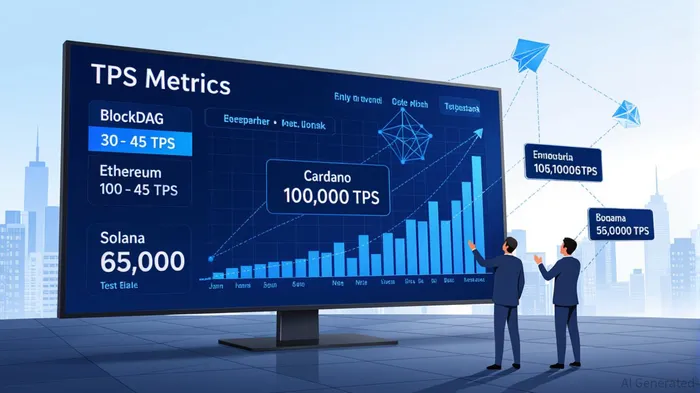
BlockDAG’s hybrid Directed Acyclic Graph (DAG) and Proof-of-Work (PoW) architecture enables it to process 15,000 transactions per second (TPS), outpacing Ethereum’s 30–45 TPS [1] and rivaling Solana’s 65,000 TPS [2]. This scalability is achieved through parallel validation of transactions, reducing latency and enabling applications in DeFi, NFTs, and enterprise solutions. By contrast, Ethereum’s Pectra upgrade and Cardano’s Hydra Layer 2 solution, while promising, have yet to match BlockDAG’s real-world throughput [2]. Solana’s high TPS, meanwhile, has raised decentralization concerns, creating a gapGAP-- BlockDAG aims to fill with its balanced model [1].
Grassroots Adoption: Presale and User Growth
BlockDAG’s grassroots success is evident in its presale performance and user acquisition. The project has raised $386 million across 30 token batches, selling 25.4 billion tokens [1]. Its X1 mobile mining app has attracted 2.5 million users, democratizing participation in a space often dominated by institutional players [1]. This contrasts with VC-backed projects like Solana and Cardano, which rely heavily on institutional partnerships and early-stage funding. For example, Solana’s recent ETF considerations and Cardano’s $20 million investment from Inveniam Capital [2] highlight their institutional focus, whereas BlockDAG’s user base reflects broad, community-driven adoption.
Strategic Partnerships and Ecosystem Development
BlockDAG’s ecosystem has grown rapidly, with 4,500+ developers building over 300 decentralized applications (dApps) on its EVM-compatible platform [1]. This mirrors Ethereum’s early success but with a focus on scalability. Meanwhile, partnerships with global sports teams like Inter Milan and Borussia Dortmund have enhanced its brand visibility and real-world utility [1]. In contrast, VC-backed projects like Ethereum and Cardano have prioritized enterprise integration (e.g., Circle’s ARC blockchain) and academic-driven upgrades [3], which, while credible, lack the viral appeal of BlockDAG’s sports and entertainment collaborations.
VC-Backed Momentum vs. Grassroots Resilience
While VC funding has fueled innovation in projects like Solana and Cardano, it also introduces risks such as token dumping and misaligned incentives [4]. For instance, Solana’s $20 million Series A round led by a16z crypto and Union Square Ventures [1] underscores institutional confidence but raises questions about long-term community alignment. BlockDAG, by contrast, has avoided these pitfalls by prioritizing organic growth. Its $7.8 million revenue from 19,300 ASIC miner sales [1] and 2,005 active projects [3] demonstrate a self-sustaining model that reduces reliance on external capital.
Challenges and Long-Term Outlook
Despite its strengths, BlockDAG faces hurdles, including the need to execute a successful mainnet launch and stabilize its post-listing price. Analysts project a $0.05 price post-listing, with long-term targets of $1 by 2027 and $15 by 2030 [1]. These projections hinge on maintaining developer momentum and expanding real-world use cases. Meanwhile, VC-backed projects like Ethereum and Cardano continue to refine their scaling solutions (e.g., Ethereum’s sharding roadmap [1]) but must address throughput limitations and regulatory scrutiny.
Conclusion
BlockDAG’s hybrid architecture, grassroots adoption, and strategic partnerships position it as a formidable challenger to VC-backed Layer 1 blockchains. While projects like Solana and Cardano benefit from institutional backing, BlockDAG’s community-driven model offers a compelling alternative, balancing scalability with decentralization. As the crypto market matures, the interplay between VC-funded innovation and grassroots resilience will define the next phase of blockchain adoption.
**Source:[1] BlockDAG | Best Crypto ICO | Layer 1 Crypto Presale 2025 [https://blockdag.network/][2] Why BlockDAG Outperforms Ethereum and Cardano as the [https://www.ainvest.com/news/blockdag-outperforms-ethereum-cardano-major-crypto-breakout-2025-2508/][3] Cardano's Price Trajectory: Blockchain Infrastructure Innovation in Quest for Sustainable Bullish Momentum [https://www.ainvest.com/news/cardano-price-trajectory-blockchain-infrastructure-innovation-quest-sustainable-bullish-momentum-2508/][4] VCs in Web3: Extractive Threats vs Constructive Alignment [https://university.mitosis.org/vcs-in-web3-extractive-threats-vs-constructive-alignment/]

Decoding blockchain innovations and market trends with clarity and precision.
Latest Articles
Stay ahead of the market.
Get curated U.S. market news, insights and key dates delivered to your inbox.






Comments
No comments yet