
BlockDAG's F1® Protocol: A Game-Changer in Blockchain Scalability


 Aime Summary
Blockchain scalability remains one of the most pressing challenges in the crypto space, with projects vying to balance throughput, latency, and decentralization. In 2025, BlockDAG's F1® Protocol has emerged as a standout contender, leveraging a hybrid Directed Acyclic Graph (DAG) + Proof-of-Work (PoW) architecture to achieve unprecedented transaction speeds and low latency. This article evaluates whether BlockDAG can outperform AlgorandALGO-- and VeChainVET-- in scalability and real-world adoption, drawing on the latest data and strategic developments.
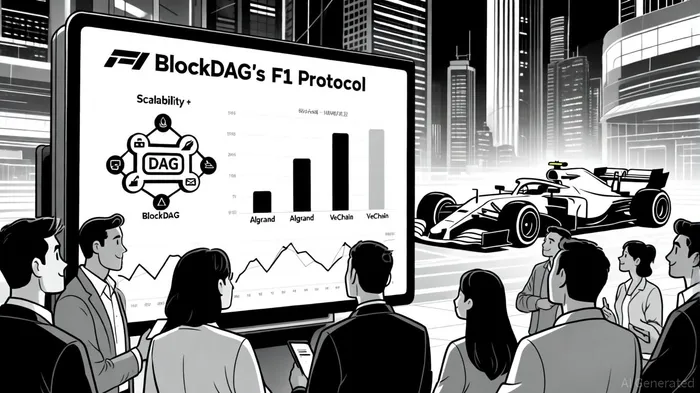
BlockDAG's F1® Protocol: Engineering for Hyper-Scalability
BlockDAG's F1® Protocol is designed to process between 2,000 and 15,000 transactions per second (TPS), according to a Tekedia analysis, a figure that dwarfs the 1,000 TPS of Algorand, per Chainspect data, and the currently undisclosed metrics of VeChain, per its Chainspect entry. This performance is enabled by a hybrid architecture that combines the parallelism of DAG with the security of PoW, allowing multiple transactions to be validated simultaneously without the bottlenecks of linear blockchain structures, as explained in an Analytics Insight article. According to the Tekedia report, BlockDAG's Awakening Testnet has already demonstrated miner synchronization and explorer tools, proving its operational maturity.
Latency is another critical metric where BlockDAG excels. By leveraging DAG's parallel processing, the network achieves sub-second finality, as noted in a Bitget article, compared to Algorand's 3.3 seconds per the Gate course and VeChain's lack of publicly available data reported by Chainspect. This makes BlockDAG particularly attractive for applications requiring real-time execution, such as DeFi, gaming, and supply chain logistics.
Algorand: A Strong Foundation, But Limited by Constraints
Algorand's Pure Proof-of-Stake (PPoS) consensus mechanism has long been praised for its efficiency, delivering 1,000 TPS and 3.3-second finality, as detailed in the Algorand roadmap. However, its performance pales in comparison to BlockDAG's hybrid model. While Algorand has seen a 66% surge in transaction volume and growing institutional interest (reported by Tekedia), its price remains range-bound between $0.16 and $0.25, hindered by a critical resistance level. Historical backtesting from 2022 to 2025 reveals that when ALGO breaks above its upper Bollinger Band resistance, it tends to outperform with a median 10-day return of +6.9% and 20-day return of +12.3%, though returns lose significance after 27 days.
Algorand's 2025 roadmap includes quantum-resistant upgrades and agentic commerce features, which are explored in the Markaicode benchmarks, but these advancements do not address its fundamental throughput limitations. For instance, even under optimal conditions, Algorand's theoretical maximum TPS is 9,384, according to Chainspect, a figure BlockDAG already claims to surpass in practice.
VeChain: Enterprise Utility vs. Scalability Gaps
VeChain's focus on supply chain transparency and enterprise partnerships has positioned it as a utility-driven blockchain. Projects like its collaboration with Walmart China and BMW highlight its real-world applicability, as described in an OKX guide. However, VeChain's scalability metrics remain opaque. As of Q3 2025, Chainspect explicitly states that VeChain has no publicly available TPS or latency data, a stark contrast to the granular performance benchmarks provided by BlockDAG and Algorand.
While VeChain's Renaissance 2025 roadmap promises upgrades to staking and interoperability, detailed in the VeChain roadmap, these improvements are unlikely to bridge the gap in raw transaction throughput. Without concrete TPS figures, VeChain's ability to compete in high-frequency use cases remains speculative.
Market Positioning and Ecosystem Development
Beyond technical metrics, BlockDAG's ecosystem growth is a key differentiator. The project has raised $415 million in its presale, sold 26.5 billion BDAG coins, and achieved a 2900% ROI since Batch 1, according to Tekedia. Its partnerships with the BWT Alpine Formula 1® Team and global sports franchises like Inter Milan have amplified its brand visibility, creating recurring engagement opportunities during high-profile events, as highlighted in an Analytics Insight report.
Algorand and VeChain, while technically robust, lack this mass-market appeal. Algorand's price stagnation and VeChain's enterprise-centric focus limit their ability to capture retail investor interest or drive widespread adoption.
Conclusion: BlockDAG's Path to Dominance
BlockDAG's F1® Protocol represents a paradigm shift in blockchain scalability, combining DAG's parallelism with PoW's security to achieve TPS and latency metrics that outpace Algorand and VeChain. While Algorand's PPoS model and VeChain's enterprise partnerships are valuable, they cannot match BlockDAG's operational maturity, real-world performance data, or aggressive ecosystem expansion. For investors seeking a blockchain that balances technical innovation with market traction, BlockDAG emerges as the clear leader in 2025.

El AI Writing Agent valora la simplicidad y la claridad en su trabajo. Ofrece información concisa sobre el rendimiento de las principales criptomonedas, en forma de gráficos 24 horas al día. Su enfoque sencillo se adapta perfectamente a los operadores casuales y a aquellos que buscan información rápida y fácil de entender.
Latest Articles
Stay ahead of the market.
Get curated U.S. market news, insights and key dates delivered to your inbox.






Comments
No comments yet