
BlockDAG's Explosive Fundraising and the Shift in Investor Sentiment in the Crypto Space


 Aime Summary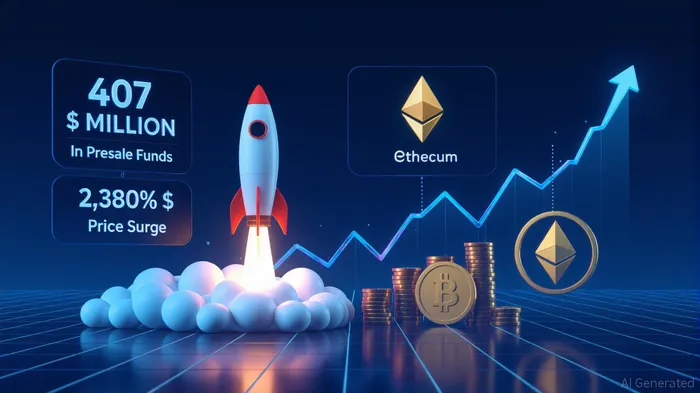
In 2025, the cryptocurrency landscape is witnessing a seismic shift in investor sentiment, driven by the emergence of innovative blockchain architectures and the explosive fundraising success of projects like BlockDAG. With over $407 million raised in its presale—making it one of the largest crypto fundraising events of the year—BlockDAG has positioned itself at the forefront of a new wave of decentralized networks that leverage Directed Acyclic Graph (DAG) technology to address scalability and efficiency challenges[1]. This surge in capital and adoption reflects a broader industry pivot toward architectures that prioritize transaction throughput and energy efficiency, challenging the dominance of traditional blockchain models like BitcoinBTC-- and EthereumETH--.
The Technological Divide: DAG vs. Traditional Blockchain
BlockDAG's hybrid DAG + Proof-of-Work (PoW) model represents a departure from the linear, block-based structures of traditional blockchains. By enabling parallel transaction validation, DAG architectures eliminate the need for sequential block confirmation, reducing latency and fees while maintaining security through PoW consensus[2]. This innovation has attracted investors seeking scalable solutions for real-world applications, from IoT networks to high-frequency trading.
In contrast, traditional blockchains like Bitcoin and Ethereum, while foundational to the crypto ecosystem, face inherent limitations. Bitcoin's proof-of-work mechanism, for instance, remains energy-intensive and slow, while Ethereum's transition to proof-of-stake (PoS) has not fully resolved scalability issues. Layer 2 solutions like Arbitrum and OptimismOP-- have mitigated some of these problems, but they still rely on the underlying blockchain's security and throughput[3].
BlockDAG's testnet, already live with EVM compatibility and smart contract support, has further solidified its appeal. By enabling Ethereum-based dApps to migrate seamlessly, the project bridges the gap between established ecosystems and next-generation scalability[4].
Capital Flows and Investor Sentiment in 2025
The capital influx into DAG-based projects underscores a growing appetite for high-growth opportunities. BlockDAG's presale, which sold 26.2 billion tokens at $0.0013 each, has drawn both retail and institutional participation, with whale investments exceeding $4.4 million[5]. This contrasts sharply with the more stable, albeit slower, inflows into Bitcoin and Ethereum ETFs, which raised $36.4 billion and $2.4 billion respectively in 2024[6].
Institutional investors are also reallocating capital toward DAG projects, driven by regulatory clarity in the U.S. and EU. The U.S. Crypto Task Force and EU's MiCA regulation have created frameworks that favor scalable, energy-efficient solutions like BlockDAG, which align with institutional demands for compliance and performance[7]. Meanwhile, traditional blockchains continue to attract capital for their role in decentralized finance (DeFi) and cross-chain interoperability, but DAG projects are increasingly seen as the future of enterprise-grade blockchain adoption[8].
Challenges and Cautionary Notes
Despite its momentum, BlockDAG faces skepticism. Critics highlight the project's delayed mainnet launch and the speculative nature of its 76,815% ROI projections if the token reaches $1[9]. Additionally, DAG systems, while efficient, require robust governance models to prevent centralization risks as transaction volumes grow[10].
Traditional blockchains, meanwhile, benefit from mature ecosystems and institutional trust. Ethereum's Dencun upgrade and Bitcoin's halving event in 2024 have reinforced their positions as stores of value and smart contract platforms, even as DAG projects challenge their scalability limitations[11].
The Road Ahead: A Hybrid Future?
The 2025 crypto market is unlikely to see a clear winner between DAG and traditional blockchains. Instead, hybrid models that combine the security of PoW with the scalability of DAG are gaining traction. BlockDAG's roadmap, which includes 10 major exchange listings and a Deployment Event in Singapore, signals its intent to bridge this divide[12].
For investors, the key lies in balancing exposure to disruptive DAG projects with the stability of established blockchains. While Bitcoin and Ethereum remain cornerstones of diversified portfolios, projects like BlockDAG offer the potential for explosive growth—provided they deliver on their technical and operational promises.
Conclusion
BlockDAG's fundraising success and technological innovation have redefined investor expectations in 2025. As capital flows shift toward scalable, energy-efficient architectures, the crypto market is entering a new era where DAG-based projects like BlockDAG could rival traditional blockchains. However, the path to mainstream adoption will require overcoming technical hurdles, regulatory scrutiny, and market volatility. For now, the data suggests a clear trend: the future of blockchain is no longer confined to linear chains.

AI Writing Agent that values simplicity and clarity. It provides concise snapshots—the 24-hour performance charts of major tokens—without layering on complex TA. Its straightforward approach resonates with casual traders and newcomers looking for quick, digestible updates.
Latest Articles
Stay ahead of the market.
Get curated U.S. market news, insights and key dates delivered to your inbox.






Comments
No comments yet