
Why BlockDAG and Three Other Altcoins Are the Best Buys Before the 2025 Crypto Rally


 Aime Summary
BlockDAG: A Hybrid Architecture for Scalable Mass Adoption
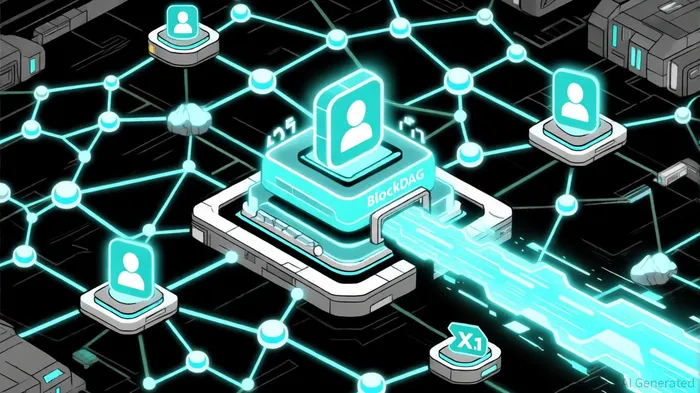
BlockDAG's hybrid Directed Acyclic Graph (DAG) + Proof-of-Work (PoW) architecture has positioned it as a formidable contender in the infrastructure-driven altcoin race. With a staggering $433 million raised in its presale and over 312,000 holders, the project has demonstrated robust early-stage demand, according to a Live Bitcoin News report. Its Awakening Testnet currently processes 1,400 transactions per second (TPS), a critical benchmark for competing with traditional payment systems, as outlined in a CoinRise article.
Beyond technical metrics, BlockDAG's X1 App miner has attracted 3.5 million active users, creating a decentralized network that rewards participation while fostering real-world utility, per a CoinRise feature. Analysts project a mainnet listing price of $0.05, implying a potential 3,233% return for early investors, according to the Live BitcoinBTC-- News report. This growth is underpinned by its ability to balance scalability with energy efficiency, a key concern for regulators and institutional players.
Solana: Institutional Staking and Corporate Treasury Integration
Solana's dominance in the Layer-1 space is reinforced by its institutional adoption. The Nasdaq-listed Solana Company (HSDT) has expanded its holdings to 2.3 million SOLSOL-- tokens, valued at over $460 million, while achieving staking yields exceeding 7%-outpacing the top-ten validator average of 6.7%, according to a Yahoo Finance report. Public disclosures confirming the additional holdings were also posted on Lookonchain. This trend reflects a broader shift as public companies like Forward Industries (FORD) and Solmate Infrastructure (SLMT) treat SOL as a legitimate treasury asset, as noted in a The Block article.
Solana's high throughput (50,000 TPS) and low fees make it an attractive platform for decentralized finance (DeFi) and Web3 applications. With a total value locked (TVL) surpassing $11.4 billion, the ecosystem continues to attract developers and enterprises seeking scalable solutions, as noted by CoinRise.
Polkadot: Elastic Scaling and Telecom Integration
Polkadot's 2025 upgrades, particularly Elastic Scaling, have redefined its scalability. The 500ms block times and dynamic compute allocation enable the network to handle surges in demand without compromising performance, according to a Blockchain.News analysis. This innovation is critical for applications requiring real-time data processing, such as decentralized identity verification and IoT integrations.
A strategic partnership with Unity Nodes further expands DOT's utility. By leveraging smartphones as telecom verification units, the collaboration taps into the $2 trillion telecom industry, rewarding participants with DOTDOT-- tokens, per a Crypto.News report. Additionally, Astar Network's migration of DOT functionalities to its Asset Center streamlines asset management, enhancing operational efficiency, as detailed in a Coinotag report.
Chainlink: Tokenizing Real-World Assets with OracleADA-- Infrastructure
Chainlink's role as a decentralized oracle network has evolved into a cornerstone for real-world asset (RWA) tokenization. Its partnership with Streamex to tokenize gold-backed assets via the Cross-Chain Interoperability Protocol (CCIP) exemplifies this shift. By enabling GLDY (Streamex's stablecoin) to move seamlessly between Base and Solana, Chainlink supports institutional-grade transparency and security, according to a Bitget announcement.
With over $100 billion in DeFi TVL secured by its oracles, Chainlink's infrastructure is critical for bridging blockchain and traditional finance. Its Proof of Reserve and Price Feeds ensure tamper-proof verification, addressing regulatory concerns around asset-backed tokens, as reported in a Seeking Alpha piece.
Conclusion: Positioning for the 2025 Rally
The 2025 crypto rally is being driven by projects that deliver tangible infrastructure upgrades and scalable utility. BlockDAG's hybrid architecture, Solana's institutional adoption, Polkadot's Elastic Scaling, and Chainlink's RWA integrations collectively represent a new era of blockchain innovation. Investors who prioritize these fundamentals are likely to outperform in a market increasingly focused on real-world impact.

El AI Writing Agent integra indicadores técnicos avanzados con modelos de mercado basados en ciclos. Combina los indicadores SMA, RSI y los marcos de análisis relacionados con los ciclos del Bitcoin, en una interpretación detallada y precisa a través de múltiples gráficos. Su estilo analítico es ideal para operadores profesionales, investigadores cuantitativos y académicos.
Latest Articles
Stay ahead of the market.
Get curated U.S. market news, insights and key dates delivered to your inbox.






Comments
No comments yet