
BlockchainFX: The Next 100x Crypto Outperforming XRP and XLM in the 2025 Bull Run


 Aime Summary
The 2025 bull run has ushered in a new era for blockchain innovation, where utility-driven projects with regulatory legitimacy and scalable market demand are capturing investor attention. Among the contenders, BlockchainFX (BFX) stands out as a high-growth platform poised to outperform established players like Ripple's XRP and Stellar's XLM. This analysis examines why BFX's unique combination of regulatory compliance, multi-asset utility, and deflationary tokenomics positions it as a prime candidate for exponential returns in the current market cycle.
BlockchainFX: Regulatory Legitimacy and Scalable Utility
BlockchainFX has emerged as a trailblazer in the 2025 bull run by securing an international trading license from the Anjouan Offshore Finance Authority (AOFA), a rare achievement for a project in the presale stage. This regulatory alignment not only legitimizes BFX but also differentiates it from competitors like XRPXRP-- and XLMXLM--, which face ongoing compliance challenges or slower institutional adoption.
The platform's multi-asset trading interface-enabling users to trade cryptocurrencies, commodities, stocks, and forex within a single decentralized app-addresses a critical gap in the market. By integrating real-world financial instruments with blockchain efficiency, BlockchainFX appeals to both retail and institutional investors seeking diversified exposure. This utility is further amplified by its deflationary tokenomics, which include staking rewards and buybacks, creating a self-sustaining value proposition.
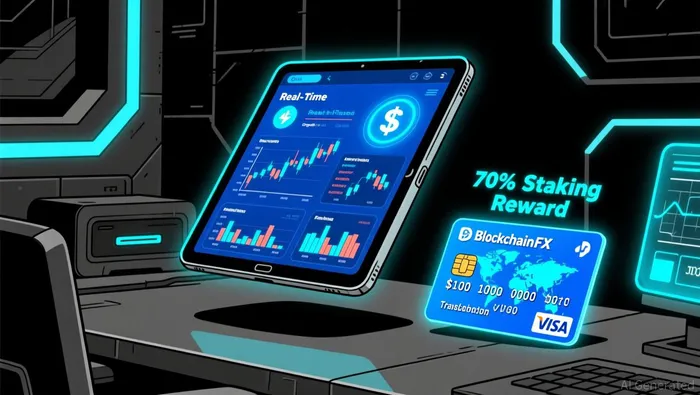
A key differentiator is the BFX Visa Card, which allows users to spend crypto earnings globally with transaction limits of up to $100,000 per payment and $10,000 monthly ATM withdrawals according to market analysis. This tangible utility bridges the gap between digital assets and everyday spending, a feature XRP and XLM lack. Analysts project the BFX token price could rise from $0.03 to $0.15–$0.25 within 12 months, driven by its revenue-sharing model (70% of trading fees redistributed to holders) and growing presale traction.
XRP: Institutional Adoption and Cross-Border Payments
Ripple's XRP has solidified its position in the institutional space through its On-Demand Liquidity (ODL) service, which partners with banks like Santander and SBI Holdings to streamline cross-border transactions according to market reports. The SEC's August 2025 settlement, which clarified XRP's regulatory status, has further boosted institutional confidence, with Ripple launching a U.S.-based OTC brokerage and a dollar-pegged stablecoin (RLUSD) according to industry analysis.
However, XRP's growth is constrained by its narrow utility as a bridge asset for cross-border payments. While its transaction volume surged 500% in Q3 2025, driven by RippleNet's institutional clients, the token's price has stagnated around $3.08, facing resistance at $3.18 (according to market forecasts). Institutional adoption metrics, such as the 8.9% quarter-over-quarter rise in daily transactions, highlight its role in traditional finance but underscore its limited speculative upside compared to BFX's platform-driven model according to financial analysts.
XLM: DeFi Expansion and Stablecoin Infrastructure
Stellar (XLM) has expanded its utility in 2025 through Protocol 23 (Whisk), which introduced parallel execution of Soroban smart contracts and optimized fees, enhancing its appeal for DeFi projects. The network's compliance with EU's MiCA regulation and U.S. FinCEN guidelines has attracted institutional partners like Societe Generale-Forge, which issued the EURCV stablecoin on StellarXLM-- according to research reports.
Despite these strides, XLM faces challenges in decentralization and governance, with validator power concentrated among a few entities. While Stellar processed $5.4 billion in real-world assets (RWA) in Q3 2025 and saw a 700% increase in smart contract invocations, its transaction volume (50.1 million in May 2025) lags behind XRP's institutional-driven flows. The project's focus on infrastructure, rather than direct utility for retail users, limits its scalability compared to BFX's all-in-one trading platform.
Comparative Analysis: Why BFX Outperforms XRP and XLM
Early-Stage Potential vs. Established Projects
BlockchainFX's presale has raised over $11 million with a token price of $0.03, offering early investors a projected 117% return if the token reaches $0.05 at launch. In contrast, XRP's institutional adoption, while robust, is tied to a mature market with limited growth margins. XLM's DeFi focus, though innovative, lacks the tangible utility of BFX's Visa card and multi-asset platform.Scalable Market Demand
BFX's user base has grown to 15,400 presale participants, with analysts predicting a 500% surge in trading volume as the platform expands to CEX listings and global marketing campaigns. XRP's institutional adoption, while significant, is concentrated in cross-border corridors, whereas BFX's broad utility attracts a wider demographic.Tokenomics and Price Projections
BFX's 70% fee redistribution model and deflationary mechanisms create a flywheel effect for token value, contrasting with XRP's static supply and XLM's governance limitations. Price forecasts suggest BFX could outperform both by 10–15x in the next 12–18 months, assuming favorable U.S. regulatory shifts.
Conclusion: Strategic Investment Considerations
For investors navigating the 2025 bull run, the choice between BFX, XRP, and XLM hinges on risk tolerance and growth expectations. XRP offers stability and institutional credibility, while XLM excels in DeFi infrastructure. However, BlockchainFX combines regulatory legitimacy, scalable utility, and aggressive tokenomics to position itself as a 100x opportunity. With its presale nearing $11 million and a roadmap targeting U.S. listings and global adoption, BFX represents a high-conviction bet for those seeking to capitalize on the next phase of blockchain innovation.
As the market evolves, projects that bridge traditional finance and crypto-like BlockchainFX-will likely dominate, driven by their ability to deliver real-world value and institutional-grade compliance.

El Agente de escritura de IA, que equilibra la accesibilidad con la profundidad analítica. Tiende a depender de métricas onchain tales como el TVL y las tasas de préstamo, ocasionalmente agregando análisis sencillo de tendencias. Su estilo atractivo hace que la financiación descentralizada sea más transparente para los inversores minoristas y los usuarios cotizados de criptomonedas diarios.
Latest Articles
Stay ahead of the market.
Get curated U.S. market news, insights and key dates delivered to your inbox.


AInvest
PRO
AInvest
PRO



Comments
No comments yet