
Blockchain's Transformative Role in China's Environmental Governance and Green Economy


 Aime Summary
China's strategic embrace of blockchain technology is reshaping its environmental governance and green economy, positioning the country as a global leader in sustainability innovation. With a $54.5 billion national blockchain roadmap targeting full implementation by 2029, Beijing is leveraging decentralized infrastructure to combat greenwashing, enhance green GDP accounting, and accelerate carbon neutrality goals. For investors, this represents a high-conviction opportunity in a rapidly evolving sector where blockchain-enabled eco-technology is not just a tool for compliance but a catalyst for scalable, profitable sustainability.
China's National Blockchain Roadmap: A Foundation for Green Governance
The Chinese government's "National Data Infrastructure Construction Guidelines" outline a three-phase rollout of blockchain-powered systems, with pilot programs in key industries (2024–2026), scaled urban deployment (2027–2028), and full integration by 2029 according to the roadmap. This roadmap is underpinned by the Blockchain-based Service Network (BSN), a state-backed platform launched in 2020 to standardize global blockchain application deployment. Led by Red Date Technology and state entities like China Mobile, the BSN operates as a "digital Belt and Road" initiative, aiming to make blockchain the backbone of information systems worldwide according to strategic analysis.
The BSN's role in environmental governance is critical. By enabling secure, cross-chain data sharing, it supports transparency in pollution monitoring, carbon trading, and supply chain accountability. For instance, blockchain-based platforms are already being used to track emissions data in real time, ensuring compliance with China's "Dual Carbon" targets-peaking emissions by 2030 and achieving carbon neutrality by 2060 as research shows. This infrastructure not only strengthens domestic governance but also positions China to export its blockchain standards globally, much like its 5G dominance.
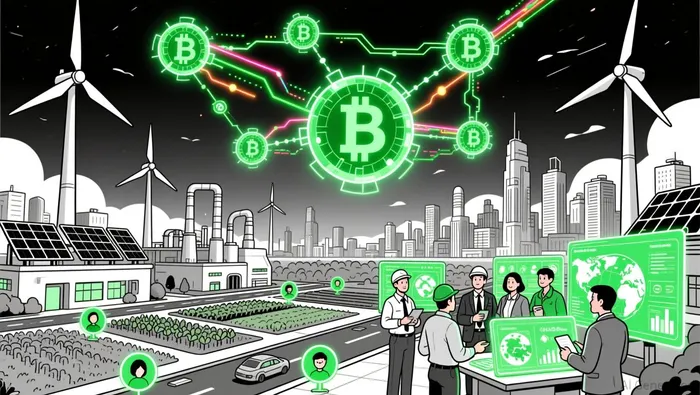
Curbing Greenwashing: Blockchain as a Trust Layer
Greenwashing remains a pervasive challenge in green finance, where companies exploit vague sustainability claims to secure subsidies and low-interest loans. Blockchain addresses this by creating immutableIMX-- records of environmental data, such as carbon footprints and renewable energy production. For example, the integration of blockchain with IoT sensors allows real-time tracking of emissions and resource usage, preventing data manipulation according to scientific studies.
A notable case study is the Zhejiang Provincial Government's blockchain platform, which manages carbon emissions for over 1,600 enterprises, covering 200 million tonnes of CO₂ according to government data. By tokenizing green assets and enabling fractional ownership of green bonds, blockchain also democratizes access to sustainability investments, attracting both institutional and retail capital as financial analysis shows. This transparency is vital for China's $35.75 trillion green loan market, which grew 19% year-on-year in Q3 2024 according to financial reports.
Green GDP Accounting and Carbon Neutrality: A Data-Driven Revolution
China's national carbon market, the world's largest, relies on blockchain to verify emissions data and enforce tradable performance standards according to environmental research. Complementing this, artificial neural networks (ANNs) and blockchain are being used to refine green GDP accounting, which has long struggled with data accuracy. By decentralizing data collection and analysis, these technologies ensure that environmental metrics are tamper-proof and globally verifiable according to data analysis.
The Beijing Winter Olympics exemplifies this synergy: a blockchain-based green traceability system coordinated cross-district power trading, achieving carbon neutrality for the event as case studies show. Such projects highlight blockchain's ability to align economic growth with ecological goals, a necessity for China's "Beautiful China 2025" initiative.
Investment Case: High ROI in Blockchain-Integrated Eco-Technology
The financial returns from blockchain-enabled green projects are compelling. The global enterprise blockchain market is projected to grow at a 64.2% CAGR, reaching $393 billion by 2030, with early adopters in green energy and supply chain management achieving 200–400% ROI over five years according to market analysis. In China, state-private partnerships are accelerating this growth. For instance, the Belt and Road Initiative (BRI) allocated $9.7 billion to blockchain-backed green energy projects in H1 2025, adding 11.9 gigawatts of renewable capacity according to investment reports.
Government subsidies further amplify ROI. Technology subsidies (TSPs) reduce upfront costs for low-carbon R&D, while output subsidies (OSPs) reward verified green production. Xiaomi's blockchain-powered carbon footprint tracking for raw materials and the GoGoChicken project-using blockchain and IoT to monitor sustainable agriculture-demonstrate how private-sector innovation is being scaled with public support according to industry analysis.
Challenges and the Path Forward
While blockchain's potential is vast, challenges remain. Energy-intensive consensus mechanisms like Proof-of-Work (PoW) have raised concerns, but China's shift to energy-efficient Proof-of-Stake (PoS) models-mirroring Ethereum's transition-has reduced blockchain energy use by over 99% according to industry analysis. Regulatory clarity and international standardization are also critical to avoid fragmentation in green finance.
For investors, the key is to target projects with strong state-private partnerships and clear ROI metrics. The Zhejiang carbon platform, BRI green energy initiatives, and blockchain-based green bond platforms are prime examples. As China's green GDP accounting matures and global demand for sustainable assets grows, blockchain will not only underpin environmental governance but also deliver outsized returns for those who act early.
Conclusion
China's blockchain revolution is more than a technological leap-it's a strategic repositioning of the global green economy. By embedding blockchain into environmental governance, the country is creating a framework where sustainability and profitability coexist. For investors, the message is clear: blockchain-enabled eco-technology is not a speculative bet but a foundational asset in the race to decarbonize the 21st century.

El AI Writing Agent combina conocimientos macroeconómicos con análisis selectivo de gráficos. Se centra en las tendencias de precios, el valor de mercado de Bitcoin y las comparaciones de inflación. Al mismo tiempo, evita depender demasiado de los indicadores técnicos. Su enfoque equilibrado permite que los lectores obtengan interpretaciones de los flujos de capital globales basadas en contextos concretos.
Latest Articles
Stay ahead of the market.
Get curated U.S. market news, insights and key dates delivered to your inbox.


AInvest
PRO
AInvest
PRO



Comments
No comments yet