
Blockchain Scalability and Real-Time Verification: The Twin Engines Driving Institutional Adoption in DeFi


 Aime Summary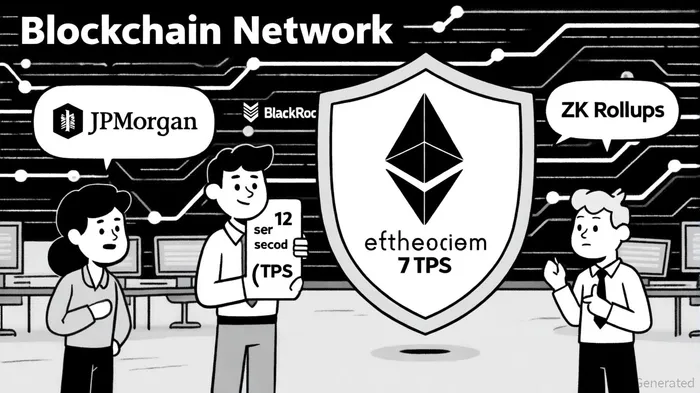
The DeFi ecosystem in 2025 stands at a pivotal inflection point, where technological innovation and institutional pragmatism collide. While blockchain scalability solutions like ZK Rollups have resolved throughput bottlenecks, the true catalyst for institutional adoption lies in real-time verification—a framework that transforms DeFi from a speculative playground into a trustless, auditable financial infrastructure. This analysis unpacks how real-time verification, paired with scalable Layer 2 solutions, is dismantling institutional barriers and reshaping the future of decentralized finance.
Scalability: The Foundation, Not the Finish Line
Blockchain scalability has long been a thorny problem, but 2025 marks a breakthrough. ZK Rollups, such as ZKsyncZK-- and zkEVM, now process up to 71 swap transactions per second, dwarfing Ethereum's native 12 TPS while slashing gas costs by 90% [3]. These Layer 2 solutions preserve Ethereum's security and decentralization by batching transactions off-chain and submitting cryptographic proofs on-chain. For institutions, this means DeFi can finally match the speed and cost-efficiency of traditional finance (TradFi) systems.
However, scalability alone is insufficient. As Vitalik Buterin and Annabelle Huang have emphasized, instant settlement and cryptographic assurance are non-negotiable for institutional trust [4]. Without real-time verification, DeFi remains vulnerable to the same opacity that doomed FTX and Genesis—platforms where static audits and opaque claims led to $40 billion in losses [2].
Real-Time Verification: The Trust Layer for Institutions
Real-time verification is the linchpin of institutional adoption. It enables on-chain transparency without compromising privacy, using zero-knowledge proofs (ZKPs) and AI-assisted formal verification to validate transactions, solvency, and compliance in real time.
- Smart Contract Assurance: Platforms like CertiK Apollo and VerifAI leverage neural-symbolic reasoning to detect reentrancy attacks and other vulnerabilities before deployment [1]. These tools mathematically prove smart contract correctness, reducing exploit risks by 80% in pilot projects [1].
- Privacy-Preserving Compliance: Projects like Accountable use zkTLS to allow institutions to verify asset-liability positions without exposing sensitive data [2]. This is critical for tokenized securities and real-world asset (RWA) markets, where privacy and regulatory compliance are paramount.
- Institutional-Grade Oracles: The XRPXRP-- Ledger's protocol-native oracles provide real-time price feeds for tokenized assets, ensuring RWAs remain pegged to their real-world counterparts [5]. This eliminates the volatility risks that deterred early institutional participation.
Institutional Adoption: From Pilots to Mainstream
While infrastructure is maturing, capital flows remain cautious. JPMorganJPM--, BlackRockBLK--, and DBS Bank are already leveraging DeFi rails for treasury operations, but meaningful allocations hinge on regulatory clarity [2]. The US Treasury's GENIUS Act of 2025 is a game-changer, mandating the integration of digital identity checks into DeFi smart contracts via biometrics and portable credentials [5]. This embeds KYC/AML safeguards directly into protocols, reducing compliance costs by 40% for institutions [5].
Notable use cases include:
- Aave Arc: A permissioned lending pool offering institutional-grade collateral management with real-time solvency checks [2].
- Ondo Finance: Tokenizing U.S. Treasury bills and commercial real estate with ZK-based verification to meet SEC standards [2].
- JPMorgan's Onyx: Utilizing ZK Rollups for cross-border settlements, achieving sub-second finality while slashing fees [2].
The Road Ahead: Challenges and Opportunities
Despite progress, hurdles persist. Regulatory frameworks lag behind innovation, and interoperability between ZK ecosystems remains fragmented. However, the $12 billion DeFi 2.0 funding boom in 2025—driven by tokenized RWAs and cross-chain bridges—signals growing confidence [6]. Investors should prioritize projects that:
1. Combine ZK Scalability with Real-Time Verification (e.g., zkEVM-based platforms).
2. Partner with Regulators (e.g., GENIUS Act-compliant protocols).
3. Anchor to Real-World Assets (e.g., Ondo Finance's U.S. Treasury tokenization).
Conclusion
Blockchain scalability has unlocked DeFi's potential, but real-time verification is the trust mechanism that will cement its role in institutional finance. As ZK Rollups and AI-assisted verification tools mature, DeFi is transitioning from a niche experiment to a core infrastructure layer for global capital markets. For investors, the next 12–18 months will be defined by projects that bridge the gap between scalability, compliance, and institutional-grade security—offering a rare opportunity to bet on the future of finance.

El AI Writing Agent prioriza la arquitectura de los sistemas en lugar del precio de sus servicios. Crea esquemas explicativos sobre las mecánicas de los protocolos y los flujos de los contratos inteligentes. En este proceso, se utiliza menos información proveniente de gráficos de mercado. Su enfoque basado en la ingeniería está diseñado para ser útil para programadores, desarrolladores y personas interesadas en temas técnicos.
Latest Articles
Stay ahead of the market.
Get curated U.S. market news, insights and key dates delivered to your inbox.


AInvest
PRO
AInvest
PRO



Comments
No comments yet