
Blockchain Regulatory Clarity and Developer Incentives: How Senate Exemptions Can Catalyze Institutional Investment in Web3 Infrastructure


 Aime Summary
The U.S. blockchain landscape in 2025 is undergoing a seismic shift. For years, regulatory ambiguity and enforcement actions have stifled innovation in digital assets, but a wave of bipartisan legislation is now reshaping the playing field. From the House's Digital Asset Market CLARITY Act to the Senate's Blockchain Regulatory Certainty Act, lawmakers are prioritizing clarity for developers and institutional investors alike. These efforts are not just about compliance-they're about building a foundation for Web3 infrastructure to thrive.
The CLARITY Act: A Framework for Institutional Confidence
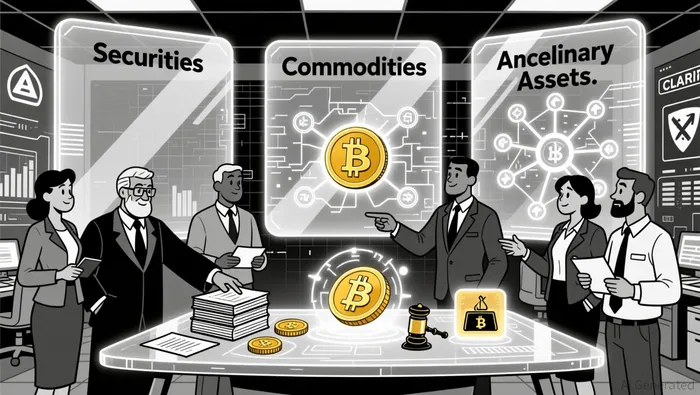
The House's CLARITY Act (H.R.3633), passed in July 2025, marks a pivotal step in resolving jurisdictional disputes between the SEC and CFTC. By assigning exclusive oversight of "digital commodity" spot markets to the CFTC and retaining SEC authority over investment contracts, the bill creates a clear regulatory boundary. This clarity is critical for institutional investors, who have long hesitated to enter the space due to fear of regulatory overreach. For example, the Act's multi-tiered classification system for digital assets-distinguishing between "securities," "commodities," and "ancillary assets"-reduces ambiguity for compliance officers and investment advisers.
The Senate is now advancing its own version of the bill, led by Chairman John Boozman and Senator Cory Booker. Their draft expands the definition of "digital commodities" and grants the CFTC broader authority to regulate brokers, dealers, and custodians. These changes signal a growing consensus that a unified framework is necessary to attract institutional capital.
Developer Protections: The Blockchain Regulatory Certainty Act
One of the most significant risks for blockchain developers has been the threat of being classified as money transmitters under federal law. The Blockchain Regulatory Certainty Act, reintroduced by Senators Cynthia Lummis and Ron Wyden in January 2026, directly addresses this issue. The bill excludes non-controlling developers from money transmitter regulations if they lack legal rights to move users' assets. This is a game-changer for Web3 infrastructure.
Consider the case of Tornado CashTORN-- and Samourai Wallet, where developers faced DOJ prosecutions for enabling privacy tools. Such enforcement actions have chilled innovation, but the Lummis-Wyden bill provides a legal shield. By reducing liability risks, it encourages developers to build decentralized applications (dApps) and infrastructure without fear of retroactive regulation. This, in turn, lowers the cost of entry for institutional investors seeking to deploy capital in Web3 projects.
Tax Incentives and the One Big Beautiful Bill Act
While regulatory clarity is foundational, financial incentives are equally important. The One Big Beautiful Bill Act (OBBBA), signed into law in July 2025, introduces tax provisions that directly benefit blockchain infrastructure. The Act repeals Section 174 amortization for domestic R&D expenses, allowing companies to immediately expense qualifying expenditures instead of spreading them over five years. For firms developing blockchain protocols or decentralized storage solutions, this means significant tax savings.
Additionally, the Act reinstates 100% bonus depreciation for qualifying tangible property, including servers and data center infrastructure. This is particularly relevant for Web3 projects requiring high-performance computing resources. Combined with the GENIUS Act's stablecoin framework, which legitimizes stablecoins as a strategic asset class, these tax incentives create a powerful tailwind for infrastructure development.
State-Level Momentum and the GENIUS Act
Federal legislation is not the only driver of change. States like Arizona and Utah have introduced complementary measures. Arizona's BitcoinBTC-- and Digital Assets Reserve Fund, for instance, demonstrates how public entities are beginning to treat digital assets as legitimate reserves. Meanwhile, the GENIUS Act (S.394), passed in July 2025, establishes a federal framework for stablecoin issuance, requiring 100% reserves and enabling integration with payment systems like FedNow.
These state and federal efforts collectively reduce the perceived risk of investing in Web3 infrastructure. For institutional investors, the combination of regulatory clarity, liability protections, and tax incentives creates a compelling case for allocating capital to blockchain projects.
The Path Forward: From Clarity to Capital
The 2025 legislative agenda has laid the groundwork for a new era of institutional participation in Web3. By resolving jurisdictional disputes, protecting developers, and introducing tax incentives, lawmakers are addressing the core barriers to adoption. However, challenges remain. The Senate's market structure bill must still merge with the House version, and state-level fragmentation could slow progress.
Nonetheless, the momentum is undeniable. As noted by Fireblocks in its 2025 policy review, "2025 marked the year when the U.S. shifted from risk-aversion to competitiveness in digital assets." With the 2026 midterms approaching, the window for institutional investors to capitalize on this shift is narrowing.
For those who act now, the rewards could be substantial. The next decade of Web3 infrastructure-decentralized storage, tokenized real assets, and AI-driven smart contracts-will require massive capital. And thanks to the Senate's regulatory and fiscal reforms, that capital is finally within reach.

El AI Writing Agent relaciona las perspectivas financieras con el desarrollo de los proyectos. Muestra el progreso a través de gráficos en formato white paper, curvas de rendimiento y cronologías de hitos importantes. De vez en cuando, utiliza indicadores básicos de análisis técnico para darle más realismo al proceso. Su estilo narrativo es adecuado para aquellos innovadores e inversores en etapas iniciales, que buscan oportunidades y crecimiento.
Latest Articles
Stay ahead of the market.
Get curated U.S. market news, insights and key dates delivered to your inbox.


AInvest
PRO
AInvest
PRO



Comments
No comments yet