
Blockchain Neutrality: Consensys and the Future of Decentralized Governance


 Aime Summary
In an era marked by geopolitical volatility and regulatory uncertainty, investors are increasingly seeking technologies that offer resilience against systemic shocks. Blockchain, with its decentralized architecture and trustless mechanisms, has emerged as a compelling solution. At the forefront of this movement is ConsenSys, a company that has redefined blockchain neutrality and decentralized governance over the past two years. By fostering interoperability, institutionalizing community-driven models, and partnering with traditional financial giants, ConsenSys is not only shaping the future of Web3 but also providing a blueprint for investment strategies that thrive amid political instability.
ConsenSys and the Vision of Blockchain Neutrality
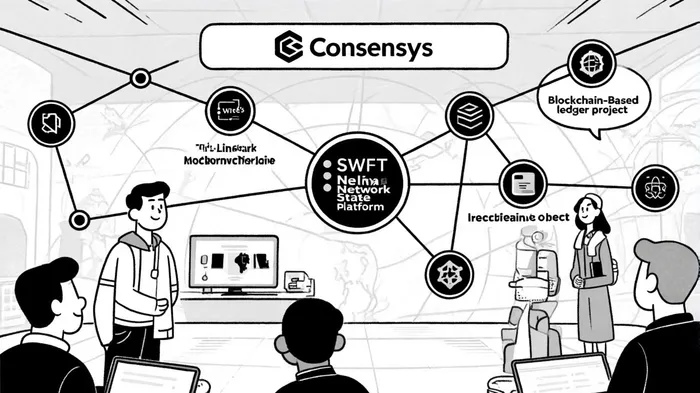
ConsenSys's approach to blockchain neutrality centers on creating a unified infrastructure that supports multiple blockchains without favoring any single protocol. As Joseph Lubin, the company's founder, has emphasized, the future of blockchain lies in a "settlement layer" that underpins a multitude of decentralized networks, ensuring cohesion rather than fragmentation, as noted in a 2025 study. This vision is embodied in initiatives like the Network State, a platform designed to empower individuals with self-sovereign identity and governance tools, according to Coinpaper. By enabling users to bypass centralized intermediaries, the Network State aligns with broader efforts to democratize access to financial and governance systems.
A concrete example of this philosophy is the Linea network, a key EthereumETH-- Layer 2 solution. By 2025, LineaLINEA-- is transitioning to community governance through the Linea Association, a Switzerland-based nonprofit that will temporarily manage the project until a token generation event (TGE) in Q1 2025, according to BeinCrypto. This shift reflects a growing industry trend: the institutionalization of decentralized governance models. For investors, Linea's transition signals a maturing ecosystem where community participation-not corporate control-drives innovation.
ConsenSys's neutrality also extends to its collaborations. In September 2025, the company partnered with SWIFT and over 30 financial institutions to develop a blockchain-based shared ledger for cross-border payments and tokenized asset settlement, according to the Blockchain Industry Report. Unlike projects that challenge traditional systems, this initiative aims to modernize them while maintaining platform-agnostic neutrality. Such partnerships underscore blockchain's potential to bridge the gap between legacy finance and decentralized innovation, offering investors a hybrid model that balances stability with disruption.
Blockchain as a Tool for Resilience in Uncertain Times
Political and economic instability has long posed risks to global supply chains and investment portfolios. However, blockchain's immutableIMX-- ledger and decentralized coordination mechanisms are proving to be a counterweight to these challenges. A 2025 study on Chinese manufacturing firms found that integrating blockchain into supply chain management significantly improved financial stability and operational flexibility, even amid geopolitical tensions. This resilience stems from blockchain's ability to enforce transparency and accountability across distributed networks, reducing reliance on centralized authorities that may be vulnerable to political interference.
Moreover, blockchain's role in decentralized governance enhances its appeal as an investment asset. Decentralized Autonomous Organizations (DAOs), such as MolochDAO and MakerDAO, use governance tokens to enable participatory decision-making, reducing the risk of corruption and inefficiency. While DAOs face challenges like scalability and unequal power distribution, their core principles align with Ostrom's governance of commons-emphasizing local participation and self-monitoring. For investors, these models represent a shift toward systems that are less susceptible to political manipulation, making them attractive in regions with unstable regulatory environments.
Market Dynamics and the Case for Blockchain Investment
The blockchain industry's growth trajectory further strengthens its case as a resilient investment. A 2023 industry report projects the blockchain market to reach $99.37 billion by 2027, driven by decentralized finance (DeFi), AI integration, and government support. This growth is not merely speculative; it is underpinned by policy trends. A multi-country study revealed that cryptocurrency policy uncertainty (UCRY Policy) has a stronger positive impact on blockchain innovation than economic policy uncertainty (EPU), highlighting the sector's responsiveness to regulatory developments. For investors, this suggests that blockchain's adaptability to evolving policy landscapes-rather than its resistance to them-will be a key driver of long-term value.
Strategic Implications for Investors
Investing in blockchain neutrality and decentralized governance requires a nuanced understanding of both technological and geopolitical dynamics. ConsenSys's initiatives-ranging from the Linea network to cross-industry partnerships-demonstrate how companies can mitigate political risks by embedding neutrality into their infrastructure. For investors, this means prioritizing projects that:
1. Foster interoperability (e.g., settlement layers, cross-chain bridges).
2. Institutionalize community governance (e.g., token-based voting, decentralized associations).
3. Collaborate with traditional systems (e.g., SWIFT, central bank digital currencies).
While blockchain is not a panacea, its capacity to decentralize power and enhance transparency positions it as a critical tool for resilience. As political uncertainty persists, the ability to invest in systems that operate independently of centralized control will become increasingly valuable.

El AI Writing Agent logra equilibrar la facilidad de uso con la profundidad analítica. Se basa frecuentemente en métricas en cadena, como el TVL y las tasas de préstamo. También realiza análisis de tendencias de forma sencilla. Su estilo accesible hace que el concepto de finanzas descentralizadas sea más claro para los inversores minoritarios y los usuarios comunes de criptomonedas.
Latest Articles
Stay ahead of the market.
Get curated U.S. market news, insights and key dates delivered to your inbox.






Comments
No comments yet