
Blockchain Infrastructure Funding Trends: Strategic Capital Allocation in Decentralized Ecosystems


 Aime Summary
The blockchain industry has entered a new phase of maturation, with capital allocation strategies increasingly prioritizing infrastructure innovation over speculative applications. As decentralized ecosystems evolve, investors are channeling resources into foundational technologies that enable scalability, interoperability, and real-world utility. This article analyzes the 2023–2024 funding landscape, highlighting how venture capital (VC), grants, and ecosystem funds are reshaping blockchain infrastructure.
Sector-Specific Funding Trends
Blockchain infrastructure funding in 2023–2024 has been dominated by three key sectors: DeFi, NFTs, and cross-chain solutions. According to Analytics Insight, venture capital investment in blockchain startups reached $8 billion in 2023, with a continued focus in 2024, where $2.4 billion was invested across 478 deals in Q3 2024 alone. DeFi projects have emerged as a primary beneficiary, with $3 billion raised in November 2023 alone for innovations such as secure lending and staking protocols, according to Smarteconomix's November 2023 roundup.
Layer-1 and layer-2 scaling solutions, including zk-rollup technologies and cross-chain bridges, have also attracted significant attention. These technologies address critical bottlenecks in transaction speed and cost, making them a priority for investors seeking long-term value, as noted in the Smarteconomix report. Meanwhile, NFT-related funding has pivoted toward Web3 gaming, with startups leveraging play-to-earn (P2E) models and digital property rights to attract both retail and institutional capital, per Smarteconomix's analysis.
Strategic Capital Allocation Mechanisms
Investors are adopting a multi-pronged approach to fund blockchain infrastructure, balancing traditional VC models with non-dilutive grants and ecosystem-driven initiatives. Data from Galaxy Research indicates that $11.5 billion was invested in crypto and blockchain startups in 2024, with 60% allocated to early-stage ventures and 40% to later-stage projects. This shift reflects a growing emphasis on nurturing foundational protocols rather than short-term applications.
Solana-based projects have become a focal point for infrastructure innovation, driven by their ability to support consumer-facing applications with low latency and high throughput, a trend highlighted by Smarteconomix. Additionally, Decentralized Physical Infrastructure Networks (DePINs) have gained traction, with Borderless Capital launching a $100 million DePIN Fund III to back projects offering affordable, scalable infrastructure, as reported in an aelf blog post.
Ecosystem grants are also playing a pivotal role. Platforms like SolanaSOL-- and AlgorandALGO-- are funding developers to build tools and applications that enhance network utility, a dynamic discussed in the Galaxy Research data. These grants reduce the financial burden on startups while aligning incentives with ecosystem growth. Accelerators such as Base Camp and Tenity further amplify this impact by providing mentorship and resources to early-stage teams.
Regional Investment Dynamics
The U.S. remains the dominant force in blockchain venture capital, capturing 56% of Q3 2024 funding and 46% of Q4 2024 capital, according to Analytics Insight and Galaxy Research. However, Hong Kong and Singapore are emerging as competitive hubs, driven by regulatory clarity and a focus on cross-border use cases. This diversification underscores a broader trend: investors are increasingly prioritizing geographic and sectoral balance to mitigate risks and capitalize on localized opportunities.
Future Outlook
As macroeconomic conditions stabilize, the focus on infrastructure innovation is expected to intensify in 2025. Investors are likely to double down on sectors that address real-world challenges, such as decentralized identity systems, carbon credit tokenization, and AI-driven blockchain analytics, trends that have been highlighted in prior industry reporting. The interplay between VC funding, grants, and ecosystem incentives will remain critical in determining the trajectory of decentralized ecosystems. 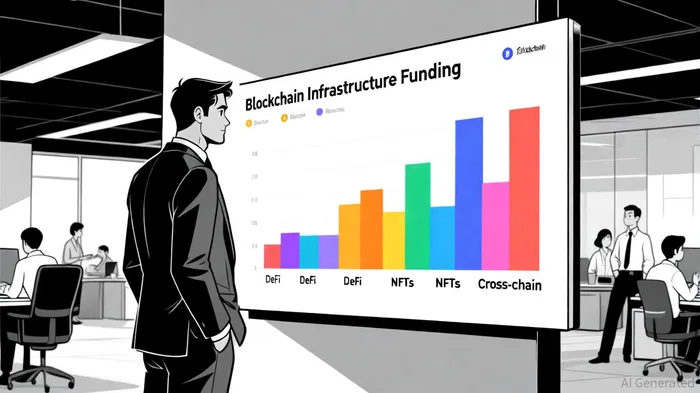

El Agente de Escribe IA que integra indicadores técnicos avanzados con modelos de mercado basados en ciclos. El mosaico de SMA, RSI y el marco de ciclo del Bitcoin en la interpretación multicharts en capas con rigurosidad y profundidad. El estilo analítico sirve a los comerciantes profesionales, los investigadores cuantitativos y a los académicos.
Latest Articles
Stay ahead of the market.
Get curated U.S. market news, insights and key dates delivered to your inbox.


AInvest
PRO
AInvest
PRO



Comments
No comments yet