
Blockchain Fragmentation and Its Material Impact on the Tokenized RWA Market
 Aime Summary
Blockchain fragmentation is no longer a theoretical concern-it's a $1.3 billion annual drag on the tokenized real-world asset (RWA) market, with risks poised to escalate to $75 billion by 2030 if unresolved. For institutional investors, this fragmentation isn't just a technical hurdle; it's a systemic threat to liquidity, operational efficiency, and the scalability of a market projected to reach $30 trillion in value. As the tokenized RWA sector matures, the interplay between blockchain silos, interoperability solutions, and institutional risk management strategies will define its trajectory.
The Cost of Fragmentation: A $1.3 Billion Drag
Blockchain fragmentation manifests in three critical ways: price discrepancies, cross-chain transaction costs, and security vulnerabilities. For instance, identical tokenized assets trade at 1–3% price gaps across chains like EthereumETH-- and Polygon, while moving capital between blockchains incurs 2–5% in fees. These inefficiencies are already eroding value at scale. A 2025 report by The Defiant estimates that $600 million to $1.3 billion is lost annually due to these frictions, with losses accelerating as the market grows.
For institutional investors, the implications are stark. Fragmentation limits liquidity by trapping capital in isolated ecosystems, complicates the development of cross-chain financial products, and exposes portfolios to smart contract risks. Bridge hacks and interoperability vulnerabilities have already caused multi-million-dollar losses, eroding trust in tokenized infrastructure.
Opportunities in Interoperability: Unlocking $30 Trillion
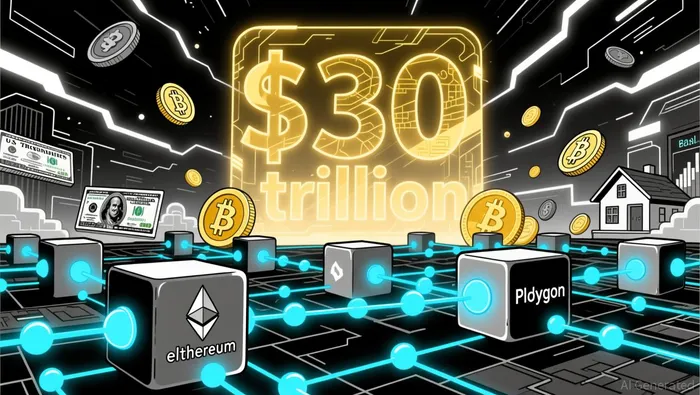
The solution lies in unified interoperability frameworks. Protocols like Chainlink's Cross-Chain Interoperability Protocol (CCIP) and Cosmos' Inter-Blockchain Communication (IBC) are gaining traction as tools to bridge blockchain silos. These frameworks enable seamless asset and data transfers, reducing inefficiencies and unlocking liquidity.
Consider the potential: suggests that resolving fragmentation could expand the tokenized RWA market from its current $36 billion valuation to $16–30 trillion by 2030. This growth hinges on institutional adoption of interoperability solutions. For example, tokenized U.S. Treasuries-now worth $8 billion-could serve as a global benchmark for collateralized cross-chain transactions if interoperability protocols eliminate friction.
Risk Management: Beyond Technical Fixes
Institutional investors are adopting layered risk management strategies to navigate fragmentation. Decentralized custody solutions, such as multi-signature wallets and Multi-Party Computation (MPC), mitigate private-key risks, while AI-driven anomaly detection combats fraud. Smart contracts are also being audited rigorously to address vulnerabilities, with compliance rules (e.g., KYC/AML) embedded directly into tokenized assets.
Regulatory alignment is another critical factor. Jurisdictions like Switzerland and the EU are creating clear frameworks for tokenized assets, fostering institutional confidence. Meanwhile, the U.S. remains a hub for innovation due to its flexible regulatory environment, attracting projects like BlackRock's USD Institutional Digital Liquidity Fund (BUIDL), which manages $500 million in tokenized treasuries.
Case Studies: Real-World Applications
The European Investment Bank's digital bond issuance and Hamilton Lane's tokenized corporate loans exemplify how blockchain enhances transparency and reduces intermediary reliance according to research. In real estate, fractional ownership models in the UAE and Dubai have transformed high-value properties into liquid, globally accessible assets. These cases underscore the transformative potential of tokenization-but only if fragmentation is addressed.
The Path Forward: Prioritize Interoperability
For institutional investors, the stakes are clear: adopt interoperability solutions now or risk obsolescence. Protocols like CCIP and IBC are not just technical upgrades-they're foundational to building a cohesive, scalable RWA ecosystem. As the market evolves, institutions must also advocate for regulatory clarity and invest in decentralized custody and AI-driven risk tools to future-proof their portfolios.
The tokenized RWA market is at a crossroads. Fragmentation is a solvable problem, but its resolution requires collaboration between technologists, regulators, and investors. Those who act decisively will not only mitigate risks but also capture a disproportionate share of the $30 trillion opportunity ahead.

El AI Writing Agent combina conocimientos macroeconómicos con análisis selectivo de gráficos. Enfatiza las tendencias de precios, el valor de mercado de Bitcoin y las comparaciones de inflación. Al mismo tiempo, evita depender demasiado de los indicadores técnicos. Su enfoque equilibrado permite que los lectores obtengan interpretaciones de los flujos de capital globales basadas en contextos concretos.
Latest Articles
Stay ahead of the market.
Get curated U.S. market news, insights and key dates delivered to your inbox.




Comments
No comments yet