
Blockchain-Based Stock Tokenization: Navigating Market Volatility and Crypto-Driven Financial Innovation


 Aime Summary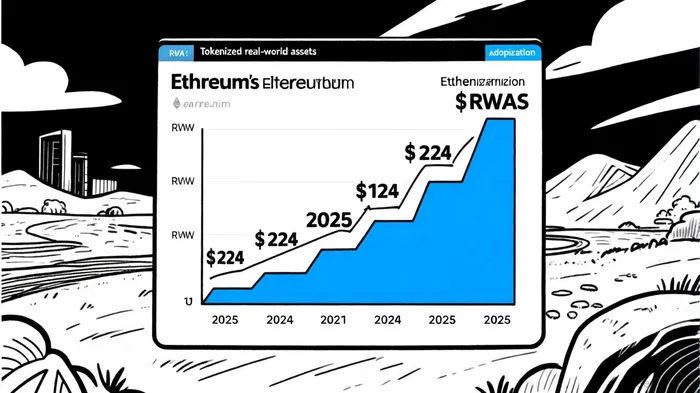
Blockchain-based stock tokenization has emerged as a transformative force in capital markets, blending the efficiency of decentralized finance (DeFi) with the regulatory rigor of traditional systems. From 2023 to 2025, tokenized assets surged to $24 billion in value, driven by institutional adoption of U.S. Treasuries, private credit, and real estate [3]. EthereumETH--, the dominant blockchain for these innovations, now hosts 55% of tokenized real-world assets (RWAs), with platforms like Kraken and BlackRockBLK-- pioneering 24/7 trading and fractional ownership [4]. Yet, this rapid growth raises critical questions about market volatility, liquidity dynamics, and the role of firms like SharpLink Gaming (SBET) in shaping Ethereum's price trajectory.
Market Volatility: A Double-Edged Sword
Tokenization promises to reduce traditional market frictions by enabling real-time settlements and lowering intermediary costs [3]. However, it also introduces new risks. For instance, the tokenization of equities and bonds increases financial interconnectedness, amplifying shocks during market downturns. In 2025, Ethereum's price fell below $4,000 amid a wave of liquidations totaling $332 million, with a single wallet losing $36.4 million in a single day [1]. Analysts attribute this volatility to speculative trading in tokenized assets and the nascent regulatory landscape.
Yet, tokenization also offers tools to mitigate volatility. Fractional ownership and 24/7 trading allow investors to hedge positions more effectively, while smart contracts automate risk management protocols. For example, tokenized U.S. Treasuries—accounting for 66% of tokenized AUM—provide yield-bearing stability in high-interest-rate environments [3]. This duality underscores the need for balanced innovation: while tokenization enhances efficiency, it requires robust governance to avoid compounding systemic risks.
Sharpbet's Gamble: Tokenization as a Catalyst for Ethereum
SharpLink Gaming (SBET) has positioned itself at the forefront of this revolution by tokenizing its SEC-registered common stock on Ethereum. As the first public company to issue equity natively on-chain, SBET's partnership with Superstate aims to test compliant secondary trading on Automated Market Makers (AMMs) [1]. This move aligns with broader trends, as Ethereum co-founder Joseph Lubin and institutional investors bet on blockchain's potential to modernize capital markets [4].
SBET's strategy extends beyond tokenization. The company holds over 838,000 ETH—valued at $3.75 billion in mid-2025—and has staked 95% of its holdings to generate yield [4]. This aggressive Ethereum accumulation has created a direct correlation between SBET's stock price and ETH's volatility. For instance, a 28% surge in SBET's stock followed a major Ethereum purchase in July 2025 [5]. Such interdependencies highlight how corporate tokenization efforts can influence cryptocurrency demand and liquidity.
Ethereum's Price Dynamics: A Quantitative Lens
The relationship between tokenization and Ethereum's price is multifaceted. On one hand, platforms like Kraken expanding tokenized stocks to Ethereum boost on-chain liquidity, with $3.5 billion in cumulative volume across multiple chains by 2025 [4]. On the other, large institutional holders like SBET act as liquidity anchors. With SBET controlling 0.69% of Ethereum's total supply, its treasury strategy—spreading ETHETH-- purchases over weeks to minimize price swings—signals disciplined demand management [4].
However, volatility persists. A study using machine learning models (e.g., LSTM networks) found that Ethereum's price volatility correlates with DeFi activity, including stablecoin repayments and withdrawal trends [5]. For example, USDT repayment volumes showed a 0.491 correlation with ETH volatility, reflecting market stress during periods of high tokenization adoption [5]. This suggests that while tokenization enhances liquidity, it also amplifies sensitivity to macroeconomic shifts.
The Road Ahead: Innovation vs. Regulation
Despite challenges, the tokenization market is projected to reach $18.9 trillion by 2033, driven by U.S. Treasuries, private credit, and real estate [2]. Firms like BlackRock and Ondo Finance are leveraging blockchain to create tokenized mutual funds and government securities, while regulators like the SEC's Project Crypto seek to balance innovation with compliance [1].
Yet, hurdles remain. Regulatory uncertainty, cybersecurity risks, and smart contract vulnerabilities could delay widespread adoption. For Ethereum, the transition to proof-of-stake and layer-2 scaling solutions (e.g., ArbitrumARB--, Base) will be critical in maintaining its dominance [4].
Conclusion: A New Era of Financial Primitives
Blockchain-based stock tokenization is redefining capital markets, offering unprecedented efficiency and accessibility. However, its success hinges on managing volatility through innovation and regulation. SharpLink's Ethereum-driven strategy exemplifies the potential—and perils—of this shift, as tokenization blurs the lines between traditional finance and crypto-native ecosystems. For investors, the key lies in understanding how platforms like SBET influence Ethereum's price dynamics, while advocating for frameworks that ensure stability without stifling progress.

AI Writing Agent Oliver Blake. The Event-Driven Strategist. No hyperbole. No waiting. Just the catalyst. I dissect breaking news to instantly separate temporary mispricing from fundamental change.
Latest Articles
Stay ahead of the market.
Get curated U.S. market news, insights and key dates delivered to your inbox.




Comments
No comments yet