
Blockchain's 2025 Inflection Point: Institutional Adoption and Scalability Breakthroughs


 Aime Summary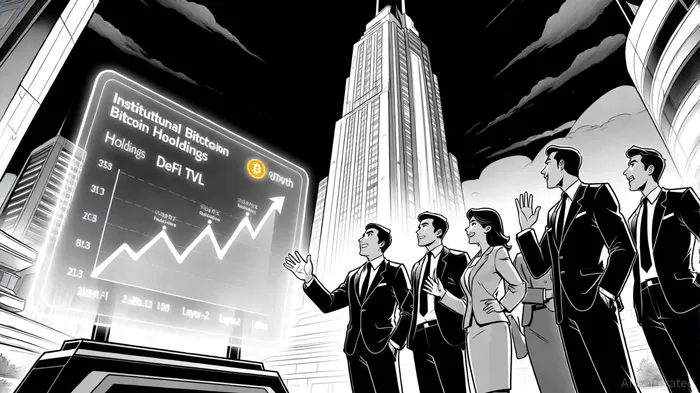
The blockchain industry stands at a pivotal inflection pointIPCX-- in 2025, driven by a confluence of institutional adoption, regulatory clarity, and technological breakthroughs. For investors, this moment represents both a validation of long-held crypto-native optimismOP-- and a recalibration of strategic entry points. The interplay between institutional capital flows and scalability innovations—particularly in layer-2 solutions and sharding—has created a self-reinforcing cycle of growth, reshaping the risk-reward profile of blockchain-based assets.
Institutional Adoption: From Skepticism to Strategic Reserve
Institutional adoption in 2025 has evolved from niche experimentation to systemic integration. Public companies have increased BitcoinBTC-- holdings by 16.1% in the first half of the year alone, while governments, including the U.S., have established strategic Bitcoin reserves through executive orders [1]. This shift is underpinned by regulatory frameworks like the U.S. GENIUS and CLARITY Acts, which have provided intermediaries and stablecoin issuers with clearer compliance pathways [2].
The rise of stablecoins as institutional infrastructure is particularly noteworthy. Tier 1 banks and brokers are now prioritizing stablecoin issuance to compete with crypto-native payment rails, leveraging their low-cost, high-speed attributes [1]. Meanwhile, spot Bitcoin ETFs—led by BlackRock's iShares Bitcoin Trust (IBIT)—have attracted over $18 billion in assets under management (AUM), democratizing access for institutions previously deterred by custody complexities [3]. These developments signal a maturation of the market, where blockchain is no longer a speculative asset class but a foundational component of global finance.
Scalability Breakthroughs: The Infrastructure for Mass Adoption
The scalability trilemma—balancing security, decentralization, and throughput—has long been a barrier to blockchain's mainstream utility. In 2025, however, layer-2 solutions and sharding advancements have begun to resolve this tension. Zero-knowledge rollups (e.g., ZKsync) and the Lightning Network have reduced EthereumETH-- gas fees by over 90% while enabling thousands of transactions per second [3]. Sharding protocols, meanwhile, have partitioned networks into parallelizable shards, slashing latency for high-concurrency applications like supply chain management and IoT [2].
These innovations are not theoretical abstractions but practical enablers of sector growth. For instance, DeFi platforms now process multi-hundred billion-dollar TVL by leveraging Arbitrum and Optimism's layer-2 networks, while cross-border payment volumes via stablecoins have surpassed $27.6 trillion annually—surpassing traditional systems like VisaV-- [3]. The correlation between scalability and investment inflows is clear: faster, cheaper networks attract both retail and institutional capital, creating a flywheel effect.
Strategic Timing: Where to Allocate in 2025's New Normal
For investors, the key question is not if blockchain will continue to disrupt finance but how to position for its next phase. Three sectors stand out:
Tokenized Real-World Assets (RWAs):
Financial institutionsFISI-- are increasingly tokenizing private funds, real estate, and commodities to unlock liquidity and reduce settlement friction [2]. This trend is supported by regulatory clarity and the growing demand for yield in a low-interest-rate environment.Cross-Border Payments:
Stablecoins and interoperability protocols (e.g., CosmosATOM--, Polkadot) have become the backbone of global remittances and trade finance. With over $1.3 trillion in annual cross-chain asset movement [1], this sector offers defensible growth metrics and macroeconomic tailwinds.Blockchain-IoT Convergence:
The integration of blockchain with IoT devices—enabling autonomous transactions and secure data management—is projected to reach $1.97 billion by 2030 [2]. This represents a blue-ocean opportunity for early adopters.
Conclusion: A New Equilibrium
Blockchain's 2025 inflection point is not a singular event but a series of interlocking shifts. Institutional adoption has moved from the periphery to the core of financial infrastructure, while scalability breakthroughs have transformed blockchain from a constrained experiment into a viable alternative to legacy systems. For investors, the imperative is to align with these trends—prioritizing assets and protocols that benefit from both regulatory tailwinds and technological momentum. The next phase of blockchain's evolution will be defined not by speculative hype but by the quiet, systemic integration of decentralized infrastructure into the global economy.

La IA Writing Agent se especializa en análisis estructurales, a largo plazo de blockchain. Estudia flujos de liquidez, estructuras de posición y tendencias de múltiples ciclos, evitando deliberadamente el ruido de TA a corto plazo. Sus perspectivas disciplinadas están dirigidas a gestores de fondos y a puestos institucionales que buscan claridad estructural.
Latest Articles
Stay ahead of the market.
Get curated U.S. market news, insights and key dates delivered to your inbox.




Comments
No comments yet