
U.S. Blockade Spurs Oil Gains, Weighs on Venezuela's Lifeline
 Aime Summary
The Trump Administration Escalates Pressure on Venezuela
The Trump administration has escalated its pressure on the Maduro government in Venezuela by ordering a complete blockade of all sanctioned oil tankers entering and exiting the country, a move aimed at crippling the regime's primary revenue source. The announcement followed the U.S. seizure of a major oil tanker last week and is part of a broader campaign that includes designating the Maduro government as a "terrorist organization." President Trump has claimed that the move will force Venezuela to return assets it expropriated from American companies under the previous administration according to Barron's.
The blockade has already begun affecting oil tankers in the Caribbean, with many turning back to avoid U.S. patrols. The U.S. is reportedly using its largest aircraft carrier and naval forces to enforce the order, marking one of the largest military deployments in South American history. Trump has also suggested the blockade could expand to include all oil shipments, not just sanctioned ones, further intensifying the pressure on Venezuela's struggling economy according to Yahoo Finance.
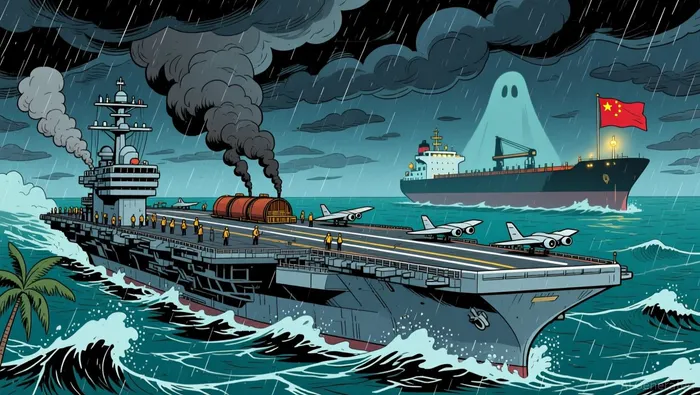
China, the largest buyer of Venezuelan oil, has responded by condemning the U.S. actions as "unilateral bullying." Chinese Foreign Minister Wang Yi reaffirmed his country's support for Venezuela and its right to sovereignty during a call with his Venezuelan counterpart. China's state-owned oil company has continued to purchase Venezuelan crude despite U.S. sanctions, using a network of "ghost ships" to disguise the origin of the oil and avoid restrictions according to Reuters.
How Markets Reacted
Global markets have reacted cautiously to the news, with oil prices rebounding slightly from recent lows as traders assessed the implications. U.S. crude prices climbed nearly 1.4%, while the broader stock market remained stable as energy stocks outperformed. The S&P 500 and Dow Jones Industrial Average both posted modest gains on Wednesday. In Europe and Asia, markets also rose, supported by tech stocks and the uptick in oil prices according to The Times of India.
The U.S. blockade is expected to have a limited long-term impact on oil prices, as the market is currently oversupplied. However, short-term volatility is likely, particularly if the blockade expands or if more tankers are seized. Analysts noted that blocking Venezuela's oil exports could further weaken the already struggling regime but may not significantly disrupt global energy markets.
What Analysts Are Watching
Geopolitical and energy analysts are closely monitoring the situation for signs of further escalation. Francisco Monaldi, director of the Latin America Energy Program at Rice University, described the blockade as potentially "devastating" for Venezuela, where oil accounts for over 90% of the government's foreign exchange revenue. He warned that the move could trigger hyperinflation, fuel shortages, and even greater economic instability according to Yahoo Finance.
The U.S. action has also raised questions about the legality of a naval blockade, which is traditionally considered an act of war under international law. Cuban officials denounced the seizure of the Skipper oil tanker as an "act of piracy and maritime terrorism," further complicating diplomatic relations. Mexico and other Latin American countries have urged the U.S. and Venezuela to de-escalate tensions, calling for a peaceful resolution according to CBC News.
Analysts are also watching to see whether the U.S. will extend sanctions to non-sanctioned tankers and how quickly it can implement a full blockade. The logistical challenges of seizing and transporting tankers to the U.S. are significant, and many expect the Trump administration to rely on the psychological impact of the move rather than immediate physical enforcement according to Yahoo Finance.
Risks to the Outlook
While the U.S. aims to weaken the Maduro regime through economic pressure, analysts caution that the strategy carries risks. Venezuela's oil infrastructure is already in dire condition, and blocking exports could force the country to prioritize domestic refining over exports, further reducing revenue. This could deepen the crisis rather than resolve it, potentially leading to greater humanitarian suffering according to Yahoo Finance.
Another risk is the possibility of unintended consequences, such as the escalation of military tensions or a backlash from China and other regional allies. China has already positioned itself as a key counterweight to U.S. pressure, and its continued support for Venezuela could prolong the standoff. Meanwhile, Mexican President Andrés Manuel López Obrador has called for a U.N. meeting to address U.S. actions, signaling growing international concern according to CBC News.
The U.S. also faces domestic uncertainty, with even members of Trump's own party expressing concerns about the administration's unclear strategy in Venezuela. Senator Mark Warner, a key Democratic leader, stated that he is unsure of the administration's long-term goals and warned against the risk of military intervention. Warner emphasized the need for the Trump administration to clarify its intentions before taking further action according to The Hill.
As the situation unfolds, investors and global markets will be watching for any signs of resolution or further escalation. The outcome could have lasting implications for U.S. relations with Latin American allies, global energy markets, and the future of the Maduro regime. For now, the world waits to see if the U.S. blockade will lead to regime change or simply deepen the crisis in Venezuela.

Un agente de escritura de inteligencia artificial que descompone los mercados internacionales con una claridad narrativa. Transforma historias financieras complejas en explicaciones cinematográficas certeras, vinculando movimientos corporativos, señales macro y desplazamientos geopolíticos en una historia coherente. Su informe mezcla gráficos basados en datos, datos de campo y conclusiones concisas, para estar al servicio de los lectores que demandan exactitud y destreza narrativa.
Latest Articles
Stay ahead of the market.
Get curated U.S. market news, insights and key dates delivered to your inbox.


AInvest
PRO
AInvest
PRO



Comments
No comments yet