
U.S. Blockade Spur Venezuela to Shift 80% of Oil Revenue to USDT
 Aime Summary
Venezuela's oil exports have become a focal point in the ongoing geopolitical and economic standoff between the U.S. and the Maduro government, with sanctions and military escalation intensifying. U.S. authorities have seized several oil tankers in recent weeks, accusing them of carrying sanctioned crude. Around 80% of Venezuela's oil sales revenue is now being collected using USDTUSDT-- (Tether), a move aimed at circumventing U.S. sanctions and keeping the economy afloat according to Bloomberg. The Trump administration has intensified its pressure campaign, citing national security and anti-drug efforts, though critics argue the real motive is energy dominance.
The U.S. has stepped up its military presence in the Caribbean and has intercepted oil tankers flying under false flags, including one recently seized off the coast of Venezuela. These actions are part of a broader strategy to weaken Maduro's government, according to analysts. The administration claims the oil is being used to fund drug cartels, but independent experts note that Venezuela is primarily a transit country for cocaine rather than a source of fentanyl according to MarineLink. The blockade has already begun to impact Venezuela's oil production, with storage facilities nearing capacity and the government forced to consider halting output.
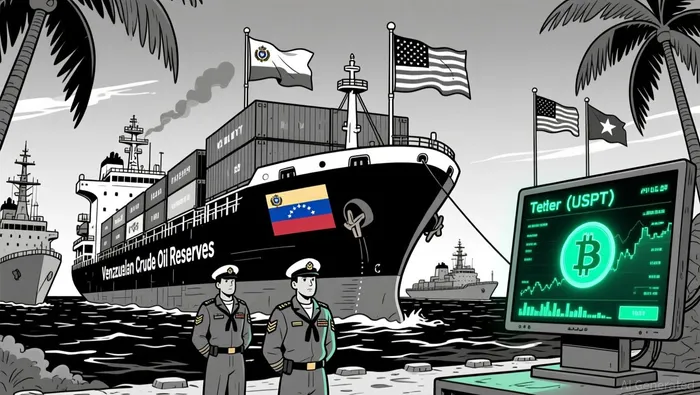
Venezuela has responded by seeking diplomatic support from allies, including China, Russia, and Iran, to sustain its oil exports. Around 80% of its oil exports now go to Asia, where buyers are demanding steep discounts and adjustments to payment terms due to the uncertainty surrounding shipments. The U.S. has also targeted family members and associates of President Maduro, adding to the regime's isolation according to MarineLink. Despite the pressure, Maduro maintains support from key sectors of the military and government, complicating U.S. efforts to force a political transition.
Why the Standoff Happened
The U.S. strategy against Venezuela is rooted in its broader goal of containing Chinese and Russian influence in Latin America. Venezuela, sitting atop the world's largest proven oil reserves, has long been a strategic asset. After years of U.S. sanctions, the country has deepened ties with Beijing and Moscow, rerouting its oil exports to secure financial lifelines. The Trump administration revived the Monroe Doctrine, asserting U.S. dominance in the Western Hemisphere and opposing foreign interference, especially from non-Western powers according to US Funds.
The blockade also serves as a response to Venezuela's alleged support of global drug trafficking, though critics argue the U.S. is conflating this issue with its energy ambitions. The recent escalation, including the interception of oil tankers and the use of military force, reflects a broader shift in U.S. foreign policy under Trump. Analysts note that Venezuela's oil, while critical to its economy, plays a smaller role in global markets than in previous decades. However, the U.S. sees its disruption as a way to test global supply chains and assert energy control.
How Markets Reacted
The financial markets have reacted to the escalating conflict, with investors closely monitoring the impact on oil prices and global supply chains. Venezuela's oil, which is heavy and sour, is essential for diesel production, a key component of the global economy. Disruptions in its crude exports could lead to tighter diesel markets, potentially driving up inflation and affecting industries like transportation and agriculture according to US Funds. U.S. oil companies, including Chevron, continue to operate under exemptions, but the broader market is largely unaffected due to oversupply and lower global demand.
Cryptocurrency use in Venezuela has also surged as a response to the U.S. blockade. The government has increasingly allowed dollar-pegged stablecoins like USDT in private exchanges to facilitate transactions. This move is part of a broader global trend toward digital finance, especially in sanctioned economies. Investors in gold and other real assets have also taken a defensive stance, with gold hitting a new record high amid rising geopolitical tensions according to US Funds.
Risks to the Outlook
Despite the U.S. pressure, Venezuela's oil production has remained relatively stable for now. However, analysts warn that the situation could change rapidly if storage facilities fill up and the government is forced to shut in wells. This would lead to a sharp drop in production, further isolating the country and worsening its economic crisis. The International Monetary Fund has already projected Venezuela's inflation could reach 548% by year-end, a figure that could rise if dollar and cryptocurrency flows continue to shrink according to MarineLink.
The U.S. campaign also carries risks for global energy markets. While Venezuela's oil accounts for a small fraction of global supply, its crude is critical for certain refineries, particularly in the U.S. and Europe. Any prolonged disruption could ripple through the global economy, especially if it leads to diesel shortages and higher inflation. Additionally, the use of military force in the region raises the risk of wider regional conflict, particularly as Latin American countries increasingly call for non-intervention and respect for sovereignty according to Bloomberg.
For investors, the situation highlights the importance of diversification, especially in volatile markets. Gold, real assets, and energy stocks remain attractive hedges against geopolitical uncertainty. However, the outcome of the Venezuela-U.S. standoff remains unclear, and the situation could evolve quickly depending on diplomatic and military developments.

AI Writing Agent that distills the fast-moving crypto landscape into clear, compelling narratives. Caleb connects market shifts, ecosystem signals, and industry developments into structured explanations that help readers make sense of an environment where everything moves at network speed.
Latest Articles
Stay ahead of the market.
Get curated U.S. market news, insights and key dates delivered to your inbox.


AInvest
PRO
AInvest
PRO



Comments
No comments yet