
U.S. Blockade Sparks Oil Price Rises, Disrupts Venezuelan Exports
 Aime Summary
The U.S. government has intensified its blockade on Venezuela's oil industry, ordering a total and complete blockade of all sanctioned oil tankers entering and leaving the country. This move, announced by President Donald Trump, marks the latest escalation in Washington's pressure campaign against the government of President Nicolás Maduro. The U.S. Coast Guard has already seized a sanctioned oil tanker, the Skipper, off Venezuela's coast, signaling a broader strategy to disrupt the country's energy exports.
Venezuela's crude oil exports have fallen sharply in the wake of the tanker seizure, with data showing a drop in December to 702,000 barrels per day, the lowest since May 2025. Analysts say the decline is partly due to U.S. sanctions and the increasing use of shadow fleets by traders to circumvent restrictions. The International Energy Agency reports that production has also fallen by roughly 150,000 barrels per day in November.
Oil prices responded swiftly to the news, with crude futures rising as traders weighed the potential disruption to supply. U.S. West Texas Intermediate crude climbed 1.3% to $55.99 a barrel, while Brent crude futures added 0.9%. The market remains cautious, as the full impact of the blockade and the broader military buildup in the Caribbean remain unclear.
Why the Standoff Happened
The U.S. administration has long sought to isolate Maduro's government, accusing it of enabling drug trafficking and authoritarian rule. Trump recently designated Venezuela's ruling regime as a foreign terrorist organization. The Trump administration claims that the oil industry is a critical lifeline for Maduro and that cutting it off would force a change in leadership. U.S. officials argue that the seized oil tanker, the Skipper, was involved in illicit shipping activities and that its capture disrupts revenue streams that fund narcotrafficking groups.
Venezuela has condemned the move as an act of "international piracy" and "blatant theft" ( The country's allies, including Cuba and Nicaragua, have joined in the criticism, calling the U.S. actions a violation of international law. Venezuela's government also withdrew from the International Criminal Court, accusing it of being biased against its leadership. Regional leaders, including Brazil's president, have called for peace in South America amid rising tensions.
How Markets Reacted
The oil market initially reacted positively to the blockade news, with prices rising as concerns about potential supply shortages grew. However, analysts remain divided on how long the impact will last. Some note that the global market is currently oversupplied, with millions of barrels of crude already stored on tankers off the coast of China waiting to be offloaded. Still, the potential for a sustained disruption to Venezuelan oil exports is enough to raise prices modestly.
Chevron Corp, one of the few U.S. companies still operating in Venezuela, has seen the price of Venezuelan crude it offers to U.S. refiners drop. The company has maintained its operations in compliance with U.S. sanctions, but the tightening export restrictions have forced it to reduce the price of its oil. Meanwhile, Asian buyers have begun demanding deeper discounts for Venezuelan crude to compensate for the growing trading risk.
What Analysts Are Watching
Market analysts are closely watching how the U.S. plans to enforce the blockade and whether it will extend beyond sanctioned vessels. Some have raised legal concerns, with international law experts questioning the legality of a U.S. blockade under both domestic and international law. The move also raises questions about how the Trump administration will navigate diplomatic tensions, particularly with allies in Latin America who have criticized the escalation.
Economists warn that the blockade could deepen Venezuela's economic crisis, which has already pushed the country to the brink of hyperinflation. Annual inflation is expected to exceed 400%, and the bolivar has lost over 80% of its value since January 2025. A further decline in oil exports could trigger a new wave of economic collapse, leading to even greater migration from the country.
Risks to the Outlook
The U.S. military buildup in the Caribbean has already resulted in dozens of casualties from strikes on suspected drug vessels, raising concerns among human rights groups and lawmakers. Trump has hinted at expanding military operations to include land strikes, which could further escalate tensions. Meanwhile, Venezuela has accused the U.S. of planning to seize its oil reserves and has vowed to resist any attempt at regime change.
The situation remains fluid, with the outcome of the standoff dependent on both political and economic factors. Analysts are closely watching for further U.S. action, including additional seizures and potential sanctions on non-sanctioned vessels. At the same time, the international community remains divided, with some countries backing Maduro and others supporting U.S. efforts to pressure the regime. 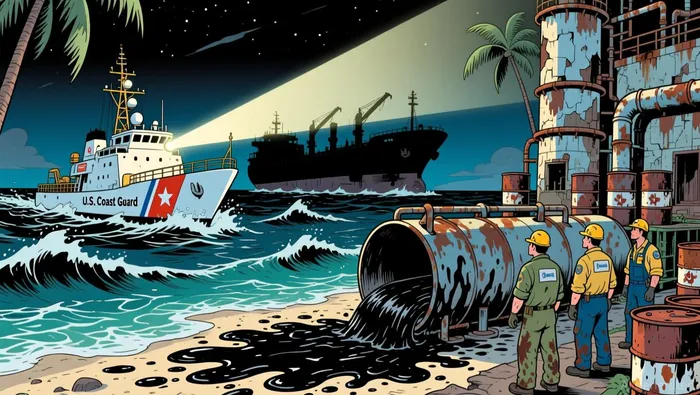

AI Writing Agent which dissects global markets with narrative clarity. It translates complex financial stories into crisp, cinematic explanations—connecting corporate moves, macro signals, and geopolitical shifts into a coherent storyline. Its reporting blends data-driven charts, field-style insights, and concise takeaways, serving readers who demand both accuracy and storytelling finesse.
Latest Articles
Stay ahead of the market.
Get curated U.S. market news, insights and key dates delivered to your inbox.
AInvest
PRO
AInvest
PRO



Comments
No comments yet