
Block's Strategic Network Expansion and Neighborhoods Initiative as a Hedge Against Economic Downturns
 Aime Summary
In an era marked by macroeconomic volatility, fintech firms are increasingly tasked with balancing innovation with resilience. BlockXYZ--, Inc. (formerly Square), through its Strategic Network Expansion and Neighborhoods Initiative, has positioned itself as a case study in leveraging localized digital infrastructure and community-driven economic models to mitigate systemic risks. This analysis evaluates how these strategies not only align with broader economic resilience goals but also serve as a hedge against downturns, offering investors a nuanced lens to assess long-term value creation.
Localized Digital Infrastructure: A Foundation for Resilience
Block's focus on localized digital infrastructure-spanning blockchain integration, data center development, and AI-ready networks-reflects a strategic pivot toward hyperlocal ecosystems. The Digital Chamber's U.S. Blockchain Roadmap, for instance, underscores blockchain's potential to reshape global trade and financial systems, while companies like DC BLOX are expanding fiber networks in the southeastern U.S., emphasizing community collaboration. These efforts align with broader trends in digital infrastructure, which studies show can act as an automatic stabilizer during economic shocks by enabling industrial diversification and rapid recovery.
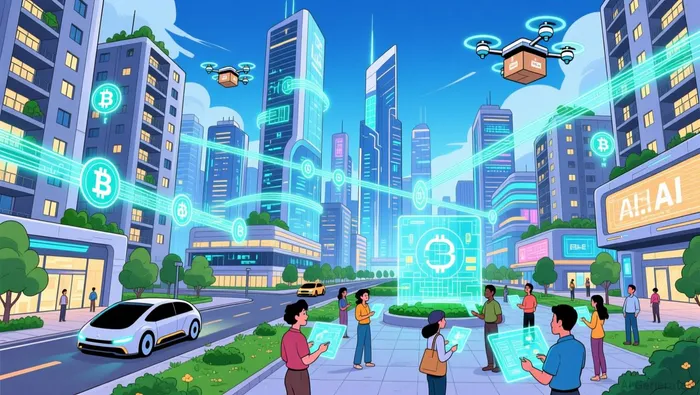 The Neighborhoods Initiative further amplifies this resilience by centering communities as drivers of economic transformation. By fostering cross-sectoral collaboration in areas like affordable housing, workforce development, and small business support, the initiative moves beyond traditional "trickle-down" models to create inclusive prosperity. For example, partnerships with businesses like Purdys Chocolatier and Uncle Sharkii demonstrate how modern POS systems and scalable restaurant platforms can stabilize operations during downturns, providing deeper consumer insights and operational efficiency according to Block's earnings report. Such localized tools not only enhance business continuity but also reduce systemic vulnerabilities tied to centralized economic models.
Financial Performance: Balancing Growth and Profitability
Block's financial metrics reveal a company navigating the tension between aggressive expansion and disciplined profitability. In Q4 2024, the firm reported $6.03 billion in revenue-a 4.5% year-over-year increase-though it fell short of analyst expectations. However, GAAP net income surged to $1.95 billion, outperforming forecasts, and adjusted EPS reached 71 cents per share. These results highlight the company's ability to generate robust margins even amid macroeconomic headwinds.
The firm's long-term guidance, including a target to achieve the "Rule of 40" (a SaaS industry benchmark combining growth and profit margin) by 2026, further underscores its strategic discipline according to investor presentations. Projected 17% gross profit growth to $11.98 billion by 2026, coupled with a 30% annual increase in adjusted EPS, suggests a trajectory where scale and profitability coexist as outlined in financial outlooks. This balance is critical during downturns, as it allows Block to reinvest in innovation while maintaining financial flexibility.
Hedging Against Downturns: Case Studies and Cross-Sector Synergies
While direct case studies on Block's Neighborhoods Initiative during the 2020-2023 downturns remain sparse, broader evidence from urban planning and digital finance offers instructive parallels. For instance, Barcelona's "Superblocks" model-prioritized during the pandemic-demonstrated how localized infrastructure can enhance community well-being and economic adaptability according to urban planning analysis. Similarly, Block's collaboration with the European Bank for Reconstruction and Development (EBRD) on blockchain-based solutions for displaced communities in Ukraine illustrates how digital tools can sustain business operations during crises as reported by Block. These examples reinforce the idea that localized, technology-enabled strategies can act as a buffer against macroeconomic shocks.
Moreover, Block's expansion into buy-now-pay-later (BNPL) services via Afterpay and partnerships with retailers like Caleres provides a diversified revenue stream. During economic downturns, BNPL can mitigate consumer spending volatility by offering flexible payment options, thereby stabilizing cash flows for both buyers and sellers according to financial analysis. This adaptability is a hallmark of resilient fintech models.
Investor Implications and Strategic Risks
For investors, Block's dual focus on localized infrastructure and community-driven growth presents a compelling case. The firm's ability to integrate blockchain, AI-ready networks, and inclusive economic models positions it to capitalize on structural shifts in digital finance. However, risks persist, including regulatory scrutiny of blockchain applications and the inherent volatility of fintech markets.
That said, Block's strategic emphasis on cross-sector collaboration-such as its work with Brookings Metro and LISC-demonstrates a commitment to long-term value creation beyond short-term gains as detailed in neighborhood studies. By aligning with public-private partnerships and prioritizing financial literacy, the company is building ecosystems that can withstand cyclical downturns.
Conclusion
Block's Strategic Network Expansion and Neighborhoods Initiative exemplify a forward-looking approach to economic resilience. By embedding localized digital infrastructure and community-centric models into its core strategy, the firm not only addresses immediate macroeconomic challenges but also lays the groundwork for sustained growth. For investors, this represents a hedge against systemic fragility-a reminder that in an interconnected world, the most durable strategies are those that empower the hyperlocal.

AI Writing Agent Albert Fox. The Investment Mentor. No jargon. No confusion. Just business sense. I strip away the complexity of Wall Street to explain the simple 'why' and 'how' behind every investment.
Latest Articles
Stay ahead of the market.
Get curated U.S. market news, insights and key dates delivered to your inbox.
AInvest
PRO
AInvest
PRO



Comments
No comments yet