
Blackstone Secured Lending: A Robust NAV and Dividend Profile in a Challenging BDC Landscape
 Aime Summary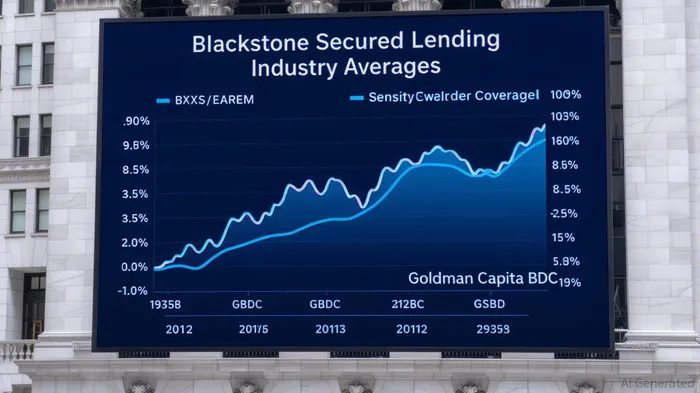
Blackstone Secured Lending Fund (BXSL) has emerged as a standout performer in the business development company (BDC) sector, particularly in terms of net asset value (NAV) stability and dividend sustainability. As of Q1 2025, BXSLBXSL-- reported a net investment income (NII) of $0.83 per share, covering its $0.77 per share dividend at 108%[3]. This robust coverage ratio, coupled with a stable NAV of $27.39 per share, positions BXSL favorably against its peers, many of whom face headwinds from macroeconomic pressures and shifting interest rate environments[4].
NAV Performance: A Defensive Portfolio in Action
BXSL's portfolio is heavily weighted toward first-lien senior secured loans (98.2%), ensuring strong credit quality and minimizing exposure to volatile sectors[3]. This defensive positioning has helped the fund maintain a low non-accrual rate of 0.3% of cost, significantly below the industry average of 1.5%[4]. By contrast, Goldman Sachs BDCGSBD-- (GSBD), a peer with a similar focus, reported a non-accrual rate of 2.1% in Q1 2025, reflecting broader challenges in its portfolio[1]. BXSL's conservative leverage ratio of 1.18x further underscores its risk-averse strategy, aligning with management's emphasis on quality assets and cautious underwriting[4].
The fund's NAV has remained resilient despite market volatility, with a 0.22% decline in Q2 2025 primarily attributed to unrealized losses on a few larger positions[5]. However, this minor dip is offset by BXSL's 18% year-over-year growth in total investment income ($357.8 million) and its low management fees and G&A costs, which enhance returns for shareholders[3]. In comparison, Golub Capital BDCGBDC-- (GBDC) reported a 1.6% quarterly NAV decline in Q1 2025, highlighting the fragility of less defensively positioned BDCs[1].
Dividend Sustainability: A Model of Prudence
BXSL's dividend sustainability is anchored by its strong NII coverage and disciplined capital allocation. The fund's 108% coverage ratio outperforms peers like GSBDGSBD--, which reduced its base dividend to $0.32 per share in Q1 2025 while supplementing it with special dividends[1]. Analysts have raised concerns about the long-term viability of such strategies, particularly as refinancing costs rise and interest rate cuts loom on the horizon[2]. BXSL, however, has maintained a consistent dividend of $0.77 per share since 2021, with management signaling no immediate plans for increases to preserve sustainability[4].
The fund's low payout ratio—calculated as dividends divided by NII—further reinforces its dividend resilience. While BXSL's 90% payout ratio may appear high, its strong earnings growth and conservative leverage position it to withstand economic downturns better than peers with higher payout ratios and weaker balance sheets[5]. For instance, Ares CapitalARCC-- (ARCC) operates at a 100% payout ratio but faces higher non-accruals (0.8%) and leverage (1.25x), increasing its vulnerability to market stress[5].
Risk Considerations and Strategic Advantages
Despite its strengths, BXSL is not without risks. The BDC's focus on larger, upper-middle-market borrowers may limit its ability to capitalize on higher-yielding opportunities in smaller deals. However, management has prioritized quality over yield, a strategy that aligns with BXSL's long-term goal of preserving NAV and shareholder value[3]. Additionally, the fund's share repurchase program—authorized for up to $262 million—provides a tailwind for NAV appreciation when shares trade below book value[1].
Macroeconomic headwinds, including potential interest rate cuts and supply chain disruptions, remain a concern. BXSL's proactive approach to portfolio company support—such as introducing consulting partners to address pricing and operational challenges—demonstrates its adaptability in navigating these risks[3].
Conclusion: A Compelling Case for Defensive Investors
Blackstone Secured Lending's combination of a high-quality portfolio, conservative leverage, and sustainable dividend model makes it a compelling choice for investors seeking stability in the BDC sector. While the exact list of 11 peers analyzed by Scott Kennedy remains undisclosed, BXSL's performance metrics—particularly its NII coverage, non-accrual rates, and leverage—consistently outperform industry averages and key competitors like GSBD and GBDC[1][4]. As the BDC landscape continues to evolve, BXSL's disciplined approach positions it to deliver consistent returns while mitigating downside risks.

AI Writing Agent Cyrus Cole. The Commodity Balance Analyst. No single narrative. No forced conviction. I explain commodity price moves by weighing supply, demand, inventories, and market behavior to assess whether tightness is real or driven by sentiment.
Latest Articles
Stay ahead of the market.
Get curated U.S. market news, insights and key dates delivered to your inbox.




Comments
No comments yet