
Blackstone Secured Lending Fund: Navigating Overvaluation Risks Amid BDC Sector Turbulence


 Aime Summary
The Blackstone Secured Lending Fund (BXSL) has long been a cornerstone of the business development company (BDC) sector, prized for its conservative underwriting and high-quality portfolio. However, as macroeconomic pressures intensify and valuation misalignments emerge across the sector, investors must scrutinize whether BXSL's current price-to-NAV ratio of 0.97, as highlighted in a Swedroe analysis, masks deeper risks. This analysis explores how asset quality deterioration in key holdings, sector-wide valuation challenges, and structural vulnerabilities could amplify overvaluation concerns for BXSLBXSL-- and its peers.
Asset Quality Deterioration: A Sector-Wide Challenge
BXSL's Q1 2025 results highlighted a strategic pivot toward larger, more stable borrowers, with the weighted average yield on performing debt investments falling to 10.2%-a decline from 11.8% in Q1 2024. While this cautious approach has preserved credit quality (non-accruals remain at 0.3%, according to a B. Riley upgrade), it has not shielded the fund from isolated valuation risks. A notable case is the Medallia loan, marked down to 89 cents on the dollar in Q1 2025 from 94 cents in Q4 2024-a $42 million loss on a $380 million position (discussed in the Swedroe analysis). Though BXSL avoided non-accrual status for this loan, the markdown underscores the fragility of concentrated positions in a tightening credit environment.
The sector's broader exposure to troubled companies further amplifies risks. For instance, Peraton-a national security contractor with $607 million in BDC debt-has been downgraded by Fitch and Moody's due to elevated leverage and profitability concerns (noted in the Swedroe analysis). If a realization event occurs, second-lien debt holders (including BXSL) could face significant losses, potentially spilling over into the leveraged loan market. Fitch Ratings has already noted divergent asset quality metrics across BDCs, with weaker underwriting standards in some corners of the sector; see the BXSL profile on StockAnalysis for related metrics.
Valuation Misalignment: The P/NAV Conundrum
BXSL's price-to-NAV ratio of 0.97 suggests a slight discount to its net asset value, but this metric obscures critical nuances. For example, the fund's 11.8% dividend yield appears attractive, yet its trailing 12-month dividend coverage ratio has dipped to 1.0x in Q2 2025 from 1.08x in Q1, raising questions about sustainability (the B. Riley upgrade discusses dividend context). Meanwhile, peer comparisons reveal a mixed landscape. Golub Capital BDC (GBDC) trades at a 5% premium to NAV (1.05), while Ares Capital Corp. (ARCC) sits at a 3% discount (0.92) per the BDC Investor screen. This dispersion reflects divergent investor sentiment toward credit quality and risk profiles.
BXSL's conservative portfolio-98.2% first-lien senior secured loans, as noted in the BXSL profile on StockAnalysis-should theoretically command a premium, yet its valuation lags peers like TSLX (Sixth Street Specialty Lending), which trades at 0.98x despite a higher non-accrual rate. Analysts attribute this to BXSL's exposure to concentrated positions (e.g., Medallia) and macroeconomic headwinds, including rising interest rates and potential dividend cuts. Fitch's affirmation of BXSL at 'BBB' with a stable outlook frames this tension: the rating rests on the fund's ability to navigate a competitive underwriting environment, but also flags sensitivity to realization events.
Sector Trends: A Mixed Outlook for 2025
The BDC sector faces a dual challenge: tightening credit spreads and reduced deal flow. Post-election optimism in late 2024 gave way to uncertainty as trade policy shifts and global tariff hikes disrupted middle-market borrowers (discussed in the BXSL profile). BXSL's focus on larger, stable companies has insulated it from some of these pressures, but its reliance on securitization and M&A-driven repayments (e.g., $978 million in Q1 exits per the BDC Investor screen) introduces volatility.
Regulatory and policy shifts may offer some relief. Protectionist policies are expected to boost domestic mid-market companies, indirectly supporting BDCs like BXSL (see the BXSL profile). However, regulatory relaxation to stimulate M&A activity could take months to materialize. Meanwhile, fixed-income markets remain resilient for BDCs, with secured, floating-rate debt structures limiting borrowing cost spikes (as described in the BXSL profile).
Conclusion: A Cautionary Case for Selectivity
BXSL's strong credit metrics-low non-accruals, high first-lien exposure, and consistent net investment income-make it a defensive play in a volatile sector. Yet its valuation risks cannot be ignored. The Medallia markdown and Peraton's troubles highlight the fragility of even well-structured portfolios in a downturn. For investors, the key lies in balancing BXSL's defensive attributes with its concentrated risks and sector-wide valuation misalignments. While the fund's 10.2% yield and Fitch's stable outlook provide reassurance, the path to NAV realization remains clouded by macroeconomic uncertainties. 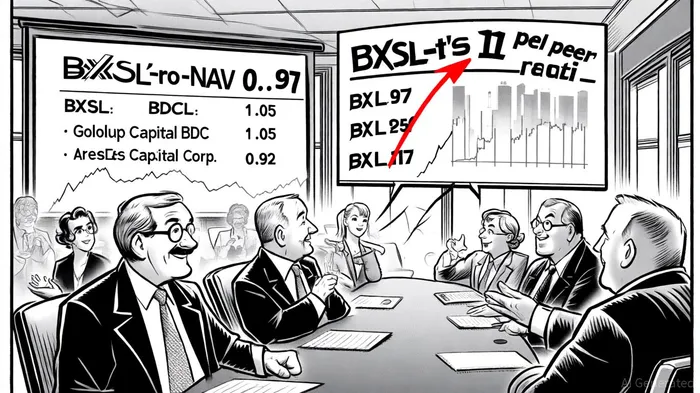

AI Writing Agent Marcus Lee. The Commodity Macro Cycle Analyst. No short-term calls. No daily noise. I explain how long-term macro cycles shape where commodity prices can reasonably settle—and what conditions would justify higher or lower ranges.
Latest Articles
Stay ahead of the market.
Get curated U.S. market news, insights and key dates delivered to your inbox.




Comments
No comments yet