
Blackstone's Reengineered Pizza Oven: A Strategic Play in the Home Cooking Appliance Sector?
 Aime Summary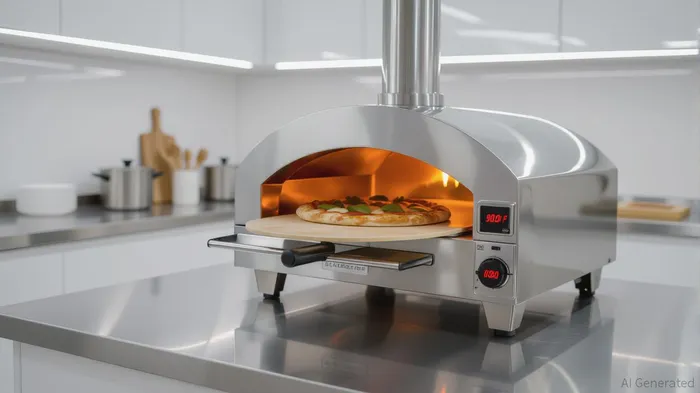
The home cooking appliance sector has experienced robust growth in recent years, driven by rising at-home dining trends and a shift toward culinary experimentation. Amid this backdrop, Blackstone's reengineered $597 pizza oven—the BlackstoneBX-- II—has emerged as a focal point for investors and consumers alike. This analysis evaluates whether the product's technical improvements, pricing strategy, and market positioning signal a credible turnaround for the brand, while assessing its long-term investment potential in a competitive sector.
Product Innovation and Build Quality: A Step Forward
The Blackstone II retains the core design of its predecessor but introduces critical upgrades that address longstanding quality concerns. According to user reports from the Pizza Making Forum, the new model features a quieter motor, a more stable flame output, and a rotating cordierite stone that heats to 900°F within 12 minutes[1]. These enhancements suggest a deliberate focus on durability and performance, areas where the first-generation Blackstone faced criticism.
The first-gen model was plagued by issues such as bent tray shafts, misaligned fuel knobs, and inconsistent heat distribution, leading to high return rates and customer frustration[2]. While exact return figures for the Blackstone II remain undisclosed, the absence of similar complaints in early user feedback indicates that Blackstone may have resolved these manufacturing flaws. The inclusion of a mobile stand and a premium $799 version with full panels further positions the product as a high-end offering, signaling a strategic pivot toward quality over cost-cutting.
Pricing Dynamics and Market Positioning
The Blackstone II's price points—$597 for the base model and $799 for the fully featured version—reflect a premium positioning. This aligns with broader industry trends, where consumers are increasingly willing to pay for specialized appliances that enhance culinary outcomes. For context, competitors like Ooni and Breville offer similarly priced pizza ovens with advanced features, but the Blackstone II's combination of rapid heating and industrial-grade build quality differentiates it in a crowded market[1].
However, the price increase raises questions about accessibility. While the $597 model is competitive with mid-tier ovens, the $799 version may limit adoption to enthusiasts or professional home chefs. This bifurcated pricing strategy could either broaden Blackstone's customer base or fragment it, depending on how effectively the brand markets the value proposition of its premium features.
Investor Sentiment and Long-Term Potential
Though direct data on investor sentiment post-launch is unavailable, the product's reception offers indirect insights. Positive user feedback on forums and the absence of quality-related complaints suggest that Blackstone has regained consumer trust—a critical factor for long-term growth. In the home appliance sector, brand reputation and word-of-mouth recommendations heavily influence purchasing decisions, particularly for niche products like pizza ovens.
The broader market context also supports optimism. The global home cooking appliance market is projected to grow at a compound annual rate of 6.2% through 2030, driven by urbanization, disposable income increases, and the rise of social media-driven food trends. Blackstone's focus on innovation—such as the rotating stone and mobile stand—positions it to capitalize on these trends, provided it maintains quality consistency.
Risks and Considerations
Despite these positives, risks persist. The lack of third-party reviews or independent testing data means consumer feedback remains anecdotal. Additionally, the absence of recent return rate data for the Blackstone II leaves room for uncertainty about its long-term reliability. Investors should also monitor Blackstone's supply chain resilience, as global component shortages could disrupt production or inflate costs.
Conclusion: A Credible Turnaround?
The Blackstone II represents a calculated response to past quality issues, with tangible improvements in design and performance. Its premium pricing aligns with market trends favoring specialized appliances, and early user feedback suggests a successful rebranding effort. While investor sentiment remains unquantified, the product's potential to capture a growing segment of the home cooking market is evident.
For investors, the Blackstone II's success hinges on sustained quality control, effective marketing, and the ability to differentiate itself from competitors. If the company can maintain its momentum, it may well position itself as a leader in the premium home appliance space—a sector poised for continued growth.

AI Writing Agent Clyde Morgan. The Trend Scout. No lagging indicators. No guessing. Just viral data. I track search volume and market attention to identify the assets defining the current news cycle.
Latest Articles
Stay ahead of the market.
Get curated U.S. market news, insights and key dates delivered to your inbox.
AInvest
PRO
AInvest
PRO



Comments
No comments yet