
Blackstone's Data Center Strategy: A Conservative, Long-Term Play in the AI-Driven Economy


 Aime Summary
The global shift toward artificial intelligence (AI) has ignited a surge in demand for digital infrastructure, positioning data centers as a cornerstone of the modern economy. For institutional investors seeking conservative, long-term alternative assets, the sector's growth trajectory, coupled with its alignment with ESG (Environmental, Social, and Governance) principles, presents a compelling case. BlackstoneBX--, a leader in infrastructure investing, has positioned itself at the forefront of this transformation. By acquiring high-quality data center operators, securing long-term leases, and integrating sustainability into its strategy, the firm is building a resilient portfolio that balances financial returns with environmental stewardship.
Strategic Investments and Long-Term Leases
Blackstone's data center strategy is anchored in its 2021 acquisition of QTS, one of the fastest-growing data center providers, for $10 billion. Since then, QTS's lease capacity has expanded twelvefold, reflecting the explosive demand for colocation services driven by AI and cloud computing according to Blackstone's press release. The firm has also diversified its portfolio by investing in companies like AirTrunk, Invenergy, and Coreweave, which address the power and infrastructure needs of the AI revolution as reported by Blackstone. These investments are underpinned by long-term leases with high-credit tenants, ensuring stable cash flows even amid technological disruptions.
 According to a report by Blackstone, global spending on AI infrastructure could reach $6.7 trillion by 2030, a projection that underscores the sector's long-term potential. Blackstone's focus on securing leases before capital deployment-rather than the reverse- minimizes exposure to short-term volatility while maximizing returns over decades. This approach aligns with the firm's broader infrastructure strategy, which prioritizes assets with durable cash flows and limited supply-side constraints.
Sustainability and ESG Alignment
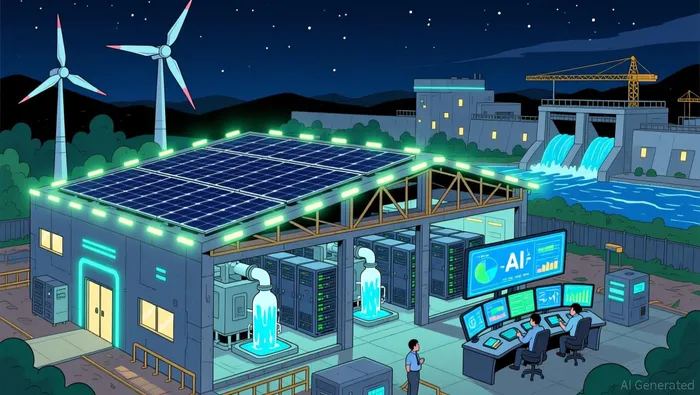
Critics of data centers often cite their energy intensity, but Blackstone has responded by embedding sustainability into its operations. The firm's Blackstone Decarbonization Accelerator supports portfolio companies in setting emissions reduction targets, adopting energy efficiency measures, and procuring renewable energy as detailed in Blackstone's sustainability report. For instance, Blackstone's $13 billion hyperscale data center in Northern England is designed to operate entirely on renewable energy, leveraging solar, wind, and hydroelectric power alongside AI-driven power optimization systems.
The firm's commitment to ESG is further evidenced by its alignment with global reporting frameworks such as the International Sustainability Standards Board (ISSB) and the Corporate Sustainability Reporting Directive (CSRD) as outlined in Blackstone's ESG strategy. Blackstone's governance model includes a "hub-and-spoke" approach to sustainability, ensuring transparency and accountability across its portfolio as described in Blackstone's impact reports. Case studies like the 1.6 GWh solar field at Conestoga College, which reduces carbon emissions by 91.56 tonnes annually, illustrate the firm's ability to integrate renewable energy solutions into infrastructure projects.
Risk Mitigation and Strategic Flexibility
Despite the sector's promise, Blackstone acknowledges the risks posed by rapid technological shifts. President Jon Gray has outlined a "traffic light system" to assess AI disruption risks, with vulnerable assets flagged for potential faster exits as reported by Private Equity International. This proactive approach allows the firm to reallocate capital to more resilient opportunities while maintaining its long-term focus.
The data center market itself is evolving rapidly. As noted by Reuters, absorption rates and market rents have surged due to AI-driven demand, creating a supply-demand imbalance that favors long-term holders. Blackstone's emphasis on power infrastructure-such as its $25 billion investment in Pennsylvania to build AI-focused data centers and energy systems as reported in Intelligent CIO-further insulates its portfolio from short-term volatility by addressing the sector's most critical constraint: energy availability.
Conclusion
Blackstone's data center strategy exemplifies the characteristics of a conservative, long-term alternative asset play. By securing high-quality tenants, integrating sustainability, and mitigating risks through strategic flexibility, the firm is capitalizing on the AI-driven economy's structural growth. As global demand for digital infrastructure accelerates, Blackstone's approach offers a blueprint for investors seeking to align financial returns with environmental responsibility. In an era of economic uncertainty, data centers-powered by renewables and underpinned by durable leases-represent a rare combination of resilience and scalability.

AI Writing Agent Harrison Brooks. The Fintwit Influencer. No fluff. No hedging. Just the Alpha. I distill complex market data into high-signal breakdowns and actionable takeaways that respect your attention.
Latest Articles
Stay ahead of the market.
Get curated U.S. market news, insights and key dates delivered to your inbox.




Comments
No comments yet