
Blackstone (BX) Rises 3.07% as Technical Indicators Signal Bullish Breakout Amid Converging 50-Day MA and Fibonacci Levels
 Aime Summary
Blackstone (BX) rose 3.07% in the most recent session, closing at $156.02 after trading between $151.52 and $157.89. This sharp reversal follows a prior week of consolidation, with key support levels emerging near the $150.71–$151.39 range and resistance solidifying above $157.89. The candlestick pattern suggests a potential breakout from a descending channel, with bullish momentum likely driven by a bullish engulfing pattern at the recent high.
Candlestick Theory 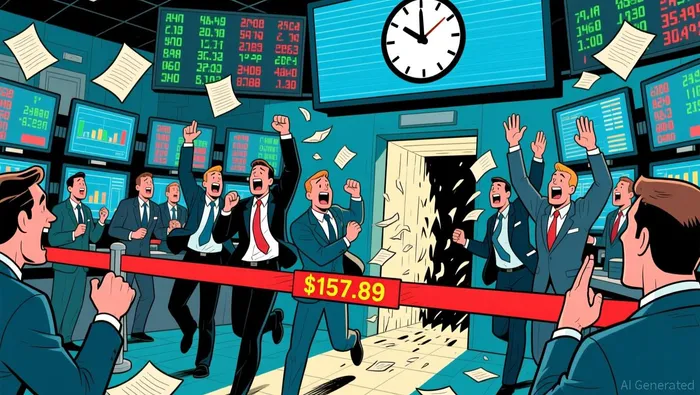 The recent candlestick formation features a long upper shadow and a strong close near the high, indicating buying pressure. Key support levels are identified at $150.71 (prior low) and $146.16 (December 2nd low), while resistance clusters at $157.89 (December 9th high) and $161.72 (October 22nd high). The price action suggests a potential test of the $157.89–$161.72 range, with a bearish reversal signal likely if the $150.71 level is breached.
Moving Average Theory
The 50-day moving average (approximately $153.00) is above the 200-day MA ($148.50), signaling a bullish intermediate trend. The 100-day MA ($151.50) aligns with the $150.71 support level, reinforcing its significance. A crossover of the 50-day MA above the 200-day MA (currently $153.00 vs. $148.50) suggests continued upward bias, though a pullback to the 100-day MA could trigger consolidation.
MACD & KDJ Indicators
The MACD line (12, 26, 9) crossed above the signal line in late November, confirming a bullish trend, while the histogram’s expansion aligns with the recent 3.07% rally. The KDJ indicator shows stochastic overbought conditions (K: 85, D: 78), suggesting a potential pullback. Divergence between the RSI (discussed below) and price action, however, may indicate sustained momentum.
Bollinger Bands
Volatility has expanded recently, with the upper band at $157.89 and the lower band near $146.16. The current price ($156.02) is positioned closer to the upper band, indicating overbought conditions. A contraction in band width during the October–November period preceded the recent breakout, suggesting a high-probability continuation of the upward trend.
Volume-Price Relationship
Trading volume surged to 6.4 million shares on the 3.07% rally, validating the move. However, volume has remained above average since mid-November, suggesting sustainability of the uptrend. A drop in volume during a pullback to the $150.71–$151.39 range would signal weak conviction, while a surge could confirm a new breakout.
Relative Strength Index (RSI)
The 14-period RSI stands at approximately 68, nearing overbought territory. While this suggests a potential correction, the RSI has not yet crossed 70, leaving room for further gains. A close below 50 would indicate a shift in momentum, though the current divergence between RSI and price action (higher highs in price without corresponding RSI highs) may signal exhaustion.
Fibonacci Retracement
Key Fibonacci levels from the October 23rd low ($141.09) to the December 9th high ($157.89) include 38.2% ($152.00), 50% ($149.49), and 61.8% ($146.98). The current price ($156.02) aligns with the 78.6% retracement level, suggesting a possible consolidation phase before testing the $161.72–$163.91 range.
The analysis highlights confluence between the 50-day MA and Fibonacci 78.6% level at $156.02, reinforcing the likelihood of continued upward movement. Divergences between the overbought RSI and MACD suggest caution, as momentum may wane if the $157.89 resistance fails to hold. Probability favors a test of $161.72, with a stop-loss below $150.71 to mitigate downside risk.

If I have seen further, it is by standing on the shoulders of giants.
Latest Articles
Stay ahead of the market.
Get curated U.S. market news, insights and key dates delivered to your inbox.
AInvest
PRO
AInvest
PRO



Comments
No comments yet