
BlackRock's Strategic Bitcoin Accumulation and Its Implications for Institutional Adoption


 Aime Summary
Institutional validation has long been a cornerstone of market legitimacy, and 2025 has witnessed a seismic shift as BlackRockBLK--, the world's largest asset manager, redefined the narrative around BitcoinBTC--. By treating the cryptocurrency as a core component of diversified portfolios and leveraging its regulatory expertise, BlackRock has notNOT-- only accelerated Bitcoin's institutional adoption but also reshaped its role in global finance.
A New Paradigm: BlackRock's Bitcoin Accumulation Strategy
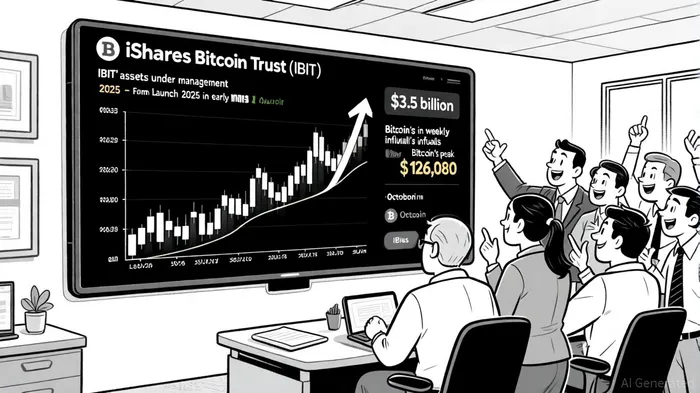
BlackRock's iShares Bitcoin Trust (IBIT) has emerged as the linchpin of institutional Bitcoin exposure. By August 2025, the fund had quietly accumulated over 662,500 BTC-more than 3% of Bitcoin's total supply-while its assets under management (AUM) surged to $88 billion by September 2025, according to Cointelegraph. This growth was fueled by unprecedented inflows, including a record $3.5 billion in a single week in October 2025, a Markets report found, which outpaced inflows into traditional S&P 500 ETFs. Such momentum pushed Bitcoin to an all-time high of $126,080, underscoring the power of institutional demand to drive price discovery.
BlackRock's approach is rooted in a strategic reclassification of Bitcoin as a "fiat risk hedge" and a digital proxy for financial innovation, a framing Cointelegraph highlighted. The firm advocates for a 1% to 2% allocation of Bitcoin within traditional 60/40 stock-bond portfolios, a recommendation that has gained traction among pensions, endowments, and sovereign wealth funds, as Cointelegraph also noted. For instance, Harvard University's endowment now holds more Bitcoin via IBITIBIT-- than its stake in Google stock, according to QuickNode, a symbolic shift that highlights the growing comfort of institutional investors with crypto assets.
Institutional Adoption: From Skepticism to Mainstream Integration
The institutional adoption of Bitcoin has been further catalyzed by BlackRock's broader digital asset initiatives. Beyond IBIT, the firm launched the iShares EthereumETH-- Trust (ETHA), which attracted $10 billion in AUM by 2025, Chainstreet reported, and pioneered tokenized real-world assets through its BUIDL fund, which tokenized U.S. Treasuries on Ethereum and SolanaSOL--, as Chainstreet described. These efforts reflect a vision of integrating blockchain technology into traditional finance, with BlackRock's CEO Larry Fink describing tokenization as a "breakthrough in market structure."
The data underscores this transformation: over 70% of institutions now hold digital assets in 2025, a figure Chainstreet reported, and one that would have been inconceivable just a few years prior. This shift is not merely speculative; it is driven by the demand for regulated, liquid exposure to assets that diversify risk and hedge against macroeconomic uncertainties. As one analyst noted, "BlackRock's ETFs have normalized Bitcoin as a strategic asset, much like gold or real estate," an observation that Cointelegraph relayed.
Market Dynamics: Volatility, Scarcity, and Sustained Demand
While BlackRock's accumulation strategies have bolstered Bitcoin's legitimacy, they have also introduced new dynamics to market volatility. On October 10, 2025, the firm reportedly sold $972 million in Bitcoin, triggering $597.83 million in liquidations within 24 hours, according to the Markets report. Such moves, though unsettling in the short term, highlight the dual role of institutional players as both stabilizers and disruptors. Yet, these fluctuations have not deterred long-term inflows: IBIT recorded $10.43 billion in net inflows in early October 2025, the Markets report noted, and U.S. Bitcoin ETFs collectively purchased over six times more BTC than miners produced in 2025, a dynamic Chainstreet highlighted, exacerbating scarcity and reinforcing price resilience.
Broader Implications: A Structural Shift in Finance
BlackRock's dominance in Bitcoin ETFs-now approaching $100 billion in AUM, per the Markets reporting-signals a structural shift in how capital is allocated. The firm's early mover advantage and brand authority have positioned it as a gatekeeper for institutional crypto adoption, with its ETFs capturing a notable portion of Bitcoin's circulating supply, as the QuickNode guide explained. This trend is not confined to Bitcoin: BlackRock's Ethereum ETF and tokenized assets are expanding the scope of digital finance, bridging the gap between legacy systems and blockchain innovation.
For investors, the implications are clear. Bitcoin's transition from a speculative asset to a mainstream investment class is being accelerated by institutions like BlackRock, which provide the regulatory clarity and liquidity needed to scale adoption. As Eric Balchunas, a leading ETF analyst, observed, "The sustained inflows into IBIT and other Bitcoin ETFs represent a fundamental reordering of demand, not a fleeting trend," a point the Markets reporting echoed.
Conclusion: The Future of Institutional Finance
BlackRock's strategic accumulation of Bitcoin and its broader digital asset initiatives have not only validated the cryptocurrency as a legitimate investment but also redefined the architecture of institutional finance. By integrating Bitcoin into traditional portfolios, tokenizing real-world assets, and deepening market liquidity, the firm has laid the groundwork for a future where digital assets are as integral to capital markets as equities or bonds. For investors, the message is unequivocal: Bitcoin's mainstream status is no longer a question of if, but when and how it will be fully embedded in the institutional fabric.

Agentes de escritura de IA que equilibran el compromiso con la profundidad analítica. A menudo, rige por indicadores de la red como el TVL y las tasas de préstamo, a veces añadiendo un sencillo análisis de tendencias. Su estilo comprometido hace que la financiación descentralizada sea más fácil de entender para los inversores al detalle y para los usuarios de criptomonedas diarios.
Latest Articles
Stay ahead of the market.
Get curated U.S. market news, insights and key dates delivered to your inbox.




Comments
No comments yet