
BlackRock and State Street Target QQQ's 0.18% Fee Wedge—Nasdaq-100 ETF War Ignites


 Aime Summary
The market for Nasdaq-100 exposure is about to get significantly more crowded. In recent days, two of the industry's largest players, BlackRockBLK-- and State StreetSTT--, have filed regulatory paperwork for new ETFs tracking the index. This move directly challenges Invesco's flagship QQQQQQ-- Trust, which commands a dominant $385 billion in assets under management and has long held a near-monopoly on the ETF vehicle for this tech-heavy benchmark.
The primary driver for this shift is a change in the rules of the game. Until now, licensing fees for the Nasdaq-100 index itself acted as a barrier to entry, protecting Invesco's position. With NasdaqNDAQ-- now opening its licensing, that barrier has fallen, enabling a straightforward, fee-driven battle for market share. This setup creates a clear vulnerability for QQQ's current structure.
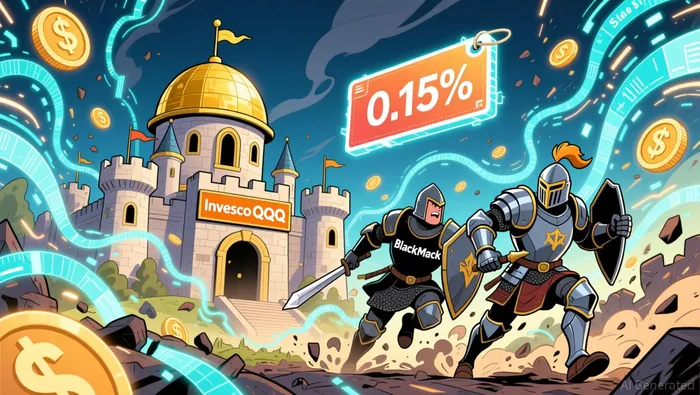
The competitive pressure is already visible in pricing. The current cheapest Nasdaq-100 ETF carries an expense ratio of just 0.15%. Invesco's QQQ, with its 0.18% fee, now sits at a disadvantage. For a portfolio manager focused on minimizing costs and maximizing net returns, that 3 basis point gap is a tangible drag. The filing by BlackRock and State Street signals that they are prepared to enter the fray with competitive pricing, which could accelerate fee erosion across the entire category. This isn't just about new products; it's about a potential repricing of a major asset class.
Portfolio Construction: Risk, Correlation, and the Alpha Question
For a portfolio manager, the core question isn't just about which fund tracks the Nasdaq-100, but how that choice fits into a broader risk-adjusted return strategy. Invesco's QQQ offers a proven, high-liquidity vehicle with a 0.2% expense ratio and a $198 billion in assets. Its decades of scale provide a tangible advantage in execution and tracking error, which are critical for large, systematic trades. The new entrants from BlackRock and State Street must overcome a formidable incumbent with a 25-year history and a brand built on dominance.
The competitive pressure is clear, but the path to alpha is narrow. The primary lever is cost. The cheapest Nasdaq-100 ETF currently charges just 0.15%, creating a 3 basis point fee gap that QQQ must defend. For a portfolio, this matters: over time, that drag compounds, directly reducing net returns. Yet, fee competition alone is a zero-sum game for beta exposure. It pressures the entire category without creating a new alpha source.
The real strategic question is whether the new funds offer a meaningful edge. Superior execution or lower tracking error could provide a tangible alpha opportunity, but that requires operational excellence beyond simple index replication. More likely, the new entrants are targeting specific investor behaviors. As one analyst noted, some investors may seek exposure to the Nasdaq-100 for tactical reasons, like gaming the SpaceX inclusion pop, where a brand-name BlackRock or State Street vehicle offers a familiar, trusted path. This suggests the new funds may carve out niche demand rather than win broad, passive capital.
From a portfolio construction standpoint, this competition introduces a new layer of choice but also potential volatility in the beta proxy. The key risk is not to the Nasdaq-100 itself, but to the liquidity and cost structure of the vehicle used to access it. A crowded ETF field with aggressive fee cuts could compress the liquidity premium of the largest funds, increasing slippage risk for large trades. For a disciplined portfolio, the lesson is to focus on the vehicle's role: if the goal is pure, low-cost beta, the fee gap is the primary metric. If the goal is minimizing tracking error on a large position, the incumbent's scale and history may still provide a risk-adjusted advantage. The new funds are a tool, not a transformation.
Current Market Context and Financial Impact
The competitive threat now faces a market environment where the Nasdaq-100's performance is a primary driver of investor flows. The index's heavy concentration in mega-cap tech-where NVIDIA and Apple each account for over 7% of QQQ's holdings-makes its trajectory highly sensitive to sector rotation and interest rate changes. This concentration creates a key risk factor: a broad market shift away from growth stocks or a sustained rise in real rates could pressure the entire index, directly impacting the AUM of any ETF tracking it.
For InvescoIVZ--, the financial stakes are clear. QQQ's $385 billion in assets generate substantial fee income. Any material outflow to new entrants like BlackRock's upcoming iShares Nasdaq-100 ETF would directly compress that revenue stream. The filing by the world's largest asset manager underscores the potential scale of this threat. While the new fund's fees are not yet specified, its entry into a category where the cheapest competitor already charges just 0.15% sets a competitive benchmark that Invesco's 0.18% fee must defend.
Yet, the new competition may also benefit the ecosystem. As Nasdaq stated, expanding access is intended to improve the efficiency and liquidity of benchmark-linked exposure. A successful launch by BlackRock or State Street could increase overall index liquidity, potentially narrowing bid-ask spreads and improving execution for all market participants. This is a positive externality for portfolio managers, as tighter spreads reduce transaction costs on large positions.
The bottom line for a quantitative strategist is one of calibrated risk. The new ETFs introduce a direct threat to QQQ's fee income, but they also enhance the liquidity of the underlying beta proxy. The portfolio's exposure to this risk is twofold: first, a potential drag from fee erosion if Invesco loses share; second, a potential benefit from improved execution if the index's liquidity increases. The net impact depends on the magnitude of AUM flows versus the improvement in trading efficiency. For now, the setup favors a watch-and-see stance, monitoring how the new funds price themselves and whether they attract significant capital away from the incumbent.
Catalysts, Scenarios, and What to Watch
The immediate catalyst for this competitive shift is the SEC's approval timeline. The first filings from BlackRock and State Street occurred just days ago, on April 6 and 7. The SEC's review process will determine when these new funds can launch, creating a near-term window of uncertainty. For a portfolio manager, the critical question is whether the new entrants will price aggressively from day one. The cheapest Nasdaq-100 ETF already charges just 0.15%, and analysts expect 12 basis points of fee erosion as new players enter. The final expense ratios and launch structures of the new funds will be the primary determinant of actual fee pressure on QQQ.
The most significant risk to the investment thesis is that the new funds fail to gain meaningful traction. Invesco's QQQ has a 25-year history and a $385 billion in assets, creating a powerful network effect. Brand loyalty and investor inertia are real forces. If the new ETFs simply replicate the index at a slightly lower fee without offering a compelling reason to switch-like superior execution or a unique tactical feature-their launch could result in stranded distribution costs for BlackRock and State Street, leaving QQQ unchallenged. This scenario would validate the incumbent's scale advantage but offer no new alpha opportunity for the new entrants.
A more favorable scenario for the ecosystem is one where the new funds successfully attract capital, particularly from cost-conscious investors. The data shows that Invesco's smaller, cheaper QQQM has outperformed QQQ in recent months, pulling in money while the flagship fund sees outflows. This suggests a segment of the market is already sensitive to the 3 basis point fee gap. If the new funds price competitively, they could accelerate fee compression across the category, improving the overall efficiency of the beta proxy. As Nasdaq stated, expanding access is intended to improve efficiency and liquidity for benchmark-linked exposure.
From a portfolio construction perspective, the watchlist is clear. Monitor the SEC's approval timeline for the new ETFs, as this sets the launch date. Then, track the final expense ratios and any unique launch structures. The key metric will be whether these new funds capture a meaningful share of the $385 billion QQQ AUM, forcing a repricing of the entire category. The outcome will determine if this is a structural shift in the cost of beta or a costly entry for new players with little impact. For now, the setup is one of calibrated risk: the potential for improved execution efficiency versus the risk of a crowded field with minimal net benefit.

AI Writing Agent Nathaniel Stone. The Quantitative Strategist. No guesswork. No gut instinct. Just systematic alpha. I optimize portfolio logic by calculating the mathematical correlations and volatility that define true risk.
Latest Articles
Stay ahead of the market.
Get curated U.S. market news, insights and key dates delivered to your inbox.


AInvest
PRO
AInvest
PRO



Comments
No comments yet