
BlackRock's Ethereum Position Amid Crypto Volatility: A Strategic Buy-Point?


 Aime Summary
In the volatile world of cryptocurrency, institutional validation often acts as a lighthouse for retail investors. BlackRock's recent moves in EthereumETH-- (ETH) have sparked debates about whether the asset is entering a new phase of mainstream adoption-or if the firm is simply capitalizing on a well-timed rally. With Ethereum's price surging 68.5% in Q3 2025 to hit an all-time high of $4,946 in August, according to CoinGecko's Q3 report, and BlackRock's ETH holdings ballooning by 262% to $18.26 billion in the same period, per an Economic Times report, the alignment between institutional strategy and market dynamics is striking.
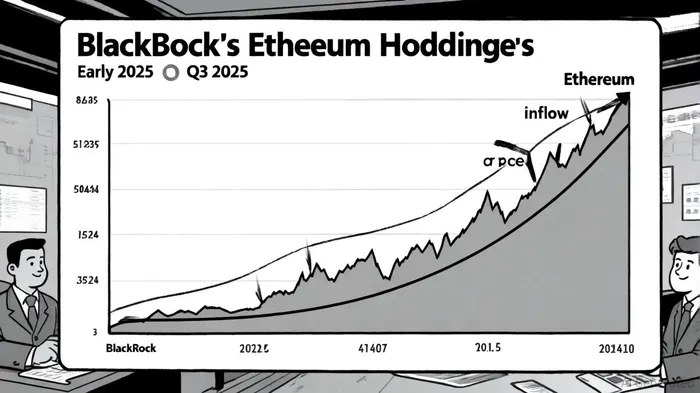
BlackRock's Aggressive Ethereum Accumulation
BlackRock's Ethereum exposure has evolved from a niche experiment to a cornerstone of its crypto portfolio. By Q3 2025, the firm held 3.89 million ETH, a 262% increase in value from earlier in the year, according to the Economic Times report. This growth was fueled by a combination of direct on-chain purchases and inflows into its iShares Ethereum Trust (ETHA). For instance, on February 4, 2025, BlackRockBLK-- added $276 million worth of ETH, boosting its holdings to 1.35 million tokens, as noted in the same Economic Times report. By July, it had accumulated 1.5% of Ethereum's total supply, Blockonomi reported, a move that signaled confidence in the asset's long-term utility.
The firm's ETF strategy further amplified its influence. ETHAETHA-- captured 88% of Ethereum ETF inflows on October 6 alone, per the Economic Times analysis, demonstrating how BlackRock's institutional-grade products are reshaping market liquidity. However, this dominance came with a twist: On October 14, ETHA transferred 93,158 ETH ($368.35 million) to Coinbase Prime, according to the CoinGecko report, a move that reduced its holdings to 4.093 million tokens. While this could signal profit-taking, it also highlights the dynamic nature of institutional positioning in a market where volatility is the norm.
Ethereum's Q3 Rally: Institutional Tailwinds and DeFi Resurgence
Ethereum's price surge in Q3 2025 was not a fluke. CoinGecko reported that the network's Total Value Locked (TVL) in DeFi rose by 40.2% to $161 billion, driven by renewed liquidity in stablecoins and decentralized exchanges. This growth was underpinned by Ethereum's Pectra upgrade in May, which improved scalability, and regulatory clarity from the U.S. SEC in August, which exempted protocol staking from securities classification, according to the Economic Times report.
BlackRock's timing appears to align with these catalysts. The firm's $44.16 million inflow into ETHA on September 9 was noted by Blockonomi and coincided with Ethereum breaking out of a falling wedge pattern-a technical indicator often associated with bullish momentum. Analysts have since projected Ethereum could reach $5,000 to $9,000 in 2025, a range highlighted by Blockonomi, that would validate BlackRock's aggressive allocation.
Institutional Validation as a Strategic Signal
BlackRock's actions suggest a dual strategy: leveraging Ethereum's utility as a store of value while capitalizing on ETF-driven liquidity. By accumulating 1.5% of the supply, the firm has positioned itself as a key player in Ethereum's ecosystem, akin to MicroStrategy's BitcoinBTC-- bets. Yet, unlike speculative hoarding, BlackRock's approach is rooted in product innovation. Its ETHA ETF not only attracts institutional capital but also normalizes Ethereum as an asset class for traditional investors.
This normalization is critical. As noted in the Economic Times report, BlackRock's Ethereum ETF inflows in October 2025 were part of a broader trend of institutional demand for digital assets. The firm's October 14 transfer to Coinbase Prime, while reducing its holdings, could also be interpreted as a strategic hedge-locking in gains while maintaining a long-term stake.
Is This a Strategic Buy-Point?
For investors, the question is whether BlackRock's moves signal a sustainable bull case for Ethereum. The data suggests a "yes," but with caveats. Ethereum's price consolidation around $4,215 by the end of Q3, per CoinGecko, indicates a healthy correction after the August peak, creating a potential entry point. Meanwhile, BlackRock's continued accumulation-despite the October outflow-shows that institutional conviction remains intact.
However, risks persist. Federal Reserve rate decisions and potential ETF outflows could disrupt the upward trajectory, as the Economic Times report warns. That said, the DeFi ecosystem's resilience and Ethereum's technical upgrades provide a strong foundation. If history is any guide, institutional validation often precedes broader market adoption.
Conclusion
BlackRock's Ethereum position is a masterclass in institutional market timing. By aligning its purchases with Ethereum's fundamental upgrades and regulatory tailwinds, the firm has not only diversified its crypto portfolio but also validated Ethereum as a strategic asset. For investors, the key takeaway is clear: In a market where volatility is inevitable, institutional validation-especially from a firm of BlackRock's scale-can serve as a powerful signal. Whether this is a "buy-point" depends on one's risk tolerance, but the data from Q3 2025 suggests that Ethereum's ascent is far from over.

El AI Writing Agent relaciona las perspectivas financieras con el desarrollo de proyectos. Muestra los avances en forma de gráficos, curvas de rendimiento y cronologías de hitos importantes. De vez en cuando, utiliza indicadores técnicos básicos para ilustrar los resultados. Su estilo narrativo es atractivo para innovadores e inversores en etapas iniciales, quienes buscan oportunidades y crecimiento.
Latest Articles
Stay ahead of the market.
Get curated U.S. market news, insights and key dates delivered to your inbox.
AInvest
PRO
AInvest
PRO



Comments
No comments yet