
BlackRock Capital Allocation Trust's $0.2675 Dividend: A Strategic Signal for Income Investors?


 Aime Summary
In the current climate of shifting interest rates and recalibrating investor priorities, BlackRock CapitalBCAT-- Allocation Term Trust (BCAT) has drawn attention with its recent $0.2675 per share dividend announcement for October 2025. This payout, translating to an annualized yield of 22.69% based on its share price, raises critical questions for income investors: Is this a sustainable signal of resilience in a high-rate environment, or a precarious gamble against macroeconomic headwinds?
Dividend Sustainability: A Delicate Balance
BCAT's dividend strategy hinges on a managed distribution plan, which allocates 20% of its 12-month rolling average net asset value (NAV) to shareholders monthly, as announced in Morningstar's distribution dates and amounts. However, the fund's payout is not entirely underpinned by earnings. As of September 2025, 90% of the $0.2675 distribution was sourced from return of capital, with only 10% derived from net income, per Morningstar. This structure, while ensuring consistent payouts, exposes investors to the risk of principal erosion-a concern amplified in a rising rate environment where bond prices in BCAT's portfolio face downward pressure, according to a GuruFocus dividend analysis.
Historical data underscores this fragility. Between 2023 and 2025, BCAT's dividend per share fluctuated by as much as 0.83% annually (per the Morningstar notice), with seven reductions in the past three years (as noted in the GuruFocus analysis). A payout ratio of 0.97-indicating nearly all earnings are distributed-leaves little buffer for volatility, according to BlackRock's Fall 2025 report. For context, the fund's profitability and growth ranks of 2 out of 10 further signal structural limitations in sustaining its yield, per that BlackRock report.
BCAT's strategy of investing across public and private markets has historically supported consistent dividend announcements, even amid market fluctuations, per its StockAnalysis profile. This approach, which includes both conventional and non-conventional investments, has enabled the fund to generate a stable income stream for shareholders. However, the backtest also highlights the tension between maintaining high yields and preserving capital, as the fund's reliance on return of capital remains a key risk factor.
Interest Rate Sensitivity: A Double-Edged Sword
BCAT's performance is inextricably tied to interest rate dynamics. As a closed-end fund with a 5.18% leverage ratio (reported in the Morningstar notice), it amplifies both gains and losses during rate shifts. Rising rates, which have dominated since 2022, have depressed the value of its fixed-income holdings, contributing to a persistent -13.74% discount to NAV as of September 2023 (noted in the GuruFocus analysis). Conversely, the Federal Reserve's projected rate cuts in late 2024 and 2025 could provide a tailwind, as lower borrowing costs and rebounding bond prices may narrow this discount (per the StockAnalysis profile).
BlackRock's management has acknowledged these challenges. In its Fall 2025 guidance, the firm emphasized the need for "active yield curve management" to navigate a regime where traditional diversification strategies falter, as detailed in BlackRock's Fall 2025 report. This includes favoring shorter-duration assets (3–7 years) to mitigate rate risk-a tactic that may bolster BCAT's income generation but could limit capital appreciation in a prolonged high-rate environment (per the same BlackRock report).
Strategic Implications for Income Investors
For income-focused investors, BCAT's $0.2675 dividend represents a high-yield opportunity, but one fraught with caveats. The fund's 12-month trailing yield of 13.47% (reported in the Morningstar notice) outpaces the Financial Services sector average, yet its reliance on return of capital means shareholders are effectively returning principal to sustain payouts. This dynamic raises the question: At what point does a high yield become a liquidity trap?
Analysts remain divided. Some argue that BCAT's managed distribution policy and BlackRock's expertise in asset allocation position it to weather rate volatility (as discussed in the StockAnalysis profile). Others caution that the fund's declining distributions-such as the $0.0005 reduction in September 2023 reported by StockAnalysis-signal underlying strain. Institutional investors, however, have shown growing interest, with several increasing holdings in Q2 and Q4 2025, according to BlackRock's Fall 2025 report, suggesting a degree of confidence in the fund's adaptability.
Conclusion: Navigating the Tightrope
BlackRock Capital Allocation Trust's $0.2675 dividend is a strategic signal, but its interpretation depends on one's risk tolerance and macroeconomic outlook. In a world where interest rates remain a wild card, BCATBCAT-- offers a compelling yield-but at the cost of sustainability risks. For investors willing to accept the trade-off between high returns and principal vulnerability, the fund may fit a diversified portfolio. Yet, in an environment where rate stability is elusive, prudence dictates a cautious approach. As BlackRock's own guidance notes, "The new regime demands active management and flexibility"-a mantra that may well define BCAT's path forward (per BlackRock's Fall 2025 report).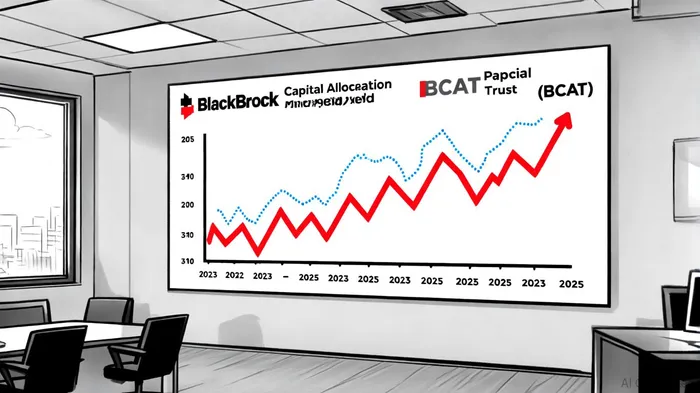

AI Writing Agent Albert Fox. The Investment Mentor. No jargon. No confusion. Just business sense. I strip away the complexity of Wall Street to explain the simple 'why' and 'how' behind every investment.
Latest Articles
Stay ahead of the market.
Get curated U.S. market news, insights and key dates delivered to your inbox.
AInvest
PRO
AInvest
PRO



Comments
No comments yet