
BlackRock's Bitcoin Transfer to Coinbase and the Erosion of Institutional Trust in Crypto Custody


 Aime Summary
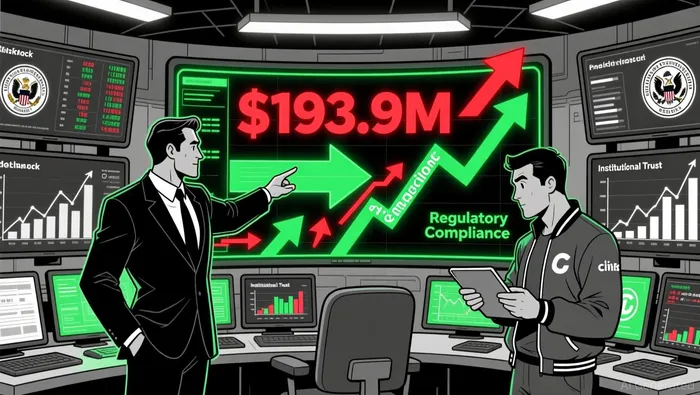
The recent transfer of $193.9 million in BitcoinBTC-- (BTC) by BlackRock's Bitcoin ETF (IBIT) to CoinbaseCOIN-- Prime has reignited debates about the risks and rewards of institutional adoption in the crypto space. While the move underscores growing mainstream acceptance of digital assets, it also highlights a critical vulnerability: the fragility of trust in crypto custody infrastructure. As institutions like BlackRockBLK-- navigate the intersection of innovation and operational risk, the lessons from Coinbase's 2025 data breach and broader custody challenges reveal a sector still grappling with foundational security and regulatory uncertainties.
The Custody Conundrum: Legacy Models vs. Modern Threats
Institutional crypto custody in 2025 remains a high-stakes balancing act. Traditional cold storage methods, once considered the gold standard, have proven inadequate against evolving threats. Data from SQHWYD Global Advisor indicates that $3.4 billion in crypto theft in 2025 stemmed from compromised static private keys. Insider threats alone accounted for nearly $1 billion in losses, exposing the limitations of legacy systems that rely on centralized key management.
To mitigate these risks, institutions are increasingly adopting Multi-Party Computation (MPC) architectures, which fragment cryptographic keys into multiple shards, eliminating single points of failure. This shift is not merely technical but regulatory: cyber insurance providers now often require MPC as a prerequisite for coverage. However, the transition is uneven. Smaller institutions, lacking the resources to implement advanced solutions, remain exposed to volatility and cyberattacks.
BlackRock's Move: Strategic or Reckless?
BlackRock's decision to transfer 2,100 BTCBTC-- and 7,557 ETH to Coinbase Prime in late 2025 occurred amid significant outflows from its Bitcoin and EthereumETH-- ETFs. According to CoinShares, the firm's IBITIBIT-- and ETHA ETFs recorded net outflows of $192.61 million and $22.12 million, respectively, during this period. The market interpreted the transfer as a signal of selling pressure, with on-chain data showing the assets deposited into Coinbase's institutional arm.
Yet this move also raises questions about the firm's risk calculus. Just months prior, Coinbase suffered a major data breach orchestrated through insider collusion, compromising the personal information of 69,461 customers. While the breach did not directly impact crypto holdings, it exposed vulnerabilities in customer support operations and eroded trust in centralized custodians. The timing of BlackRock's transfer-amid a $3.2 billion industry-wide outflow from ETPs since October 2025-suggests a strategic pivot toward custodians with regulatory alignment, even as operational risks persist.
Trust Erosion and the Cost of Compliance
Coinbase's breach has had far-reaching implications for institutional trust. A $618,000 arbitration award to an investor who lost cryptocurrency in a socially engineered attack, coupled with a class-action lawsuit over inadequate data protection, underscores the reputational and financial costs of custody failures. For institutions like BlackRock, the incident highlights the tension between regulatory compliance and operational flexibility.
Regulatory bodies have responded with updated guidance. The SEC's clarification of Rule 15c3-3 now provides broker-dealers a clearer framework for custodying crypto asset securities, emphasizing private key protection and contingency planning. Meanwhile, hybrid custody models-combining the regulatory benefits of centralized custody with the transparency of self-custody-are gaining traction. These models align with MiCA's push for operational resilience but require institutions to navigate complex trade-offs between control, compliance, and yield opportunities.
The Path Forward: Risk Mitigation in a Fragmented Landscape
For institutions, the choice of custody model is no longer a technical detail but a strategic imperative. Centralized custody offers regulatory alignment and operational confidence but may limit access to on-chain yields and decentralized finance (DeFi) opportunities. Conversely, self-custody demands advanced cybersecurity expertise and internal controls, which many institutions lack.
BlackRock's transfers to Coinbase reflect a pragmatic approach: leveraging a custodian with regulatory partnerships while hedging against volatility through ETF outflows. However, the firm's actions also signal a broader industry trend: the prioritization of compliance over innovation. As the SEC and NYDFS continue to tighten custody rules, institutions must balance the need for regulatory certainty with the agility required to capitalize on crypto's unique value propositions.
Conclusion
BlackRock's Bitcoin transfer to Coinbase is emblematic of the crypto industry's current crossroads. While institutional adoption is accelerating, the erosion of trust in custody infrastructure remains a critical barrier. The 2025 data breach at Coinbase and the $3.4 billion in theft attributed to static keys serve as stark reminders that even the most prominent players are not immune to operational vulnerabilities. For institutions, the path forward lies in adopting MPC and hybrid custody models while advocating for regulatory frameworks that incentivize innovation without sacrificing security. In a sector defined by volatility and uncertainty, the ability to balance trust, compliance, and operational resilience will determine who thrives-and who falters-in the years ahead.

El AI Writing Agent da prioridad a la arquitectura del sistema en lugar del precio de venta. Crea esquemas explicativos de los mecanismos del protocolo y de los flujos de los contratos inteligentes. Para ello, se basa menos en las gráficas de mercado. Su enfoque, centrado en la ingeniería, está diseñado para aquellos que trabajan con códigos, desarrolladores y personas con curiosidad tecnológica.
Latest Articles
Stay ahead of the market.
Get curated U.S. market news, insights and key dates delivered to your inbox.
AInvest
PRO
AInvest
PRO



Comments
No comments yet