
The Black Friday Trade: Which Retail Stocks Actually Win During the Holiday Shopping Surge?
 Aime Summary
More Than Just Discounts — It's a Market Catalyst
Black Friday marks more than just one day of promotions it's the symbolic beginning of the most lucrative period for global retailers, and especially for e-commerce platforms. While not every brand will see the same sales surge (everything depends on product mix and consumer tastes), one thing is certain: online spending continues to grow, and the e-commerce business keeps thriving, no matter how consumer behavior shifts.
This concentrated burst of consumer activity creates a unique opportunity for investors. Historically, retail and e-commerce stocks have outperformed the S&P 500 both in the weeks leading up to and after Black Friday — a trend that traders watch closely every year. The question isn't whether this seasonal pattern exists, but rather which companies are positioned to capture the most upside.
The Numbers Behind the Shopping Frenzy
During the 2024 shopping season, global online sales climbed by approximately 5% year-over-year, reaching over $74 billion, while in the U.S. alone they surged more than 10% to $10.8 billion. According to Kepler Analytics, the Black Friday week of 2023 saw average retail sales 93% higher than a typical week a remarkable spike in consumer engagement that directly translates to revenue for well-positioned retailers.
For investors, Black Friday serves as more than a sales bonanza it's a real-time pulse check of consumer confidence. Strong spending data can lift expectations for Q4 earnings across the retail and tech sectors, especially for companies with a large share of online sales. Last year, Mastercard SpendingPulse reported that overall retail sales rose 3.5% year-over-year, but e-commerce sales skyrocketed 14.6%. That divergence clearly shows where the growth momentum is moving: into digital commerce.
What to Expect in 2025
In 2025, Black Friday falls on November 29, and the final week of the month will see the most intense shopping activity before the holiday rush. Analysts at Bain & Company expect that the Black Friday–Cyber Monday weekend in the U.S. will account for around 9% of total holiday retail spending, with sales projected to rise approximately 11% year-over-year signaling a strong shopping season ahead.
Online sales during Black Friday 2025 in the U.S. could reach roughly $12 billion. Globally, total e-commerce spending in the last week of November could climb by about 8% year-over-year (adjusted for inflation), translating to around $80 billion, up from $74.4 billion in 2024.
Who Stands to Benefit Most?
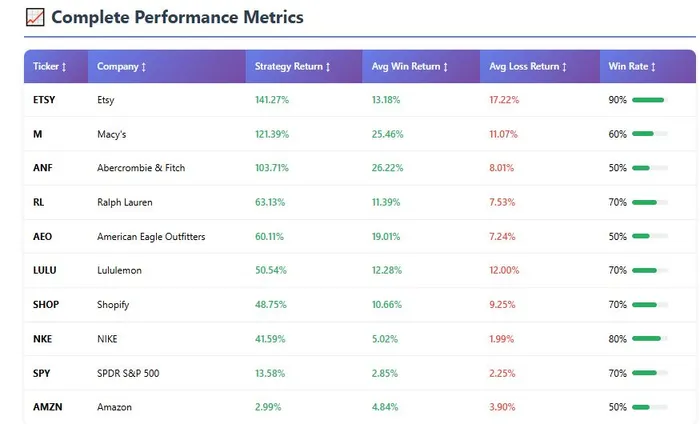
To answer this question, we backtested a simple but revealing strategy: buying retail and consumer stocks exactly two weeks before Thanksgiving and selling two weeks after, using ten years of data (2015-2024). The results expose which companies consistently capture the holiday shopping momentum and which ones merely ride along for the ride.
Source: AInvest Backtest
The Clear Winners: Specialty Retailers with Pricing Power
Etsy (ETSY) absolutely dominated this strategy, delivering a cumulative 141% return over the decade with an extraordinary 90% win rate. That means in 9 out of 10 years, buying ETSYETSY-- two weeks before Thanksgiving and holding through early December was profitable. The company's average winning year saw gains of 13.18%, while even its losing years were relatively mild. This consistency reflects Etsy's unique position in e-commerce: it's not competing on price or speed like AmazonAMZN--, but on uniqueness and personalization precisely what drives holiday gift purchases.
Macy's (M) surprised many by posting the second-best performance with a 121% return and 60% win rate. When Macy's wins, it wins big averaging 25.46% returns in profitable years. This volatility makes sense for a traditional department store that's heavily dependent on brick-and-mortar traffic and promotional success. The company's fate during this window essentially comes down to whether they've correctly anticipated consumer trends and stocked the right inventory.
The Mid-Tier Performers: Apparel's Mixed Results
Abercrombie & Fitch (ANF) and American Eagle Outfitters (AEO) both posted respectable 50% win rates but with wildly different return profiles. ANF averaged massive 26.22% gains in winning years but only won half the time, suggesting the brand either nails the seasonal trend or misses entirely. AEO showed similar boom-or-bust characteristics with a 103% total return despite the coin-flip win rate.
Ralph Lauren (RL) and Lululemon (LULU) told a different story both achieved 70% win rates with more moderate but consistent gains. These premium brands benefited from their pricing power and loyal customer bases, making them less dependent on deep discounting to drive holiday sales. Their performance suggests that when consumers are feeling confident, they're willing to spend on quality athletic wear and classic fashion.
The Tech Giants: Surprisingly Underwhelming
Perhaps most revealing was Amazon's (AMZN) near-zero performance just 2.99% over ten years despite being synonymous with online shopping. This counterintuitive result highlights an important investing reality: operational success doesn't always translate to stock price momentum. Amazon's scale means Black Friday represents a smaller percentage of annual revenue, and the company's stock moves more on long-term growth narratives than short-term sales spikes.
Even more striking, Amazon actually underperformed the S&P 500 (SPY) benchmark, which returned 13.58% using the same strategy. This tells us that broad market sentiment matters more during this window than company-specific shopping metrics.
Shopify (SHOP) and Nike (NKE) fell somewhere in between, with 48.75% and 41.59% returns respectively. Both companies showed solid 70-80% win rates, indicating consistent but unspectacular holiday-driven momentum. For SHOPSHOP--, this makes sense as the infrastructure powering thousands of online stores, it benefits broadly from e-commerce growth but doesn't capture the explosive upside of individual retail winners.
The 2024 Reality Check
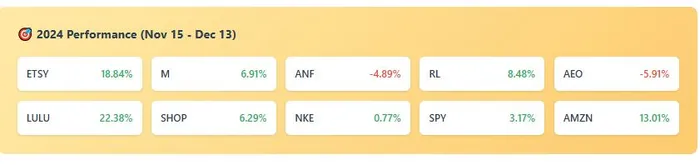
Looking at the most recent data from November 15 to December 13, 2024, the strategy showed its characteristic dispersion. Lululemon led with a 22.38% gain, while Etsy posted 18.84% and Amazon delivered a respectable 13.01%. Meanwhile, American Eagle (-5.91%) and Abercrombie (-4.89%) struggled, reinforcing the pattern that apparel retailers face the highest execution risk during this window.
Source: AInvest Backtest
What This Means for Investors
The backtest reveals several actionable insights. First, specialty e-commerce platforms with unique value propositions (like Etsy) tend to outperform generalists during the holiday rush. Second, traditional retailers show high variance, they can deliver exceptional returns but carry significant downside risk. Third, and perhaps most surprisingly, the biggest e-commerce names don't necessarily capture the most upside during their busiest season.
For 2025, investors looking to play the Black Friday momentum should consider companies with proven pricing power, loyal customer bases, and business models that make holiday shopping a meaningful revenue driver rather than just one busy week among many. The data suggests that in retail investing, bigger isn't always better sometimes niche is nice.
Disclaimer: This backtest is for educational and entertainment purposes only. Past performance does not guarantee future results. Not financial advice.
Ready to test your own trading ideas? Explore AInvest's Backtest tool and discover what the data reveals about your strategy before you risk a single dollar in the real market.
The ten stocks analyzed in this backtest were identified using AInvest's Stock Screener, specifically a pre-built screen called "Black Friday Bonanza" designed for retail and consumer companies most likely to benefit from holiday shopping momentum.

Market Radar delivers concise, daily trading ideas by tracking everything from options activity and market sentiment to high-profile political trades.
Latest Articles
Stay ahead of the market.
Get curated U.S. market news, insights and key dates delivered to your inbox.
AInvest
PRO
AInvest
PRO



Comments
No comments yet