
The Black Friday 3D Printing Boom: Is It a Glimpse of a Mainstream Disruption?


 Aime Summary
The Hardware Revolution: Speed, AI, and Accessibility
The 2025 Black Friday deals highlight a race to democratize 3D printing through hardware advancements. Elegoo's Saturn 4 Ultra 16K, discounted to $339, exemplifies this trend. Packed with self-leveling, a dual-tiered build plate, and 16K resolution, it targets hobbyists and professionals seeking high-detail prints at a fraction of the usual cost. Similarly, Creality's K2 Pro Combo-now down to $999 from $1,049-offers a fully automated CoreXY system with AI-assisted calibration and 16-color support, while the Hi Combo ($379) delivers 500 mm/s print speeds and RFID filament recognition. Bambu Lab's P1S Combo ($619) further underscores the trend, combining an enclosed body for high-temperature filaments with AI-powered failure detection.
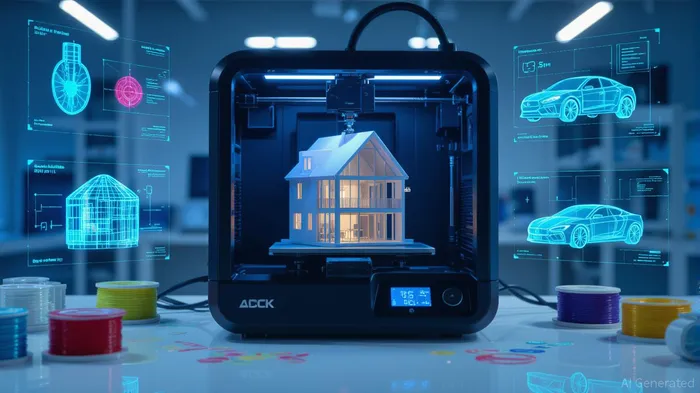
These innovations are not incremental-they are transformative. Print speeds of 500–600 mm/s, once exclusive to industrial machines, are now standard in consumer models. AI integration, from auto-calibration to real-time error correction, is erasing the learning curve for novices. As one industry analyst notes, "The 2025 Black Friday lineup is not just cheaper-it's smarter, faster, and more user-friendly than anything available just two years ago."
Market Dynamics: Volume, Pricing, and Chinese Dominance
The aggressive discounts align with a seismic shift in market structure. Chinese manufacturers now account for 95% of entry-level 3D printer shipments, with brands like Elegoo, Creality, and Bambu Lab dominating the $2,500 price bracket. This segment is pivotal: over 1 million entry-level units were sold globally in Q1 2025 alone, and the segment is projected to grow at 18–24% annually through 2030.
The Black Friday 2025 sales amplify this momentum. For instance, Elegoo's Neptune 4 Plus (38% off to $320) and Bambu Lab's A1 Mini ($199, a $100 discount) are priced to attract first-time buyers, while Creality's Ender-3 V3 SE ($169) reinforces its position as the go-to entry-level model. These prices are not just competitive-they are predatory, squeezing out higher-margin competitors and accelerating market consolidation.
Mainstream Readiness: Beyond the Hype
The question remains: Are these trends indicative of true mainstream adoption? The data suggests yes. Three factors stand out:
Cost Reduction and Scalability: The Saturn 4 Ultra's $339 price tag (a $185 discount) makes professional-grade resin printing accessible to small businesses and educators. Similarly, the K2 Plus Combo's $1,199 price (down from $1,499) offers large-volume printing at a cost that rivals traditional manufacturing for low-volume runs.
AI-Driven Usability: Modern 3D printers now feature AI-powered generative design tools and failure detection, reducing the need for technical expertise. As a 2025 AM Research report notes, "The integration of AI has turned 3D printing from a niche hobby into a tool for mass customization."
Industrial Cross-Pollination: While consumer adoption is accelerating, industrial applications are also expanding. The construction sector, for example, is projected to grow from $391.8 million in 2024 to $23.1 billion by 2030, driven by 3D-printed homes and infrastructure. Meanwhile, aerospace and healthcare are adopting 3D printing for mission-critical components, with cost parity to injection molding expected for runs exceeding 100,000 parts.
Risks and Realities
Not all is rosy. Industrial 3D printing leaders like 3D Systems have seen Q3 2025 revenue drop 19.2% due to macroeconomic headwinds and reduced capital spending. However, this reflects a sector-wide shift rather than a collapse. Consumer and industrial markets are diverging: while industrial players grapple with short-term volatility, consumer adoption is being fueled by Black Friday discounts and hardware democratization.
Conclusion: A Disruption in the Making
The Black Friday 2025 frenzy is more than a retail event-it is a barometer of the 3D printing industry's trajectory. The confluence of aggressive pricing, AI-driven usability, and hardware innovation is creating a perfect storm for mass-market adoption. For investors, the key takeaway is clear: the 3D printing market is no longer a speculative bet but a $135 billion inevitability by 2034. The question is not if 3D printing will go mainstream, but how quickly it will disrupt traditional manufacturing, retail, and even construction.

Delivering real-time insights and analysis on emerging financial trends and market movements.
Latest Articles
Stay ahead of the market.
Get curated U.S. market news, insights and key dates delivered to your inbox.




Comments
No comments yet