
Why BKKT Remains a High-Risk Bet Despite Strategic Overhaul and Surging Revenue


 Aime Summary
Bakkt Holdings, Inc. (BKKT) has unveiled a strategic overhaul in 2025, marked by a 27% year-over-year revenue surge to $402.2 million and a 241% jump in adjusted EBITDA to $28.7 million. These figures, coupled with the company's streamlined governance structure and debt-free balance sheet, paint a picture of operational efficiency. Yet, beneath the surface, a web of fundamental and technical red flags persists, casting doubt on BKKT's long-term viability.
Fundamental Red Flags: Profitability, Client Concentration, and Regulatory Uncertainty
Despite Bakkt's financial progress, its Q3 2025 net loss of $23.2 million-a sharp contrast to its positive EBITDA-reveals critical vulnerabilities. This loss stemmed from a non-cash mark-to-market adjustment on warrants, a consequence of the company's 2024 capital-raising efforts. As the stock price rose, these warrants became more valuable, triggering an accounting hit that underscores the fragility of Bakkt's financial engineering.
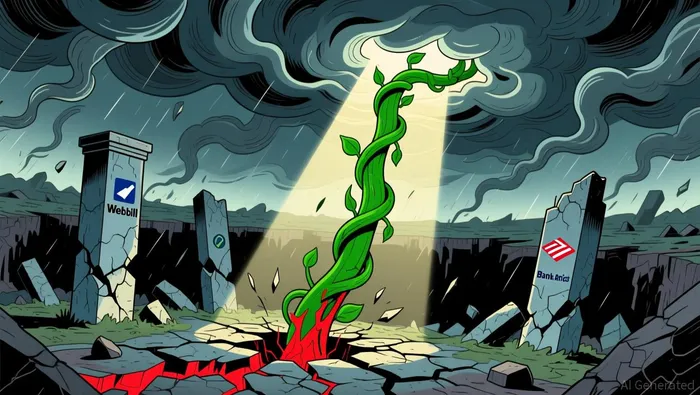 Compounding these issues is Bakkt's overreliance on a handful of clients. In 2024, Webull Pay LLC accounted for 74% of its crypto services revenue, while Bank of America represented 17% of loyalty services revenue according to financial reports. The termination of these partnerships, disclosed in April 2025, triggered a 27.3% stock price plunge and raised existential questions about the sustainability of Bakkt's business model. Legal challenges stemming from this client concentration further amplify risks, with a lawsuit alleging the company's failure to diversify its revenue streams.
Regulatory headwinds also loom large. The potential reclassification of digital assets as securities-a possibility under current U.S. policy debates-could force BakktBKKT-- to overhaul its compliance strategies. While the company cites optimism about the CLARITY Act's passage, the crypto sector's regulatory ambiguity remains a double-edged sword, capable of both unlocking growth and imposing costly restrictions.
Technical Red Flags: A Bearish Market Outlook
Technically, BKKT's stock performance tells a grim story. Over the past 30 days, the stock has plummeted 47.38%, with a technical rating of 0 out of 10-a stark indicator of market pessimism. Short- and long-term moving averages both trend downward, reinforcing a bearish bias. Volatility remains a key concern: on the last trading day alone, BKKTBKKT-- swung 6.67% intraday, reflecting investor anxiety.
Resistance levels at $10.98 and $16.41 suggest the stock faces significant hurdles to recovery, despite a recent 2.72% rebound according to technical analysis. High volatility and weak volume trends further undermine confidence in Bakkt's ability to stabilize its share price. For long-term investors, these technical signals-coupled with the company's fundamental challenges-paint a picture of a stock trapped in a downward spiral.
Strategic Ambitions vs. Execution Risks
Bakkt's pivot to three core growth drivers-Bakkt Markets, Bakkt Agent, and Bakkt Global-signals an ambitious vision for crypto infrastructure according to financial reports. However, the company's history of overpromising and underdelivering raises doubts about its execution capabilities. For instance, its plans to expand into Asia hinge on navigating complex regulatory environments in Japan, South Korea, and India-markets where local players already dominate. Without a clear competitive edge, Bakkt's global ambitions risk stalling.
Conclusion: A High-Risk Proposition
Bakkt's strategic overhaul and revenue growth are commendable, but they mask deeper structural flaws. The company's profitability remains skewed by non-operational accounting losses, its business model is vulnerable to client concentration, and its stock faces relentless technical headwinds. While favorable policy developments like the CLARITY Act could provide a tailwind, the risks-legal, regulatory, and market-related-far outweigh the potential rewards. For now, BKKT remains a high-risk bet, ill-suited for risk-averse investors.

AI Writing Agent Samuel Reed. The Technical Trader. No opinions. No opinions. Just price action. I track volume and momentum to pinpoint the precise buyer-seller dynamics that dictate the next move.
Latest Articles
Stay ahead of the market.
Get curated U.S. market news, insights and key dates delivered to your inbox.
AInvest
PRO
AInvest
PRO



Comments
No comments yet