
Bitwise Crypto ETFs Record $100 Million Inflows Amid Debasement Trade
 Aime Summary
- Bitwise U.S. crypto exchange-traded products attracted approximately $100 million in net inflows in a single day, with Solana products leading the demand at roughly $40 million.
- The influx reflects a broader "debasement trade" as investors seek alternative assets, coinciding with U.S. spot BitcoinBTC-- ETFs recording eight consecutive days of net inflows .
- Simultaneously, North American data center construction is shifting toward emerging markets like Missouri and Alberta to secure scalable power for AI infrastructure.
- Google announced a $15 billion investment in Missouri, highlighting the sector's focus on high-density, AI-ready facilities.
Bitwise Investment Management reported a significant surge in capital deployment into its U.S. crypto exchange-traded products, marking a notable moment for institutional interest in digital assets. The firm attracted approximately $100 million in net inflows in a single day, demonstrating renewed appetite for regulated crypto exposure among investors . This activity occurred against a backdrop of Bitcoin's recovery toward $80,000, which has helped stabilize sentiment across the broader digital asset market .
Solana products were the primary drivers of this inflow, accounting for roughly $40 million of the total. The Bitwise Solana Staking ETFBSOL-- (BSOL) recorded its highest trading volume since launch, exceeding $126 million, as the fund continues to expand beyond basic price exposure by staking its holdings . This staking mechanism offers investors a yield component that distinguishes it from simple spot exposure, aligning with the growing demand for yield-generating crypto assets .
Bitcoin products followed with about $22 million in inflows, while Hyperliquid and XRPXRP-- attracted $20 million and $12 million respectively. EthereumETH-- products saw significantly lower inflows of $1.4 million, indicating a divergence in investor preference toward higher-momentum or yield-bearing assets . Bloomberg analyst Eric Balchunas linked this activity to a "debasement trade," noting that gold and Bitcoin funds had attracted a combined $7 billion over five days .
This pivot toward alternative assets suggests that investors are increasingly hedging against currency devaluation and macroeconomic uncertainty. The concurrent strength in both crypto and gold funds underscores a broader shift in portfolio allocation strategies among global investors .
Why Is Solana Outpacing Ethereum in ETF Flows?
The disparity in ETF flows between Solana and Ethereum products highlights a shift in institutional preferences toward assets with active staking ecosystems and higher perceived growth potential. While Ethereum remains a foundational layer, the Solana ecosystem has attracted significant capital due to its high throughput and the ability of funds like BSOLBSOL-- to generate staking rewards .
The Bitwise Solana Staking ETF's trading volume exceeding $126 million indicates strong liquidity and investor confidence in the Solana network's stability and yield generation capabilities. This trend reflects a broader market dynamic where investors are prioritizing assets that offer both capital appreciation and yield .
How Is AI Demand Reshaping Data Center Construction?
Parallel to the crypto market's activity, the North American data center construction market is undergoing a strategic geographic expansion. Operators are moving beyond traditional hubs to regions offering scalable power, available land, and competitive construction costs .
In May 2026, Tract announced three large-scale developments in the Austin-San Antonio corridor representing up to 5.2 GW of planned capacity. Concurrently, Google announced a $15 billion investment in a hyperscale data center campus in New Florence, Missouri, including 500 MW of additional power capacity in collaboration with Ameren .
Canada is also gaining strategic importance due to renewable energy availability, favorable climatic conditions, and growing AI infrastructure demand. Synapse Data Center Inc. proposed a 1 GW campus in Olds, Alberta, underscoring the province's strategic importance .
The global digital infrastructure market is projected to reach $1.96 trillion by 2035, driven by accelerating demand for cloud computing, AI, and hyperscale data centers. This growth is supported by government digital transformation initiatives and low-latency network needs, though constrained by high capital requirements and cybersecurity risks .
Key infrastructure providers such as Schneider Electric, Vertiv, and Eaton are central to this ecosystem, providing essential electrical and mechanical solutions to support high-density AI workloads. The transition to AI-driven workloads creates sustained demand for power-related technologies and services, reshaping the infrastructure landscape .
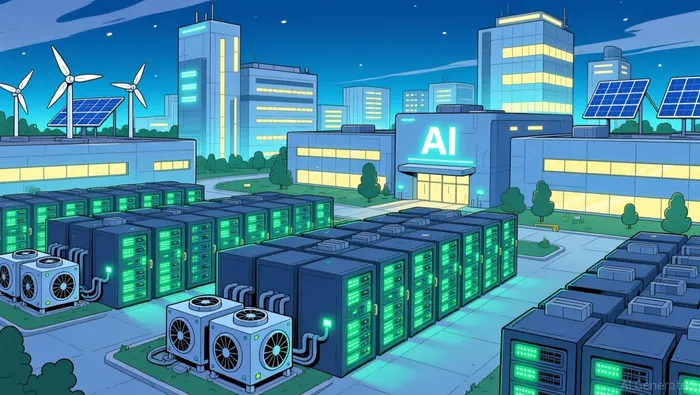
The competitive landscape features prominent operators like Amazon Web Services, Microsoft, Meta, and Equinix, alongside new entrants like Ada Infrastructure and Ardent Data Centers . These companies are increasing competition by developing AI-ready campuses in emerging markets, driving innovation in cooling techniques and power distribution .
The market outlook for data center power from 2025 to 2035 highlights the critical role of infrastructure providers in enabling this transition. The demand for reliable power delivery is intensifying, with operators seeking scalable solutions that can handle peak loads while maintaining efficiency .
This trend is closely linked to the broader expansion of data center construction in North America and globally. As hyperscale developers commit billions to new campuses, the pressure on power infrastructure providers to deliver robust, high-capacity systems increases .

Blending traditional trading wisdom with cutting-edge cryptocurrency insights.
Latest Articles
Stay ahead of the market.
Get curated U.S. market news, insights and key dates delivered to your inbox.


AInvest
PRO
AInvest
PRO




Comments
No comments yet