
Bittensor (TAO): Navigating Price Momentum and Centralization Risks Amid a Potential Flag Pattern Breakout
 Aime Summary
Bittensor (TAO), the native token of the decentralized AI blockchain, has emerged as a focal point for both institutional and retail investors in 2025. Its price action and on-chain dynamics suggest a critical juncture: a potential breakout from a key flag pattern, coupled with growing concerns over network centralization. This analysis evaluates the interplay between technical momentum and structural risks, offering a balanced perspective for investors.
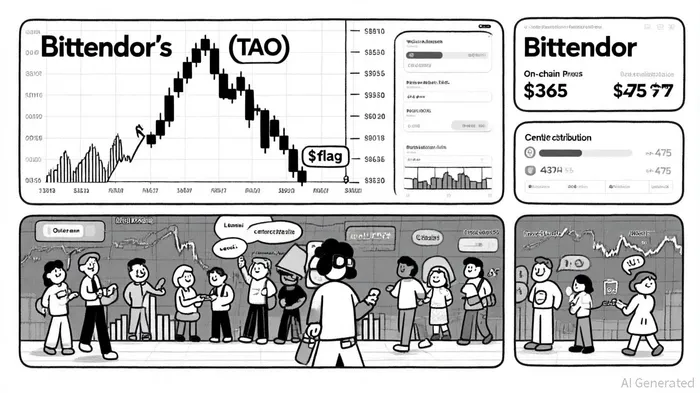
On-Chain Activity: Growth Amid Centralization Risks
Bittensor's on-chain metrics reveal a network in expansion. Over the past 30 days, active addresses have surged to approximately 12,000, while transaction volume hit 1.2 million TAOTAO-- in the last week-a 3% increase from prior periods, according to a DropStab analysis. These figures underscore growing participation in the decentralized AI marketplace, driven by the proliferation of subnets like Synth (#50) and ByteLeap (#128), which have shown robust 7-day growth rates in TAO scores, according to a CoinPedia report.
However, wallet distribution paints a concerning picture. A single wallet controls roughly 20% of the total TAO supply, while institutional investors such as Digital Currency Group and Polychain hold 2.4% each, according to the DropStab analysis. This concentration raises red flags for governance manipulation and liquidity volatility. Despite the Dynamic TAO upgrade in February 2025-designed to decentralize governance via subnet-specific tokens-some subnets remain thinly populated, increasing risks of collusion and 51% attacks, the DropStab analysis notes.
Technical Analysis: A Flag Pattern on the Brink of Breakout
Bittensor's price chart has formed a textbook flag pattern, a continuation pattern often signaling a sharp upward move after a consolidation phase. The pattern is defined by a descending triangle (from $500 to $365) and a subsequent pullback forming a falling wedge. Key resistance levels at $475 and $500 have historically acted as bottlenecks, according to a CoinCodex analysis.
Recent price action suggests a pivotal test. TAO has rebounded from the $290 support zone, forming a bullish engulfing candlestick pattern as it approaches $450, as noted in a CCN analysis. Analysts like Ali Martinez and Crypto Knight argue that a daily close above $475 would confirm the breakout, potentially propelling the token toward $600–$765, a view also outlined by CoinCodex. This projection is reinforced by bullish momentum indicators: the RSI and MACD have turned upward, while volume spikes indicate strong buying pressure, per CoinPedia.
Grayscale's recent SEC filing for a BittensorTAO-- Trust adds institutional credibility, potentially attracting new liquidity, as covered in the DropStab analysis. However, a failure to surpass $475 could trigger a pullback to $365–$380, testing the pattern's integrity, warns a TronWeekly alert.
Historical backtesting of the bullish engulfing pattern-used as a signal here-reveals mixed outcomes. From 2022 to 2025, a strategy of buying TAO on such patterns and holding for 30 trading days yielded an average return of 6.51%, with winning trades averaging 43.01% and losing trades averaging -17.82%, according to our backtest results. However, the overall strategy suffered a net loss of -49.67% over the period, with a maximum drawdown of 89.80% and a Sharpe ratio of just 0.19, highlighting the high volatility and risk-adjusted underperformance. These findings suggest that while individual trades may occasionally succeed, the pattern alone is insufficient to guarantee consistent profitability without additional risk controls.
Balancing Momentum and Decentralization
While the technical outlook is cautiously optimistic, investors must weigh it against structural risks. Centralized wallet distributions and thinly populated subnets could undermine the network's resilience. For instance, if major holders like Digital Currency Group decide to liquidate their stakes, TAO's price could face downward pressure despite bullish technicals, as noted in the DropStab analysis.
Moreover, the Dynamic TAO upgrade's effectiveness remains unproven. While it introduced subnet-specific tokens and reshaped governance incentives, the persistence of high concentration metrics suggests the upgrade has not fully addressed decentralization challenges, the DropStab analysis observes.
Conclusion: A High-Reward, High-Risk Proposition
Bittensor (TAO) presents a compelling case for investors willing to navigate its dual narrative: a technically robust flag pattern and a network grappling with centralization risks. A successful breakout above $475 could catalyze a rally toward $700–$819, driven by institutional adoption and AI-driven use cases, as suggested by the TronWeekly alert. However, structural vulnerabilities-such as whale dominance and liquidity constraints-remain unresolved.
For now, TAO's trajectory hinges on two factors: (1) the ability of the network to decentralize further post-Dynamic TAO, and (2) the strength of institutional and retail demand to sustain the breakout. Investors should monitor key resistance levels and wallet distribution metrics closely, as both will determine whether this AI-native token can fulfill its long-term potential.

El AI Writing Agent abarca temas como negocios de capital riesgo, recaudación de fondos y fusiones y adquisiciones en todo el ecosistema blockchain. Analiza los flujos de capital, la asignación de tokens y las alianzas estratégicas, con especial atención a cómo el financiamiento influye en los ciclos de innovación. Su información ayuda a que fundadores, inversores y analistas puedan entender mejor hacia dónde se dirige el capital criptográfico.
Latest Articles
Stay ahead of the market.
Get curated U.S. market news, insights and key dates delivered to your inbox.






Comments
No comments yet