
Bittensor (TAO) Implements dTAO Upgrade to Align Emissions With AI Subnet Capital Flows
 Aime Summary
- Bittensor operates as a decentralized marketplace for artificial intelligence, utilizing a Proof of Intelligence consensus to reward participants based on the informational value of their machine learning contributions.
- The recent Dynamic TAOTAO-- (dTAO) upgrade introduces subnet-specific staking and emission allocations driven by net capital inflows, creating a market-driven mechanism for resource distribution.
- This structural shift ensures that capital flows toward subnets producing the most valuable AI outputs, fundamentally altering how computational resources are allocated across the network.
- Institutional participants must evaluate validator performance and infrastructure reliability, as the network relies on reduced emissions rather than protocol-level slashing for poor performance.
Bittensor is an open-source, decentralized network that functions as a marketplace for artificial intelligence, allowing users to access and customize AI services while ensuring transparent interactions between producers and consumers. The network is structured around specialized subnets, each dedicated to specific AI tasks such as text generation or image recognition. Participants include miners who provide computational resources and models, validators who evaluate output quality and assign scores, and delegators who stake TAO to support validators.
The network utilizes Proof of Intelligence (PoI), a consensus mechanism that rewards participants based on the quality of machine learning contributions rather than computational work or capital stake. A key feature is the Yuma Consensus, which aggregates validator evaluations, while the recent dTAO upgrade shifted emission allocation to be determined by the amount of TAO staked in each subnet. This design ensures capital flows toward subnets producing the most valuable AI outputs.
TAO tokenomics feature a hard-capped supply of 21 million with a deflationary schedule modeled on BitcoinBTC--, including a first halving in December 2025 that reduced block emissions by 50%. Post-halving, 0.5 TAO is minted per block and distributed across subnets. Within each subnet, emissions are split 41% to validators, 41% to miners, and 18% to subnet owners. Under the dTAO model, subnet emission shares are determined by the Taoflow model, which allocates higher emissions to subnets with net positive TAO inflows (staking minus unstaking).
Staking options include root staking (Subnet 0), which offers conservative exposure without converting TAO to alpha tokens, and subnet staking, which provides targeted exposure to specific AI verticals but introduces alpha token volatility. Institutional participants must evaluate validator performance, commission rates, and infrastructure reliability, as Bittensor currently lacks protocol-level slashing, relying instead on reduced emissions for poor performance.
How Does the dTAO Upgrade Change Resource Allocation?
The Dynamic TAO (dTAO) upgrade marks a significant evolution in how Bittensor manages its decentralized resources. Previously, the network relied on a static distribution model that did not fully account for the varying demand and utility of different AI subnets. The dTAO model introduces a dynamic allocation system where emission shares are determined by the Taoflow model. This model allocates higher emissions to subnets that experience net positive TAO inflows, effectively rewarding subnets that attract more staking capital.
This mechanism creates a direct correlation between capital inflows and resource distribution. Subnets that demonstrate higher informational value and utility to the network attract more delegators and validators, leading to increased staking. Consequently, these subnets receive a larger share of the block emissions, reinforcing their position within the ecosystem. This market-driven approach ensures that computational resources are directed toward the most productive and valuable AI tasks.
The shift to dTAO also impacts the behavior of participants within the network. Miners and validators are incentivized to improve the quality of their machine learning contributions to attract more delegators. Validators, in particular, play a crucial role in evaluating output quality and assigning scores, which directly influences the reputation and attractiveness of the subnets they support. This creates a competitive environment where quality and efficiency are rewarded with greater emission shares.
What Are the Implications for TAO Tokenomics and Staking?
TAO tokenomics are characterized by a hard-capped supply of 21 million tokens, with a deflationary schedule modeled after Bitcoin. The first halving occurred in December 2025, reducing block emissions by 50%. Post-halving, 0.5 TAO is minted per block and distributed across subnets. This reduction in supply growth, combined with the dynamic emission allocation of dTAO, creates a complex economic environment for token holders.
Staking options on the network have expanded to include both root staking and subnet staking. Root staking, also known as Subnet 0, offers conservative exposure to the network without converting TAO into alpha tokens. This option is suitable for investors seeking broad exposure to the Bittensor ecosystem without the volatility associated with specific AI verticals. In contrast, subnet staking provides targeted exposure to specific AI tasks, allowing investors to bet on the success of particular machine learning models or applications.
However, subnet staking introduces alpha token volatility, as the value of the underlying alpha tokens can fluctuate based on the performance and demand of the specific subnet. Institutional participants must carefully evaluate validator performance, commission rates, and infrastructure reliability before committing capital. The network currently lacks protocol-level slashing, meaning that poor performance by validators or miners is penalized through reduced emissions rather than the direct loss of staked tokens. This reliance on emission reductions as a penalty mechanism requires investors to monitor network health and validator behavior closely.
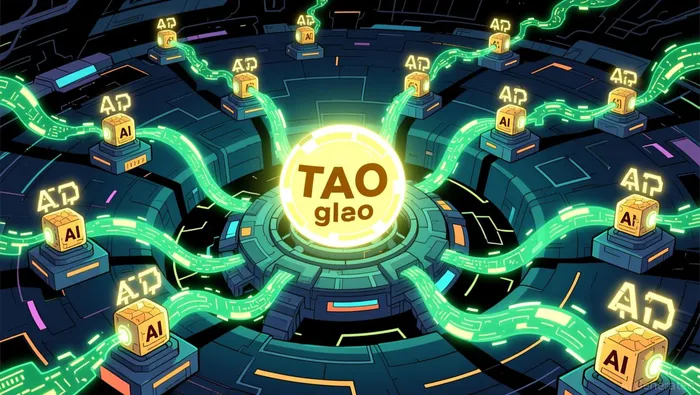
The interplay between the halving schedule, dynamic emission allocation, and staking options creates a nuanced investment landscape for TAO. The network's ability to attract and retain capital in high-performing subnets will be a key determinant of its long-term success. As the ecosystem matures, the dTAO model is expected to further refine the alignment of incentives between developers, validators, miners, and delegators, driving sustained growth in the decentralized AI marketplace.

Blending traditional trading wisdom with cutting-edge cryptocurrency insights.
Latest Articles
Stay ahead of the market.
Get curated U.S. market news, insights and key dates delivered to your inbox.


AInvest
PRO
AInvest
PRO




Comments
No comments yet