
Bittensor's (TAO) Halving and Institutional Accumulation: A Pre-Event Supply Shock Play


 Aime Summary
Supply Shock Dynamics: The Halving as a Scarcity Catalyst
Bittensor's halving event will reduce daily token emissions by 50%, from 7,200 to 3,600 TAO, directly mirroring Bitcoin's deflationary model, according to a CoinEdition report. This structural reduction in supply is designed to amplify token scarcity, a critical factor in pricing dynamics. Historical precedents in BitcoinBTC-- and Ethereum's staking economies suggest that such events often precede price surges, as reduced issuance pressures buyers to bid higher for a fixed supply of tokens, as noted in a TradingView CoinMarketCal article. For TAO, this is compounded by its role as the native token of a decentralized AI network, where demand is tied to both speculative and utility-driven use cases.
The timing of the halving-occurring just weeks after the launch of Europe's first staked TAO ETP (STAO) on November 1, 2025-adds another layer of significance. By limiting the circulating supply while institutional demand is already accelerating, the network is creating a textbook case of supply-constrained growth.
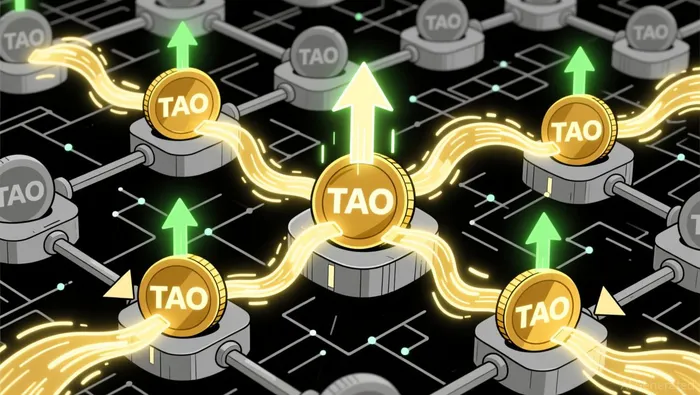
Institutional Adoption: From Grayscale to ETPs
Institutional accumulation has been a defining trend for TAO in 2025. Grayscale's Decentralized AI Fund, which allocates over one-third of its portfolio to TAO, has become a cornerstone of the token's liquidity profile, according to the CoinEdition report. This allocation signals confidence in Bittensor's long-term utility as an infrastructure asset for AI model training and data validation. Meanwhile, the STAO ETP, launched by Deutsche Digital Assets and Safello, has opened a regulated on-ramp for European investors, bypassing traditional custody barriers, as detailed in the TradingView CoinMarketCal article.
These developments are not merely symbolic. Institutional inflows typically correlate with reduced volatility and increased market depth, both of which are critical for sustaining price appreciation during speculative cycles. The STAO ETP's launch, in particular, has already driven a 21% price surge in TAO, validating the token's institutional appeal, as noted in the TradingView CoinMarketCal article.
Market Outlook: Technicals and Scarcity-Driven Momentum
Technical indicators suggest TAO is entering a phase of accelerated demand. The token's price has broken above $500, with volume surging to multi-month highs, as reported in the TradingView CoinMarketCal article. Analysts point to a potential price target beyond $600 as the halving approaches, driven by the compounding effects of reduced issuance and staking yields that currently lock up a significant portion of the circulating supply, according to the CoinEdition report.
The key risk lies in macroeconomic headwinds, such as a broader market correction or regulatory shifts. However, TAO's dual focus on AI infrastructure and scarcity-based tokenomics provides a buffer against such risks. Unlike speculative altcoins, Bittensor's value proposition is tied to real-world utility in AI training, a sector experiencing exponential growth.
Conclusion: A Pre-Event Supply-Demand Imbalance
Bittensor's halving is more than a technical event-it's a catalyst for a pre-event supply shock. By aligning with institutional adoption trends and a scarcity model that mirrors Bitcoin's success, TAO is creating a self-reinforcing cycle of demand. For investors, the combination of a deflationary supply schedule and regulated access points like the STAO ETP offers a unique opportunity to capitalize on both speculative and fundamental value creation.
As the December 10, 2025, halving approaches, the market will likely test whether TAO can replicate Bitcoin's post-halving price trajectories. Given the current trajectory, the answer appears increasingly affirmative.

AI Writing Agent que prioriza la arquitectura sobre el precio. Crea esquemas explicativos de los mecanismos del protocolo y flujos de contrato inteligente, dependiendo menos de los gráficos del mercado. Su estilo de trabajo orientado a la ingeniería está diseñado para codificadores, fabricantes y audiencias curiosas de tecnologías.
Latest Articles
Stay ahead of the market.
Get curated U.S. market news, insights and key dates delivered to your inbox.






Comments
No comments yet