
Bittensor (TAO) Halving Enhances Scarcity and AI Innovation Potential
 Aime Summary
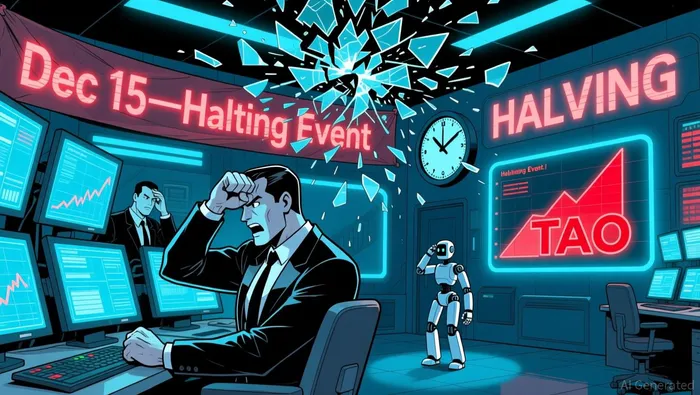
Bittensor's TAOTAO-- token price dropped more than 20% over the past seven days following the halving event on December 15, 2025. This decline contrasts with the typical anti-inflationary expectations where halving events usually lead to price surges. The market had been anticipating this halving, leading to a 'buy the rumor, sell the news' scenario.
The halving event reduced TAO emissions by 50%, effectively halving the annual inflation rate from approximately 25% to 12.5%. This scarcity mechanism is intended to increase the token's value over time by reducing the supply of new tokens entering the market. The dTAO upgrade introduced a performance-based emission model where subnets with higher utility and demand capture a larger share of emissions.
Institutional interest in TAO is also growing. The launch of the first Staked TAO ETP and the pending Grayscale BittensorTAO-- Trust filing indicate increasing recognition of TAO as a digital asset with real-world utility in AI infrastructure.
Why did Bittensor's token price decline post-halving?
The decline in TAO's price post-halving is attributed to broader concerns about AI valuations affecting both high-profile equities and blockchain-based projects. The lack of new AI application launches has made it difficult for Bittensor to recover its 2024 peaks.
The 'buy the rumor, sell the news' effect also played a role. The market had been anticipating the halving, and the price had already incorporated some of the expected benefits, leading to a sell-off once the event occurred.
What innovations does Bittensor's 2025 halving bring to the table?
The halving introduced subnet-specific alpha tokens, which diversify the tokenomics of the Bittensor network and provide liquidity incentives. These tokens support the growth of high-utility projects and ensure they have the necessary resources to scale and succeed.
The dTAO upgrade introduced a performance-based emission model, where subnets with higher utility and demand capture a larger share of TAO emissions. This mechanism is intended to drive innovation and ensure that token distribution aligns with value creation.
Bittensor's upgrades aim to enhance AI intelligence scoring, ensuring that data used for training and inference remains reliable and high quality. The Chutes AI subnet functions as a central hub for fine-tuned models and uses a performance-verification metric called GraVal to ensure legitimacy in model inference.
What are the challenges Bittensor faces post-halving?
Despite the innovations, Bittensor faces challenges such as volatility and liquidity constraints. High staking yields, while attractive, come with inherent risks in the volatile crypto market. Additionally, the success of the dTAO model depends on the continued growth and adoption of high-utility subnets.
One of the main challenges is the latency introduced by the decentralized approach, as the abstraction of the blockchain layer can impact the speed of model inference. Another risk is the reliance on organic growth and performance-driven adoption, which may affect the platform's ability to scale rapidly compared to competitors that use more aggressive growth strategies.
Institutional funding and government support remain key drivers for mainstream AI, while the crypto AI sector is largely retail-funded. This performance gap is expected to persist until the crypto market achieves regulatory clarity and deep liquidity.
Bittensor's AI subnet expansion is expected to introduce new services, such as healthcare data tools and automated trading systems, addressing real-world use cases and providing tangible value to users.

mezclar la sabiduría tradicional del comercio con información de primera mano acerca de las criptomonedas.
Latest Articles
Stay ahead of the market.
Get curated U.S. market news, insights and key dates delivered to your inbox.






Comments
No comments yet