
Bittensor TAO Emerges As Strong AI Token Post-GTC With Institutional Trusts
 Aime Summary
Bittensor (TAO) has emerged as a leading decentralized artificial intelligence platform, combining Bitcoin-style scarcity with utility in AI training and data processing. The project now operates over 64 active subnets, creating a marketplace where participants trade computational power and data services. Recent developments include the launch of a staked Exchange Traded Product on Nasdaq Stockholm and institutional interest from Grayscale, signaling a shift toward regulated access for decentralized AI infrastructure.
On-chain metrics indicate sustained validator accumulation over the last 90 days, with token holders moving assets into productive roles rather than exchange wallets. This accumulation correlates with a growing disconnect from BitcoinBTC--, suggesting TAOTAO-- is trading on AI sector fundamentals rather than general crypto sentiment. The deployment of the Covenant-72B model on Subnet 3 has further triggered a surge in demand for network services, reinforcing the platform's real-world utility.
Institutional adoption is accelerating as Grayscale launches a BittensorTAO-- Trust for accredited investors, with potential conversion into a U.S. ETF. The platform's open-source protocol creates a decentralized alternative to traditional AI infrastructure, lowering operational costs and improving security through distributed nodes. This structural shift positions Bittensor as a key player in the evolving digital asset landscape, particularly as the market seeks utility-driven narratives over pure speculation.
How Are Institutional Investors Accessing Bittensor TAO?
Institutional access to Bittensor has expanded significantly with the introduction of regulated financial products. The TAO token is now available to European investors through a staked Exchange Traded Product (ETP) listed on Nasdaq Stockholm, providing a compliant entry point into decentralized AI infrastructure. This development coincides with a 15% increase in TAO's price, reflecting growing enthusiasm for the platform's capabilities.
Grayscale has further highlighted the platform's appeal by launching a Bittensor Trust for accredited investors. This trust could potentially be converted into a U.S.-listed ETF in the future, creating a pathway for broader institutional capital inflows. The simultaneous launch of these products underscores a larger movementMOVE-- toward regulated digital asset investment, particularly within AI-focused blockchainAIB-- projects.
These instruments allow investors to gain exposure to Bittensor's ecosystem without directly holding the token, mitigating custody and regulatory risks. The ETP's staked structure ensures that the underlying assets remain productive within the network, aligning investor incentives with network growth. As the market matures, such products are expected to bridge the gap between traditional finance and decentralized AI applications.
What On-Chain Dynamics Are Driving TAO Value?
On-chain data reveals that validators have been steadily accumulating TAO tokens over the past three months, indicating strong confidence in the network's future. Unlike typical crypto assets where holders may move tokens to exchanges for liquidity, Bittensor's validator nodes are locking assets to secure the network and earn rewards. This behavior suggests a demand engine tied to utility rather than pure speculation.
TAO's price dynamics have shown a growing disconnect from Bitcoin, with its 24-hour price movement displaying a -4.17% correlation compared to the typical -3.64% against USD. This divergence implies that TAO is trading based on the specific fundamentals of the AI sector rather than general crypto market sentiment. The platform's unique mechanism, where miners contribute computing power to train AI models or offer rentable computing, creates a direct link between network usage and token demand.
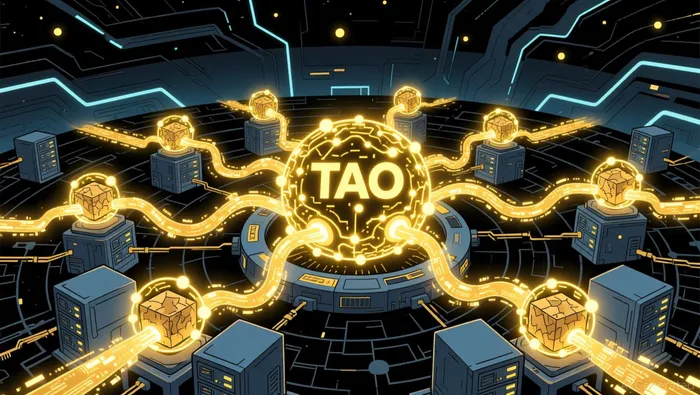
More than 64 subnets are currently active, each focused on a specific economically valuable task like text generation or deepfake detection. Validators grade miners' work, ensuring that top performers earn the most TAO, which creates a system for seeding the ecosystem with self-interested actors. This structure mimics Bitcoin's scarcity model while incentivizing AI computation, creating a sustainable demand loop.
What Risks Limit Bittensor's Growth Trajectory?
While Bittensor offers a compelling thesis, the subnet economy remains early-stage, and adoption risks persist. Some subnets are starting to show signs of product-market fit, such as Chutes offering AI inference services at costs 90% less than dominant centralized cloud providers. However, many others remain experimental, and if adoption stalls, the Bitcoin comparison may prove to be a tight supply story without a working demand engine.
The platform's open-source protocol is gaining momentum, but it faces competition from centralized AI infrastructure that benefits from established data centers. The success of Bittensor relies on the continued growth of its decentralized marketplace, where AI developers and users can exchange data and computational resources. Any failure to attract sufficient participants could undermine the network's utility and, consequently, the token's value proposition.
Furthermore, the regulatory landscape for decentralized AI remains uncertain. While the CFTC has established an Innovation Task Force to develop frameworks for crypto and AI, legal gray zones still exist. Builders and investors must navigate these evolving regulations, which could impact the pace of adoption and the scalability of the platform's solutions.
The structural parallels between TAO and Bitcoin are real, with both coins capping their total supply at 21 million and issuing new supply at a declining rate through halving events. However, the divergence lies in the incentivization of newly created supply: Bittensor miners contribute computing power to train AI models, offer rentable computing, or deliver data storage services to specialized marketplaces. This utility-driven model differentiates it from pure store-of-value assets, though the execution risk remains high.
Institutional interest is picking up, with Grayscale filing paperwork to convert its publicly traded Bittensor Trust into an exchange-traded fund. However, the chain's subnet economy is the central pillar of the bull thesis and is still very early. The market is closely watching whether these subnets can transition from experimental stages to sustainable, revenue-generating operations that drive long-term demand for the TAO token.
The recent launch of the Covenant-72B model on Subnet 3 marked a significant step toward real-world utility, triggering a surge in demand for network services. This development demonstrates the platform's ability to integrate advanced AI models into its decentralized infrastructure, validating its core value proposition. As more subnets demonstrate product-market fit, the network's resilience and growth potential will likely increase.
The CFTC's new Innovation Task Force aims to future-proof regulation and provide clear rules for innovators in crypto, AI, and prediction markets. This move seeks to resolve legal gray zones and coordinate with the SEC's Crypto Task Force, potentially creating a more favorable environment for projects like Bittensor. The establishment of clear rules of the road could accelerate institutional adoption and reduce regulatory uncertainty for decentralized AI platforms.
As the digital asset ecosystem evolves, Bittensor stands out due to its blend of Bitcoin-inspired scarcity and advanced AI infrastructure. The platform operates a decentralized marketplace where AI developers and users can exchange data and computational resources, offering a distributed alternative to traditional data centers. This approach lowers operational costs and improves security, positioning Bittensor as a potential leader in the next generation of decentralized AI applications.
The interplay between regulatory developments, on-chain accumulation, and technological advancements will define TAO's trajectory in the coming months. Investors must weigh the potential for high returns against the risks associated with early-stage technology and evolving regulatory frameworks. The success of Bittensor will ultimately depend on its ability to maintain a robust network of validators and miners while expanding its subnet ecosystem.
With over 64 active subnets and growing institutional interest, Bittensor is well-positioned to capture value in the decentralized AI market. The platform's unique structure, combining scarcity with utility, offers a compelling investment thesis for those seeking exposure to the intersection of blockchain and artificial intelligence. As the market matures, Bittensor's ability to execute on its vision will determine its long-term success and relevance.
The launch of the staked ETP on Nasdaq Stockholm and Grayscale's Trust signals a maturing market for decentralized AI assets. These developments provide regulated access points for institutional investors, potentially unlocking significant capital inflows into the Bittensor ecosystem. As more financial products emerge, the liquidity and visibility of TAO are expected to increase, further solidifying its position in the digital asset landscape.
The platform's open-source protocol continues to gain traction, offering a decentralized alternative to centralized AI infrastructure. By utilizing a distributed network of nodes for model training and processing, Bittensor lowers operational costs and improves security. This approach not only enhances the efficiency of AI development but also democratizes access to high-quality computing resources, aligning with the core principles of decentralization.
As the regulatory environment evolves, the CFTC's Innovation Task Force will play a critical role in defining the boundaries of decentralized AI markets. The initiative aims to provide clear rules for innovators, reducing legal uncertainty and fostering a more stable environment for growth. This regulatory clarity could accelerate the adoption of Bittensor and similar projects, paving the way for broader integration into the global financial system.
In conclusion, Bittensor represents a unique convergence of scarcity, utility, and institutional interest in the digital asset space. Its ability to combine Bitcoin's monetary model with decentralized AI infrastructure positions it as a key player in the evolving landscape. As the platform continues to expand its subnet ecosystem and attract institutional capital, the potential for long-term value creation remains significant, albeit contingent on successful execution and regulatory navigation.

Blending traditional trading wisdom with cutting-edge cryptocurrency insights.
Latest Articles
Stay ahead of the market.
Get curated U.S. market news, insights and key dates delivered to your inbox.
AInvest
PRO
AInvest
PRO



Comments
No comments yet