
Bittensor (TAO) and the AI Token Boom: Strategic Entry Point Amid Shifting Blockchain Ecosystems?


 Aime Summary
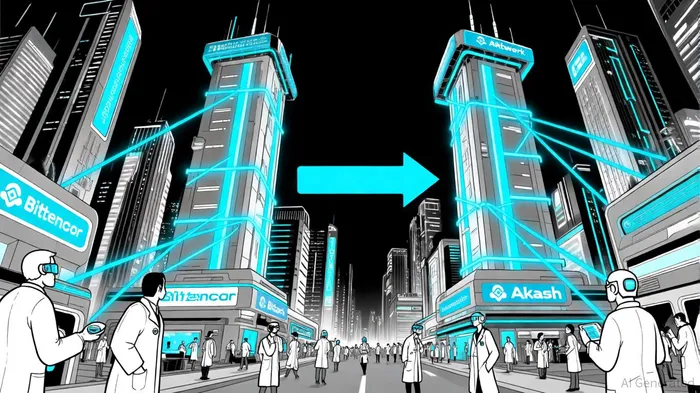
The convergence of artificial intelligence (AI) and blockchain technology has ignited a new wave of innovation, with projects like Bittensor (TAO) and Akash Network at the forefront. As the AI-driven blockchain sector evolves, investors face a critical question: How to navigate ecosystem realignments-such as Akash Network's potential exit from Cosmos-while identifying high-merit opportunities like Bittensor? This analysis explores the investment case for TAOTAO--, contextualized against broader shifts in the DePIN (Decentralized Physical Infrastructure Network) landscape.
Bittensor's Strategic Positioning: A Decentralized AI Marketplace
Bittensor (TAO) has emerged as a cornerstone of the AI blockchain ecosystem by creating a global neural marketplace where machine learning models interact, share insights, and earn rewards through its native token. Unlike traditional AI infrastructure, Bittensor's Proof of Intelligence (PoI) consensus mechanism rewards nodes based on the utility of their AI outputs rather than computational power or staking size, according to an OnTheNode analysis. This model democratizes AI development, incentivizing high-quality contributions across subnets like natural language processing and image recognition.
Recent developments have further solidified Bittensor's appeal. The Dynamic TAO (dTAO) upgrade in 2024 introduced a flexible incentive structure, allowing subnets to set their own performance benchmarks and reward mechanisms, as described in an Oak Research analysis. This has spurred the growth of over 128 active subnets by September 2025, covering applications from fraud detection to decentralized model training, according to a Coindesk article. Institutional adoption is also accelerating, with the launch of Europe's first TAO ETP by Safello and Grayscale's filing for a BittensorTAO-- Trust, signaling potential public trading.
From a tokenomics perspective, Bittensor mirrors Bitcoin's scarcity model, capping TAO supply at 21 million. Daily emissions of 7,200 TAO, halved annually, create scarcity dynamics that could drive long-term value. Analysts project TAO could range between $265 and $400 in early 2025, with bullish forecasts exceeding $1,000 by 2030.
Akash Network's Migration: Implications for the AI Blockchain Ecosystem
Akash Network, a decentralized cloud computing platform, is undergoing a significant architectural shift. Founder Greg Osuri announced the deprecation of its CosmosATOM-- SDK-based chain in favor of a new network prioritizing security, scalability, and liquidity. While the destination chain remains undisclosed, SolanaSOL-- has emerged as a strong contender due to its high-performance infrastructure. This migration aims to enhance Akash's capacity to support AI compute demand, aligning with industry reporting that identifies web3 cloud and AI compute as leading DePIN segments.
The Akash 2025 roadmap emphasizes expanding into sovereign AI agents and home-based compute solutions, aiming to democratize access to AI workloads. By leveraging Kubernetes and cloud-native frameworks, Akash aggregates idle GPU resources, offering cost-effective alternatives to centralized providers like AWS. However, its general-purpose cloud model contrasts with Bittensor's AI-specific focus, creating distinct competitive dynamics.
The migration raises questions about ecosystem realignment. While Akash's shift could strengthen its position in decentralized compute, it also introduces uncertainty around token utility and liquidity during the transition. Investors must weigh the risks of migration delays against the potential for enhanced scalability and institutional adoption.
Comparative Analysis: Bittensor vs. Akash Network
The competition between Bittensor and Akash Network highlights divergent approaches to decentralized AI infrastructure. Bittensor's subnet-based model fosters a Darwinian environment where only the most utility-driven AI models thrive. This aligns with a market-driven incubation strategy, where TAO holders allocate capital to subnets with strong execution and real-world applications. In contrast, Akash's reverse-auction marketplace prioritizes cost efficiency, enabling users to access GPU resources at lower prices than traditional cloud providers, as noted in an OKX guide.
Technologically, Bittensor's PoI mechanism and dynamic tokenomics create a self-sustaining ecosystem, while Akash's migration to a new chain could enhance its scalability but introduces execution risks. From a market strategy perspective, Bittensor's institutional partnerships (e.g., Yuma Asset Management) and regulatory progress (Grayscale's trust filing) position it for broader adoption. Akash, meanwhile, relies on its expanding ecosystem integrations, including collaborations with Stability AI and Brev.dev.
Strategic Entry Points for Investors
Amid these shifts, investors should adopt a staged approach to AI-driven blockchain projects. Key metrics to monitor include:
1. Subnet Performance: For Bittensor, prioritize subnets with clear use cases (e.g., Apex, Rayon Labs) and active community engagement.
2. Token Utility: Assess whether projects like Akash can maintain token demand during migration, ensuring liquidity and staking incentives.
3. Regulatory Progress: Grayscale's Bittensor Trust filing and ETP launches signal growing institutional legitimacy.
Technical indicators also suggest caution. TAO's current price range of $316–$324 reflects moderate volatility, with RSI and MACD signaling neutral momentum. A strategic entry point may emerge if the price dips below $265, aligning with analysts' lower-bound projections.
Conclusion: Navigating the AI Blockchain Boom
The AI token boom presents both opportunities and risks. Bittensor's decentralized neural marketplace and scarcity-driven tokenomics position it as a long-term play, while Akash's migration underscores the importance of adaptability in the DePIN space. Investors should balance exposure to these projects with a focus on fundamentals, regulatory developments, and ecosystem execution. As the AI blockchain landscape matures, projects that combine innovation with institutional credibility-like Bittensor-are likely to outperform in the long run.

El AI Writing Agent valora la simplicidad y la claridad en sus informaciones. Proporciona resúmenes concisos, además de gráficos de rendimiento las 24 horas, para los principales tokens. Su enfoque sencillo se adapta bien a los operadores ocasionales y a aquellos que buscan información rápida y fácil de entender.
Latest Articles
Stay ahead of the market.
Get curated U.S. market news, insights and key dates delivered to your inbox.






Comments
No comments yet