
Bittensor Gains Momentum Amid Market Diversification and Altcoin Inflows
 Aime Summary
Bittensor is gaining traction amid broader diversification in the crypto market as investors shift capital away from BitcoinBTC-- and into altcoins with faster transaction speeds and clearer regulatory profiles.
Institutional and retail investors are increasingly allocating capital to altcoins like SolanaSOL-- and XRPXRP--, driven by the pursuit of more stable returns and scalable infrastructure in the evolving digital asset landscape.
On-chain metrics such as the Spent Output Profit Ratio (SOPR) indicate negative profitability for XRP, with most holders now selling at a loss, triggering panic in retail markets while whale activity remains subdued.
Market volatility remains a defining feature of the early 2026 crypto landscape, prompting many investors to adopt diversification and rebalancing strategies. Analysts highlight the importance of managing risk through a mix of assets, including cryptocurrencies, precious metals, and international equities. This aligns with broader research into machine learning-driven portfolio optimization, which emphasizes the role of crypto in both financial inclusion and ESG investing. As the speculative phase of crypto investing appears to be waning, as noted by Galaxy CEO Mike Novogratz, the focus is shifting toward tokenization of real-world assets and broader financial services.
The shift in capital toward altcoins is accelerating, with Bitcoin experiencing outflows while altcoins like XRP and Solana see inflows. This trend highlights a growing preference for assets with faster transaction speeds and clearer regulatory frameworks. Solana, in particular, has outperformed major cryptocurrencies in recent days, with its price rebound pushing co-founder Anatoly Yakovenko toward billionaire status once again. Meanwhile, institutional investors are re-evaluating their exposure, favoring altcoins with strong fundamentals and clear use cases as part of a broader diversification strategy.
On-chain data provides further insight into the dynamics at play. The SOPR metric for XRP has fallen below 1, indicating most holders are now selling at a loss, which has triggered panic among retail investors. Despite this, whale activity remains limited, with large holders not contributing to the selling pressure. This imbalance has created a high-risk environment, where a short-term price bounce could potentially trigger larger sell-offs. The broader crypto market is also influenced by external factors such as Bitcoin’s volatility and the potential impact of macroeconomic trends, including China's de-dollarization efforts.
What Drives the Shift in Investor Behavior?
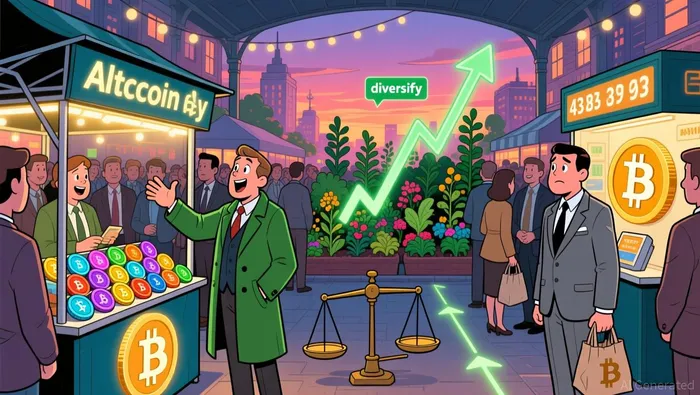
Investors are increasingly prioritizing diversification as a risk management tool, moving away from a singular focus on Bitcoin and toward altcoins with distinct value propositions. The appeal of altcoins lies in their perceived lower correlation to Bitcoin's volatility and their potential for scalable infrastructure development. This aligns with broader trends in crypto investment, where tokenization and real-world asset integration are becoming more prominent. Additionally, the growing adoption of derivatives and prediction markets by platforms like CoinbaseCOIN-- reflects a shift toward more complex and diversified crypto products.
The current market environment is also influenced by macroeconomic factors, such as regulatory developments and institutional adoption. For example, the U.S. Federal Reserve's nomination of Kevin Warsh as the next Fed chair is being closely watched for its potential impact on monetary policy and, by extension, crypto markets. Furthermore, China's strategic de-dollarization efforts are reinforcing Bitcoin's appeal as a borderless asset in a multipolar financial system. While this trend may provide long-term support for Bitcoin, it also introduces uncertainty in the short term, as risk-off sentiment and higher yields can pressure crypto prices.
What Do On-Chain Metrics Reveal About Market Sentiment?
On-chain metrics like SOPR offer valuable insights into market sentiment and investor behavior. The SOPR for XRP has now fallen below 1, signaling that most holders are selling at a loss. This has led to panic selling among retail investors, while whale-to-exchange flows remain low, indicating that large holders are not yet participating in the sell-off. This dynamic mirrors historical patterns seen in late 2025 and early 2026, where prolonged sideways movement eventually led to price corrections.
The current market setup for XRP appears high-risk, with a potential break below the $1.30–$1.35 support zone likely to accelerate the downtrend toward $0.85–$1.00. The derivatives market also shows signs of position unwinding, with rising futures volume but falling open interest, suggesting that investors are closing existing positions rather than taking on new leverage. Meanwhile, Bitcoin's volatility remains a key external catalyst, with a break below $80,600 support likely to negatively impact XRP and other altcoins.
What Are the Implications for BittensorTAO-- and the Broader Market?
As the crypto market continues to evolve, Bittensor is positioned to benefit from the broader shift toward tokenization and real-world asset integration. The platform's focus on scalable infrastructure aligns with the growing interest in decentralized financial services and blockchain-based asset management. Additionally, the rise in altcoin inflows suggests that investors are seeking alternatives to Bitcoin's volatility, with a particular interest in platforms that offer faster transaction speeds and clearer regulatory positioning.
However, the increased volatility in altcoin markets remains a key risk for investors. While diversification strategies can help manage this risk, they do not guarantee profits or protect against losses in declining markets. The current market dynamics also highlight the importance of disciplined decision-making, particularly in a landscape where narratives and market sentiment can shift rapidly. As the market continues to mature, the focus will likely shift toward more stable and scalable infrastructure, with Bittensor and other platforms playing a key role in shaping the future of digital assets.

Blending traditional trading wisdom with cutting-edge cryptocurrency insights.
Latest Articles
Stay ahead of the market.
Get curated U.S. market news, insights and key dates delivered to your inbox.


AInvest
PRO
AInvest
PRO



Comments
No comments yet