
BitMine (BMNR): A Strategic Play on Ethereum's Institutional Future


 Aime Summary
In the summer of 2025, EthereumETH-- is no longer a speculative asset—it's a foundational pillar of global finance. As institutional adoption accelerates, corporate treasuries are rewriting the rules of value accrual in the digital age. At the forefront of this revolution is BitMine Immersion Technologies (BMNR), a company that has transformed itself into the largest institutional holder of Ethereum. With 1,713,899 ETH in its treasury—valued at $4,808 per token—BitMine's $8.82 billion crypto and cash holdings position it as a critical player in Ethereum's long-term narrative. This is not just a stock story; it's a macroeconomic thesis about the future of capital.
The Alchemy of 5%: Aggressive Accumulation as a Strategic Lever
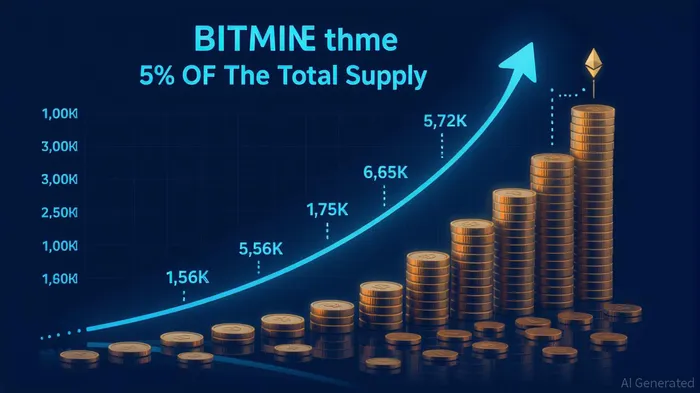
BitMine's strategy is simple yet audacious: acquire 5% of Ethereum's total supply. As of August 24, 2025, the company has already accumulated 1.71 million ETH, with a weekly addition of 190,500 tokens pushing its treasury to $2.2 billion in growth. This pace suggests a path to the 5% target, which would represent over $150 billion in Ethereum value at current prices. By locking up a significant portion of the supply, BitMineBMNR-- is not only securing its own balance sheet but also creating scarcity-driven value for Ethereum itself.
The mechanics of this strategy are clear: treasuries stabilize crypto prices. When corporations like BitMine, ETHZillaETHZ--, and SharpLink (SBET) hold Ethereum as a store of value and yield-generating asset, they reduce selling pressure and create a floor for the asset. This is the same logic that underpinned MicroStrategy's BitcoinBTC-- accumulation—except BitMine is doing it at scale with Ethereum, the most programmable and utility-driven blockchain in existence.
Institutional Backing and Liquidity: The Twin Engines of Growth
BitMine's rapid ascent is fueled by two pillars: institutional capital and market liquidity. The company has raised $250 million through private placements and executed a $1 billion stock buyback program, targeting shares trading below its market net asset value (mNAV). This buyback has narrowed the discount from 35% to under 10%, creating an arbitrage opportunity for investors.
The liquidity of BMNR's stock is equally compelling. With an average daily trading volume of $2.8 billion, it ranks 20th in the U.S. market—surpassing JPMorganJPM-- and trailing only Coinbase. This liquidity allows BitMine to execute large-scale ETH purchases without triggering market volatility, a critical advantage in a sector where price swings can erase months of gains in hours.
Yield Generation: Beyond Staking to DeFi Innovation
While Bitcoin treasuries rely on price appreciation alone, BitMine's Ethereum holdings generate active income through staking and decentralized finance (DeFi). The company's 4–6% annualized staking yield provides a buffer against price volatility, while its exploration of liquid staking tokens (LSTs) and staking-as-a-service (SaaS) models unlocks additional layers of compounding.
For example, BitMine's partnership with Electric Capital's Electric Asset Protocol allows it to tokenize real-world assets (RWAs) against its ETH reserves, generating 8–12% annualized returns. This is a stark contrast to traditional treasuries, where yields hover near zero. By leveraging Ethereum's programmable infrastructure, BitMine is not just holding crypto—it's building a financial ecosystem around it.
Regulatory Tailwinds and Macroeconomic Momentum
The institutional adoption of Ethereum is further accelerated by regulatory clarity. The GENIUS Act and the SEC's reclassification of Ethereum as a utility token have created a legal framework for corporate treasuries to deploy the asset without fear of regulatory overreach. Meanwhile, Ethereum-based spot ETFs have attracted $7.9 billion in inflows by August 2025, signaling a shift in institutional capital from Bitcoin to Ethereum.
Macro trends also favor BitMine's thesis. The Federal Reserve's dovish pivot has reduced the cost of capital, making high-yield assets like Ethereum more attractive. With a 1.32% annualized burn rate from Ethereum's deflationary supply model, the asset's scarcity is self-reinforcing—a dynamic that BitMine is positioned to exploit.
Investment Thesis: A Dual-Track Opportunity
For investors, BitMine offers a dual-track opportunity:
1. Ethereum Exposure: Each ETH token in BitMine's treasury is a leveraged bet on Ethereum's price appreciation. If ETH reaches $30,000 by 2030, BitMine's holdings would be valued at $51.4 billion, pushing its mNAV per share above $200.
2. Equity Upside: The company's stock, currently trading at a narrow discount to mNAV, offers a path to capture both Ethereum's price gains and its own operational growth.
Conclusion: The New Bretton Woods
BitMine's chairman, Tom Lee, likens the current shift to the 1971 end of the gold standard—a moment that catalyzed the modernization of Wall Street. Today, Ethereum is playing the role of gold, and BitMine is the institution building the new financial infrastructure.
For investors seeking a strategic play on Ethereum's institutional future, the case is clear: act now. BitMine's liquidity, institutional backing, and treasury-driven value accrual make it a compelling vehicle to capture the next decade of blockchain innovation. As the world's largest Ethereum treasury, BMNR is not just a stock—it's a macroeconomic bet on the future of finance.

Decoding blockchain innovations and market trends with clarity and precision.
Latest Articles
Stay ahead of the market.
Get curated U.S. market news, insights and key dates delivered to your inbox.




Comments
No comments yet